By Asia White
When Dr. Omar Shalaby talks about insects, he doesn’t see them as pests; he sees them as troves of potential forensic evidence.
Dr. Shalaby’s interest in entomology started over 6,000 miles from Muncie at the University of Alexandria in Egypt, where he earned his bachelor’s degree in biology and zoology. But over time, he developed a curiosity for smaller organisms: insects. Dr. Shalaby recalled growing up watching his father work with insects, nudging him towards an untapped branch of zoology.
“I’m originally a biologist, and then I moved into a love of entomology,” Dr. Shalaby shared. “I got into entomology because my dad was working with insects as a vector of disease, which is the transmission of malaria and viruses.”
As he explored medical journals, Dr. Shalaby discovered the emerging field of forensic entomology, the study of insects to collect forensic evidence. From there, an interest was unearthed, one that combined his background in biology and his fascination with entomology.
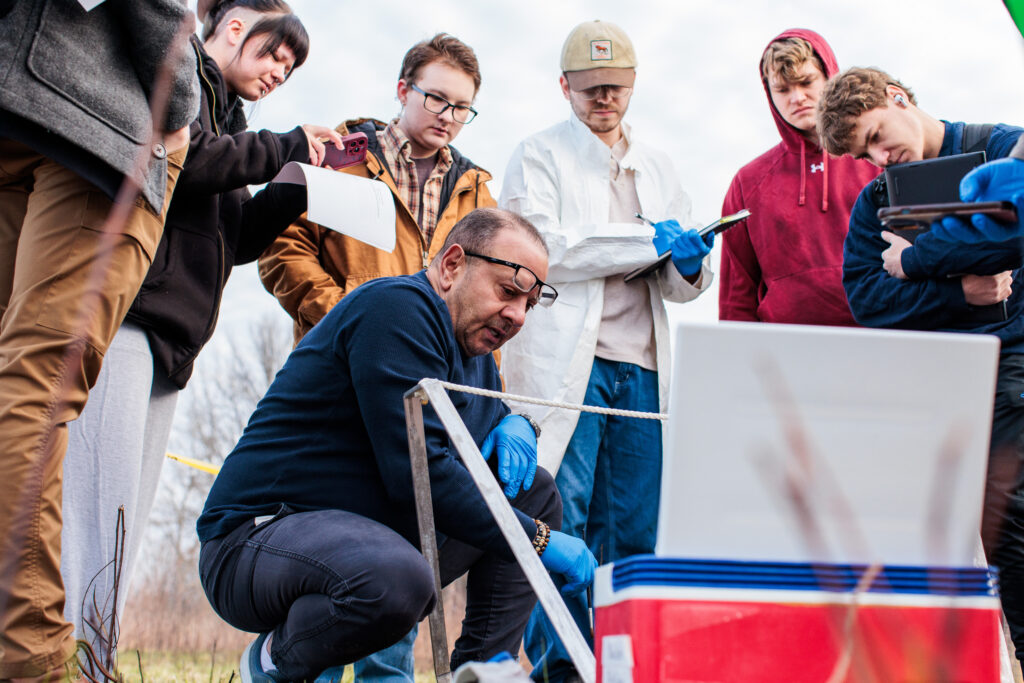
This intersection of studies relies on insects and other arthropods to uncover timelines and hidden details at a crime scene. According to Dr. Shalaby, their role becomes especially crucial 72 hours after death, when decomposition begins to attract necrophagous insects.

Photo by JB Bilbrey/Ball State University.
Familiar insects like the Musca domestica, more commonly known as the house fly, are drawn to decay as an ideal breeding environment. They lay eggs in the body’s natural openings, eyes, mouth, and any exposed areas, where the eggs hatch and grow into larvae, then pupae, and finally adults, providing a detailed timeline for forensic entomologists to determine a post-mortem interval (PMI), the amount of time that has passed since death.
“It’s very accurate,” Dr. Shalaby explained. “It’s very important to know that insects are affected by temperature, and temperature is one of the major factors that affect insect development.”
By understanding insect development, environmental conditions, and colonization patterns, entomologists can reconstruct authentic timelines that would otherwise be buried. It was this ability to uncover critical details in overlooked scenes that drew Dr. Shalaby deeper into the field, shaping his own evolution into forensic entomology.
One Man’s Insect, Another Man’s Evidence
Invigorated by the opportunity to impact a new field, Dr. Shalaby began contacting crime-scene investigation units in Egypt for more information on forensic entomology, but found that most agencies had little awareness of how insects could aid investigations.
“Yes, they see bugs, but they throw bugs away as if they’re dirt. They didn’t know that they could get a clue from them,” shared Dr. Shalaby.
Where others saw insects as insignificant, Dr. Shalaby saw the potential evidence each bug carried.
Despite the limited information on entomology in Egypt, Dr. Shalaby pursued a master’s degree in zoology and forensic biology at Alexandria University, strengthening his expertise in a field that had yet to embrace the application of entomological evidence.
It was here that his training on insect classification, morphology, and foundational entomological techniques began to take root. After joining the faculty of science at Alexandria University, Dr. Shalaby worked closely alongside the late Dr. Tarek Tantawi, who helped further develop and refine these skills.
Dr. Tantawi himself had studied entomology under Professor Bernard Greenberg, one of the United States earliest forensic entomologists, at the University of Illinois Medical Center in Chicago. Through this evolving mentorship chain, Dr. Shalaby inherited a strong scientific lineage.
“That created a direct academic lineage from Greenberg to Tantawi to myself,” he explained. “It grounded my early training in a tradition of careful taxonomy and ecological reasoning.”
Eager to expand his knowledge into real-world forensic applications, Dr. Shalaby later pursued a Ph.D. at the University of Hawaiʻi at Mānoa. There, he worked closely with Dr. M. Lee Goff, a pioneer of forensic entomology in the U.S. who served as an expert witness in more than 300 cases.
“He had all the information I needed. So I went there.”
Curiosity to Casework: The Making of an Expert
Before joining his lab, Dr. Shalaby had a strong foundation in insect taxonomy from his previous mentors, but under Goff’s wing, he was exposed to aspects of forensics that could only be learned with real-world experience.
“Our work together was immersive and hands-on. I assisted him in real forensic investigations, participated in field collections, and observed firsthand how insect succession unfolds under different environmental conditions.”

Photos by JB Bilbrey/Ball State University.
For three years, Dr. Shalaby trained closely under Goff, shaping his scientific philosophy and expertise in forensic entomology.
“Goff taught me how to operate in the unpredictable, imperfect conditions of actual casework,” he explained. “Sometimes the body has been disturbed, sometimes the weather conditions are unusual, and sometimes the samples are incomplete. These are the kinds of challenges that define real forensic investigations.”
Equally important was learning how to translate these scientific findings into legal testimony. As an expert witness, Goff showed Dr. Shalaby how to communicate complex biological evidence to the court and how to defend conclusions under cross-examination.
Although Dr. Shalaby’s path didn’t lead to court testimony, Goff’s emphasis on precision and transparency to communicate entomological evidence became a guiding principle for him.
“In forensic entomology, the strength of your conclusions depends entirely on the quality of your observations and documentation.”
This attention to detail carried into his doctoral research, where he explored the intersection of insect activity and toxicology, known as entomotoxicology. His work examined how insects feeding on decomposing tissue can accumulate trace amounts of drug toxins, offering an alternative source of evidence when traditional tissue samples are no longer viable.
“When these insects and larvae feed on tissue, they can accumulate trace amounts of drugs and toxins in the body,” Dr. Shalaby explained.

Photos by JB Bilbrey/Ball State University.
Through his research, he explored how substances such as insecticides and morphine sulfate affect blowfly development. He discovered that certain drugs can accelerate insect growth by three to five days, revealing a significant gap in an original PMI estimate.
“We correlate this with how much time the body was here, because it’s very interesting, and it’s all temperature-dependent, drug-dependent,” he explained, “Because all of these factors affect the development of this small creature.”
Even when visible insects are absent, evidence can still be found if you know where to look.
“It’s something fascinating,” Dr. Shalaby explained. “If you didn’t even find any insects, the cocoons that they leave before migrating away from the dead body are used to trace for drug analysis.”
After earning his doctorate, Dr. Shalaby returned to Egypt, bringing with him a new expertise in forensic investigations. Like his mentor, Dr. Shalaby worked as a forensic entomology consultant on cases in Egypt, Europe, and the Gulf region.
“I was working in consultancy. Whenever there was a crime case, they called me, and I went and collected specimens. But it wasn’t easy to go to the court and be an expert witness there.”
Dr. Shalaby explained that the legal systems in Egypt, Saudi Arabia, and Dubai differ from those in the United States; introducing a new forensic discipline into courtrooms required careful navigation of bureaucratic barriers. Still, Dr. Shalaby pursued the field, committed to advancing the role of insect evidence in criminal investigations.
In 2022, while his work took him between Egypt and Hawaiʻi, an unexpected call from Ball State University altered his path. The university recruited him to help launch its new forensic science program, and soon he would become a key figure for forensic entomology at Ball State.
Bringing Bugs Back
When Dr. Shalaby arrived at Ball State University in 2024, he wasn’t just stepping into a classroom; he was bringing a specialized field of study back to campus.
In recent years, entomology had not been a key part of the university’s course offerings following the retirement of faculty in the area. As other academic programs began to evolve with specialized faculty expertise, Dr. Shalaby filled that very role for forensic entomology.
“So I’m teaching this new course, and I’m putting forensic entomology as cross-listed, but still, I need students to learn insects. ”
Dr. Shalaby’s expertise in entomology has sparked a new direction for the department. But he knew that before teaching the intricacies of insect-based investigation, he must first rebuild the fundamentals.

Photos by JB Bilbrey/Ball State University
In the lab, he has collected several insects native to Muncie for students to analyze. His collection of pinned specimens is closely studied by students to determine key structural elements of the insects and make positive identifications. In the lab, students will progress from observing insect larvae under a microscope to dissecting larger insects, such as grasshoppers and roaches, to understand their central nervous systems.
“I’m doing work in the lab, telling them about general insects to understand, and then digging a bit later on into the forensic side, how we use certain insects in the field, because not all insects are doing the job.”
For most students, the path to entomology stems from an interest in biology, or at least in insects, but for third-year student Noah Tutt, it began with a course in digital forensics.
Initially, Tut needed another class to apply towards his computer science degree, when he found digital forensics to complement his studies. After taking this course, he realized he was eligible to enroll in forensic entomology.
“I figured, why not?” Tut said. “I needed another class, and now it’s one of my favorites.”
Before joining Dr. Shalaby’s lab, insects rarely registered in Tut’s daily life, but as his semester unwound, his indifference shifted to curiosity. This shift reflects a core transformation that Dr. Shalaby hopes to encourage, seeing insects not as an annoyance but as intricate organisms with genuine scientific value.
“I didn’t even think that was possible,” Tutt said of using insects to determine PMI. “I just assumed all bugs show up at once, but it’s actually very specific.”
Through lectures and lab work, Tutt learned how different insects arrive at distinct stages of decomposition, highlighting the high stakes of forensic accuracy entomologists encounter.
“One wrong mistake, instead of saying it’s a flesh fly, maybe it was a green bottle, can throw a lot of evidence out and your credibility.”
That precision is reinforced in the lab through careful observation of specimens, analysis of microscope slides, and translation of findings into detailed drawings. Through Dr. Shalaby’s precise and clear teaching style, he’s able to communicate entomological evidence to students easily.
“He puts it up on the screen, explains it, and if we don’t get it, he explains it again,” Tutt stressed. “He makes sure everyone understands.”
Dr. Shalaby’s accessible approach to understanding entomology has made the course approachable even for students without a biology background, allowing students like Tutt to learn that details matter, whether you’re analyzing insect evidence or digital evidence.

While Dr. Shalaby is busy laying the academic and scientific foundation for forensic entomology at Ball State, the lab-based side of forensics is starting to take shape, guided by his teaching assistant, a junior biology major, Raena Heath.
Evolving Entomology
Like Dr. Shalaby, Heath hadn’t originally set out to study insects. She began her academic career on the pre-med track, with plans to pursue forensic pathology, which required a medical degree. But, once again, an emerging case study shifted a young biologist’s pre-determined plan; for Heath, it was discovering aquatic entomology in Italy.
“I was looking for things on forensic pathology, and I couldn’t find anything. But then I saw something that caught my eye.” Heath shared, “It was aquatic forensic biology, but it was in relation to forensic entomology.”
The case explored the findings of diatoms in the soft tissues and internal organs of a deceased body recovered from water in Italy, which indicated the individual was likely alive when they entered the water.
“I read through all of it; I didn’t even realize this was something you could do.”
What started as curiosity quickly turned into initiative, as Dr. Shalaby was set to join Ball State’s faculty as a specialized entomologist; things for Heath began to fall into place. Before even enrolling in his class, Heath emailed him, eager to learn more about entomology. That initial conversation marked a turning point, and the following semester, Heath enrolled in two of Dr. Shalaby’s courses.
“I sat in the front row every day, answered questions, just tried to be as involved as possible,” she said. “I wanted him to know I was serious.”
By the end of the semester, Heath approached Dr. Shalaby about becoming a teaching assistant, and he accepted.
Now in his BIO 401 course, Heath plays a key role in bridging the gap between lecture concepts and hands-on lab work. She arrives at least 30 minutes before class starts to prepare specimens, set up microscopes, and ensure the lab is ready for students.
Much of the course focuses on foundational entomology, and for many students with non-science backgrounds, this means starting from scratch.
“We’ve had students who’ve never even used a microscope before,” Heath explained. “So a lot of what we’re doing is just getting comfortable with the tools and learning how to observe.”
Dr. Shalaby’s foundational approach is intentional. Before students can analyze insect evidence in a forensic context, they must first study the organisms themselves to learn how they function, grow, and interact with their environment.

For students like Heath and Tutt, what started as a general interest in forensics evolved into something more meaningful. Dr. Shalaby’s course is now gaining momentum, with more students stepping into the lab, engaging with insects, and discovering relevance in a discipline they hadn’t originally considered.
This approach, rooted in patience and precision, represents more than just coursework, where Dr. Shalaby is guiding students to notice what others overlook and reshaping how they think about traditional forensic evidence. With Dr. Shalaby’s expertise and dedication, entomology at Ball State is no longer dormant but actively evolving.
To learn more about the Forensic Science major, visit Ball State University’s Academic Programs or check out @ballstate_forensics on Instagram to see what current students are discovering from the program.