By Liberty Rister
For many students, studying abroad is a carefully planned experience that takes months, sometimes years, of preparation. For Emma Haefling, however, the opportunity came unexpectedly and ultimately reshaped both her academic journey and her perspective on the natural world. What began as a search for a course requirement quickly turned into a transformative experience studying one of Earth’s most breathtaking phenomena: the Northern Lights.
After recently switching her major to chemistry, Haefling was exploring options to fulfill her HONR 176 science requirement when she came across an online flyer advertising a unique study abroad course focused on the chemistry of the aurora borealis. The program would take place in Yellowknife, Canada, a northern city widely regarded as one of the best locations in the world to witness the auroras. The chance to combine academic learning with the opportunity to see a long-dreamed-of natural wonder immediately captured her attention.
“Seeing the northern lights has been on my bucket list for years. This opportunity was too good to pass up,” said Haefling.
The course was highly competitive, requiring students to complete an application and participate in an interview with faculty members. Only 10 to 15 students would ultimately be selected. Despite knowing the odds were limited, Haefling decided to pursue the opportunity. When she received her acceptance, the experience quickly became what she describes as a once-in-a-lifetime chance to connect classroom concepts with real-world scientific observation.
The uniqueness of the program, combined with the remote destination and specialized subject matter, reinforced her decision to take the leap. She credits the University and the Honors College for providing scholarships and academic support that helped make the experience possible.

Understanding the Science Behind the Sky
While the northern lights are widely admired for their beauty, Haefling’s experience offered a deeper layer of understanding rooted in atmospheric chemistry and physics. Throughout the course, students examined how elements interact and layer within Earth’s atmosphere to produce the vivid colors and dynamic shapes that define auroral displays. Lectures were paired with direct observation, allowing students to immediately connect theoretical concepts to the phenomenon unfolding above them.
According to Haefling, one of the most fascinating aspects of the course was learning how solar wind – streams of charged particles, or plasma, ejected from the Sun – travels through space toward Earth. Most of these particles are deflected by Earth’s magnetic field, which acts as a protective shield. Near the poles, however, magnetic forces guide the particles downward into the upper atmosphere, where they collide with molecules such as oxygen and nitrogen.
These collisions excite electrons within the molecules, causing them to jump to higher energy states. When the electrons return to their stable states, they release energy in the form of photons, producing visible light. The process results in the glowing arcs, curtains, and waves that characterize auroral activity. Haefling and her classmates studied how variations in altitude, atmospheric density, and energy levels influence the colors and intensity of the lights.
Oxygen collisions in the lower atmosphere typically create the familiar green-yellow glow most commonly associated with the aurora borealis. At higher altitudes, where oxygen molecules are more dispersed, the interactions can produce red hues. Molecular nitrogen collisions may generate pink or purple tones along the edges of auroral formations, adding complexity and depth to the visual display. Students also explored how magnetic forces affect auroral strength and geographic location, as well as how human photoreception influences the way people perceive color and motion during these events.
“The science behind the lights is much more complex than I expected,” Haefling said. “I learned so much more than I would have in a standard chemistry class.”
Science Meets Awe
Despite the rigorous academic focus of the program, Haefling emphasized that the emotional impact of witnessing the auroras firsthand was equally significant. Understanding the chemistry behind the phenomenon did not diminish its beauty; instead, it deepened her sense of wonder and appreciation.
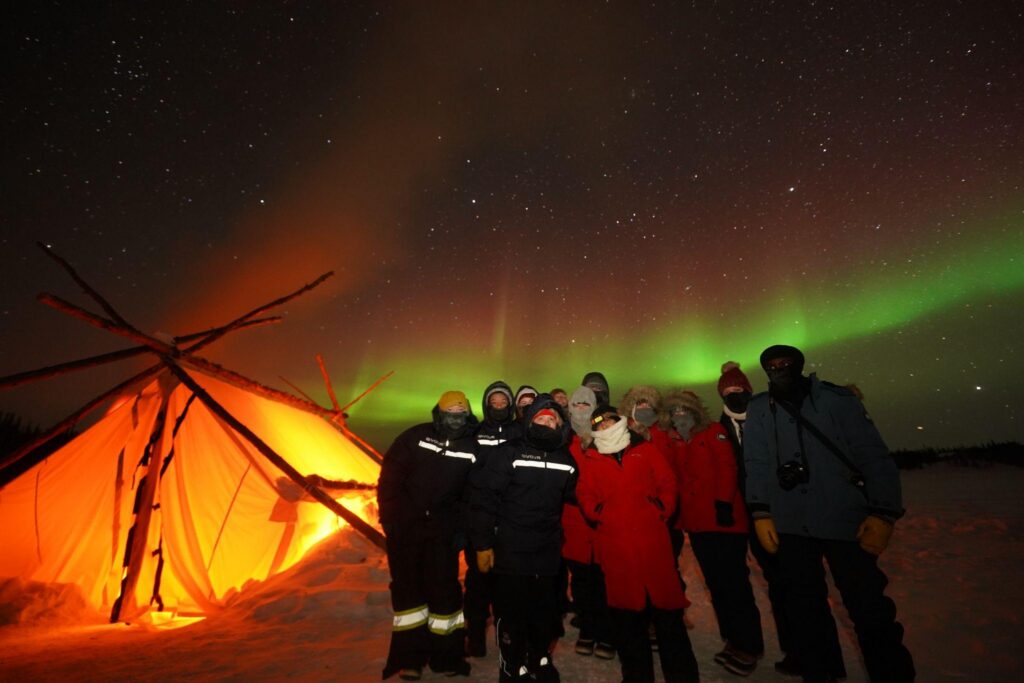
During one particularly memorable night, Haefling and her classmates laid side by side in the snow on the edge of a vast frozen lake, watching waves of green, yellow, and purple light ripple across the sky. The experience was both surreal and grounding, blending scientific observation with a profound sense of awe.
“It’s almost impossible to describe the feeling you have seeing the lights for the first time,” she said. “We were all just lying there, speechless.”
The environment itself intensified the experience. Polar regions offer exceptionally dark skies, allowing stars and constellations to appear with remarkable clarity. Haefling recalls being overwhelmed by the sheer number of stars visible overhead – a sight she had previously only encountered in controlled settings such as campus planetarium shows.
Temperatures during the trip reached nearly negative 50 degrees Fahrenheit, creating extreme conditions that required careful preparation and resilience. The cold became an unforgettable part of the experience, shaping both daily routines and nighttime observations. For many students, including Haefling, the combination of physical challenge and natural beauty created powerful emotional moments.
“Many people in our group were in tears because it was so amazing,” she said. “It truly took our breath away, in more ways than one.”

Learning Beyond the Classroom
Although aurora observation was the central focus of the course, the study abroad experience extended far beyond scientific learning. Students were immersed in the culture, history, and lifestyle of Yellowknife and the surrounding region. Through guided tours and discussions, they gained insight into the area’s environment, tourism industry, healthcare systems, and seasonal rhythms.
The program also included opportunities to learn about the traditions and perspectives of Indigenous communities, offering students a broader understanding of life in northern Canada. Exposure to different cultural practices and daily routines helped contextualize the scientific material, demonstrating how environmental conditions shape human experiences and economic systems.
For Haefling, these cultural components were just as impactful as the academic content. She describes the experience as an opportunity to expand her worldview and better understand how communities adapt to extreme climates and geographic isolation.
“Getting to learn about how people live there, their food, travel, and daily routines, really broadened my perspective,” she said.
Students also participated in a variety of winter activities that showcased the region’s unique landscape and traditions. Snowmobiling across expansive frozen terrain provided a sense of adventure and mobility in an otherwise remote environment. Dog sledding introduced the group to powerful, energetic huskies capable of traveling at impressive speeds while navigating snowy trails.
Ice fishing allowed students to stand atop the deepest freshwater lake in North America, while driving on ice roads demonstrated the ingenuity required to maintain transportation networks in harsh winter conditions. Visits to elaborate ice sculpture castles and a large-scale sculpture competition further highlighted the creativity and resilience of local communities.
Each activity reinforced the idea that meaningful learning can occur outside traditional classroom settings. By engaging directly with the environment and culture, students gained a richer understanding of the scientific concepts they were studying.

Capturing the Uncapturable
During the trip, Haefling also experimented with extreme-weather photography, attempting to document the auroras and surrounding landscapes. Capturing images in such low temperatures required technical preparation, patience, and adaptability. While she was able to produce several striking photographs, she acknowledges that images rarely convey the full emotional and sensory impact of the experience.
“Some pictures just can’t capture what it actually feels like to be there,” she said.
In addition to photography, Haefling kept a personal diary throughout the journey. Recording daily observations and reflections allowed her to process both the academic material and the emotional significance of the trip. The journal now serves as a lasting record of the challenges, discoveries, and moments of wonder she encountered.
A Transformational Experience
Reflecting on the study abroad program, Haefling emphasizes how meaningful it was to apply conceptual scientific knowledge to real-world phenomena. Observing the auroras firsthand strengthened her confidence as a chemistry student and deepened her curiosity about atmospheric processes and space-Earth interactions.
More broadly, the experience reshaped her understanding of the relationship between science and wonder. Rather than diminishing the magic of natural phenomena, scientific knowledge enhanced her appreciation for the complexity and interconnectedness of the universe.
“Even though I understood the chemistry behind the auroras, seeing them in person felt magical,” she said. “It reminded me that science doesn’t take away the beauty of something; it can actually make you appreciate it more.”
Traveling to a remote northern city, adapting to extreme weather conditions, and engaging with unfamiliar cultural environments also pushed Haefling to grow personally. The experience reinforced the value of stepping outside one’s comfort zone and embracing unexpected opportunities.
“It was definitely challenging at times,” she said. “But it was worth every second.”
Looking Ahead
As Haefling continues her studies in chemistry, she carries the lessons and memories of Yellowknife with her. Whether she is working in a laboratory or attending lectures on campus, the experience serves as a reminder that science extends far beyond textbooks and equations. It is a field rooted in exploration, curiosity, and moments of discovery that can shape a lifetime.
Her story highlights the importance of remaining open to unexpected opportunities. What began as a simple search for a course requirement ultimately led to an unforgettable journey beneath skies alive with color and motion. By taking a chance on an unfamiliar program, Haefling gained not only academic insight but also a deeper connection to the natural world and the people who shared the experience alongside her.
For Haefling, standing beneath the auroras meant more than observing a scientific phenomenon. It was a moment of profound connection – to the universe, to her classmates, and to her evolving identity as a scientist. The experience continues to influence her goals and perspectives, serving as a powerful reminder of what can happen when curiosity meets courage.
“It truly was a once-in-a-lifetime opportunity,” she said.
For more information about the Department of Chemistry, visit our website, contact our office, or follow us on Facebook.