By: Natalie Byers
The Course-based Undergraduate Research Experiences (CUREs) Program was spearheaded by the Kahn Family Endowment. The Endowment believes that a strong liberal arts education, where students are introduced to a variety of facts, values, methodologies, cultures, and perspectives, is one of the best ways to prepare them to adapt and grow in an ever-changing world.
To accomplish this, the College of Science and Humanities’ CUREs Program is designed to increase students’ access to undergraduate research experiences by providing support for faculty to develop courses focusing on undergraduate research. In these courses, students engage in original, authentic research that is of interest to external organizations.
The Anthropology Field School at the Daugherty Cabin
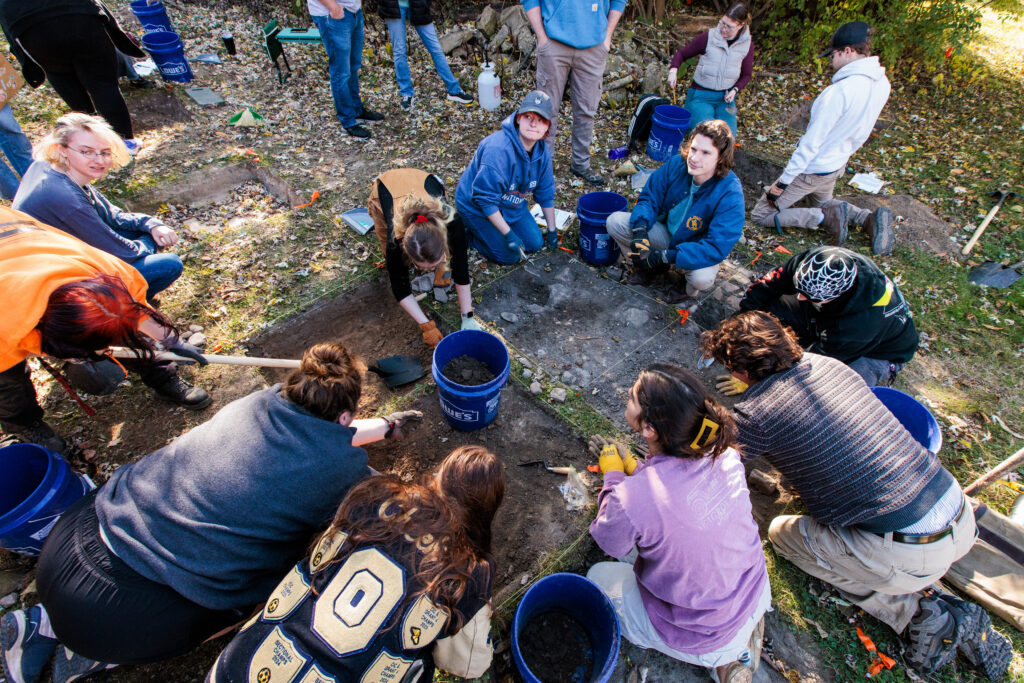
The first of these courses offered took students to an old log house in Smithfield, 20 minutes east of Muncie: a real archaeological dig site. Lab days were spent wearing gloves, digging in excavation squares, and sifting through dirt to look for artifacts. While concurrent group discussions became a guessing game, trying to figure out what the lives of this house’s owners looked like.
“It is one thing to be sitting in a classroom and learning about archaeology and what skills to use,” Addi Arena said, “but it is an entirely different thing to actually be in the field putting those skills to use.”

Under the guidance of their instructor, Dr. Mark Groover, students used satellite technology, mapping strategies, and excavation techniques they’ve been learning about each semester to study the cabin lot, construct dig sites, and search for artifacts.
Small squares were constructed on the lawn of the cabin and students worked in small groups to carefully excavate each one, looking for artifacts to uncover. Then the dirt from the squares went through large sifting screens to catch any smaller artifacts they might have missed.

Sydney Collis enjoyed how different the field school has been from her usual classes: “It’s allowed me to apply my knowledge and hone my skills outside of a classroom setting.
Meanwhile, for Addy Cline, gaining experiences like this field school has been a test to figure out if her field is truly right for her. “Getting a chance to get hands-on experience as an undergrad and seeing how artifacts and bones look like when you find them in the field has been invaluable for me,” she said. “And considering that this is my second field work program I’ve entered, I think I am definitely in the right profession.”

The Anthropology Ethnohistory Research Course
The study of anthropology involves much more than digging for artifacts at different archaeological sites. It also takes many hours doing research on the history of a past human civilization, their communication patterns, and how they evolved over time, both physically and culturally. Dr. Caitlin Murray led an anthropology course focusing on studying and researching the ethnohistory of Smithfield, Indiana.
This course served as the second part of Dr. Murray and Dr. Mark Groover’s idea to offer students professional-level training in two different but linked anthropology courses. Dr. Groover’s class offered archaeological field training at the Daugherty cabin; Dr. Murray’s class offered ethnohistorical training as they researched the cabin, the town of Smithfield, and the Native American cultures that the cabin hinted to having a presence there.

Dr. Murray explained, “We are taking a place-based approach and asking the questions, who lived here? How did they engage/alter with the environment and landscape? How do the stories associated with this place relate to the histories of North America, the U.S., and the Midwest?”
A History Course Exploring Civic Life Through Middletown
What does civic life in America really look like, and how has it changed over time? In the third CUREs course, students worked to answer that question by combining traditional research with digital storytelling. At the center of the course was the creation of a digital essay using Scalar, a multimedia platform that allows for nonlinear storytelling. Unlike a traditional paper, which is read from beginning to end, Scalar projects allow users to move between topics, themes, and sources in multiple ways. This means students have to think not just about what they are writing, but how their work connects to others and how audiences might interact with it.
The course, taught by Dr. James Connolly, was designed with a specific goal: to bring archival research into the classroom in a more interactive and meaningful way. As director of the Center for Middletown Studies, Dr. Connolly wanted students not only to learn about the archive but also to actively use it.

“Part of the value of creating a digital essay is that users can explore it along many different pathways,” Connolly said. “It encourages students to think about connections across topics and consider multiple uses for the resource they are creating.”
As the semester has progressed, students have begun to explore the Middletown archives more deeply, uncovering patterns and changes in civic engagement over time. For student Aaron Tanglertpaibul, one of the most interesting aspects of the course so far has been analyzing how authors build their arguments.
“I found our discussions about the strengths and weaknesses of the authors’ methodologies to be the most interesting part,” he said. “There is a lot of evidence presented, but it requires thinking about how far that evidence can support generalized conclusions.”

Overall, this course offers a different perspective on what it means to study history. By combining archival research, critical analysis, and digital media, students are gaining a more well-rounded understanding of both the subject and the skills involved.
An Internship for a Philosophy Outreach Project
The last CUREs course of Spring 2026 was an independent study taught by Dr. David Concepcion. The course allowed students the opportunity for guided reading and investigation in areas of philosophy not intensively covered in students’ regular philosophy classes. This study could also be continued over the course of multiple semesters, giving students an excellent opportunity to research what they’re passionate about under the guidance of a faculty advisor.
Every course offered thanks to the CUREs Grant has given numerous Ball State students opportunities for experiences preparing them for their future careers or education, and along with them, many faculty members are also now able to help their students explore topics they know a lot about but don’t always get to cover. We would like to extend our sincerest thanks to the Kahn Family for their support.