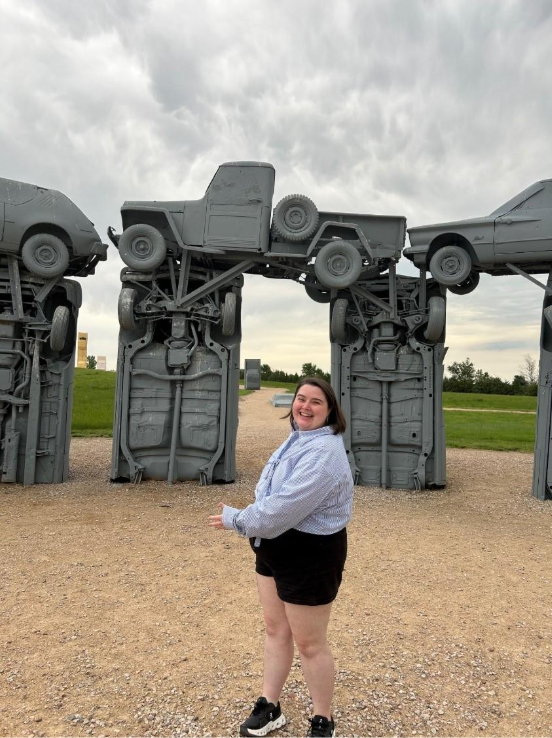
Celia’s To Kiss the Moon did not spring to life in a day. She spent four summers laboring over every page, sentence, and word. “I pretty much work on it every summer,” Celia shared. “It’s such a summer novel to me.” The ambitious reimagining of Greek mythology blends myth and the contemporary with a deep attention to place. With support from the Aspire Grant, Celia was able to bring the world of the novel to life.
To Kiss the Moon follows seven queer women on a quest to save the goddess Artemis. The novel is told through multiple points of view and centers LGBTQ+ and BIPOC characters. Celia finalized the manuscript in the final year of her master’s program. While the story draws from myth, its setting is firmly rooted in Nebraska. The Aspire Grant enabled Celia to travel to Nebraska and immerse herself in the environment, gaining firsthand experience of the terrain, communities, and cultural context that shape the narrative.
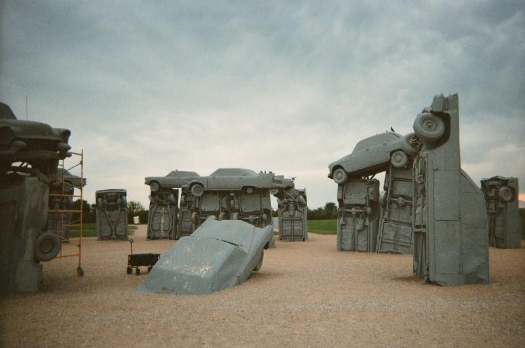
One of the most significant locations in the book is Carhenge, a replica of Stonehenge made from vintage cars. Carhenge became the site of a major battle and ritual scene involving witchcraft. Visiting it in person completely changed how she understood both the location and the state. The landscape, which was initially flat in her novel, transformed into a lush, hilly background. “You can only capture so much from Google images,” she said. “Actually going to the site location was life-changing for me.”
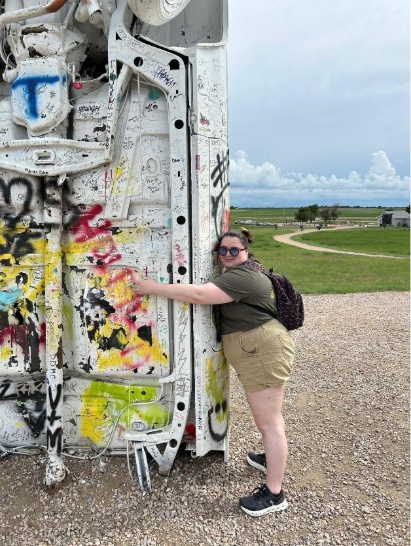
Learning from people who live in the area added depth to her characters and helped the world of the novel feel lived-in rather than imagined from a distance. The trip transformed one of her characters, Inez, a Nebraska native. “She went from 2D to 3D from going on this trip,” Celia explained. Celia’s understanding of the differences between the political landscape in Omaha and the rest of the state—the dissonances and the overlaps—informed how her character, an Omaha native, interacted with her sexuality.
Beyond travel, the Aspire Grant gave Celia something just as valuable: time. During the road trip, she read the novel aloud to her friend chapter by chapter, receiving feedback and identifying areas to expand or clarify. “By being given the time to actually talk with someone step by step, I was able to revise to a much stronger project,” she said.
Writing across multiple identities also required careful research and self-reflection. In developing characters from different racial and cultural backgrounds, including a Black character named Kayla, Celia was intentional about avoiding stereotypes and harmful tropes. She spent time reading across perspectives and examining her own assumptions to ensure that each character was treated with complexity and care. This commitment to responsible representation is central to the project and to Celia’s broader creative practice.
Celia learned about the Aspire Grant through her professors and her mentor, Dr. Katy Didden, who guided her through the application. The funding provided valuable support and time, helping Celia create a story world that felt authentic. Now, Celia has begun querying To Kiss the Moon to literary agents and is actively pursuing publication.
For students considering applying to Aspire Grants, Celia’s advice is simple and sincere: “Go for it. You never know what is possible unless you try.” She encourages applicants not to be afraid to “shoot for the moon,” to start early, and to reach out to professors for support. She also notes that interdisciplinary projects can be especially compelling and urges students to take their ideas seriously. “If you have something,” she says, “do something with it.”
If you’re working on a creative or research project, pursue the help you need to see your work come to life. Visit the Aspire webpage and start your application.
You can follow Celia’s writing journey on Instagram at @belia.book.