By Liberty Rister
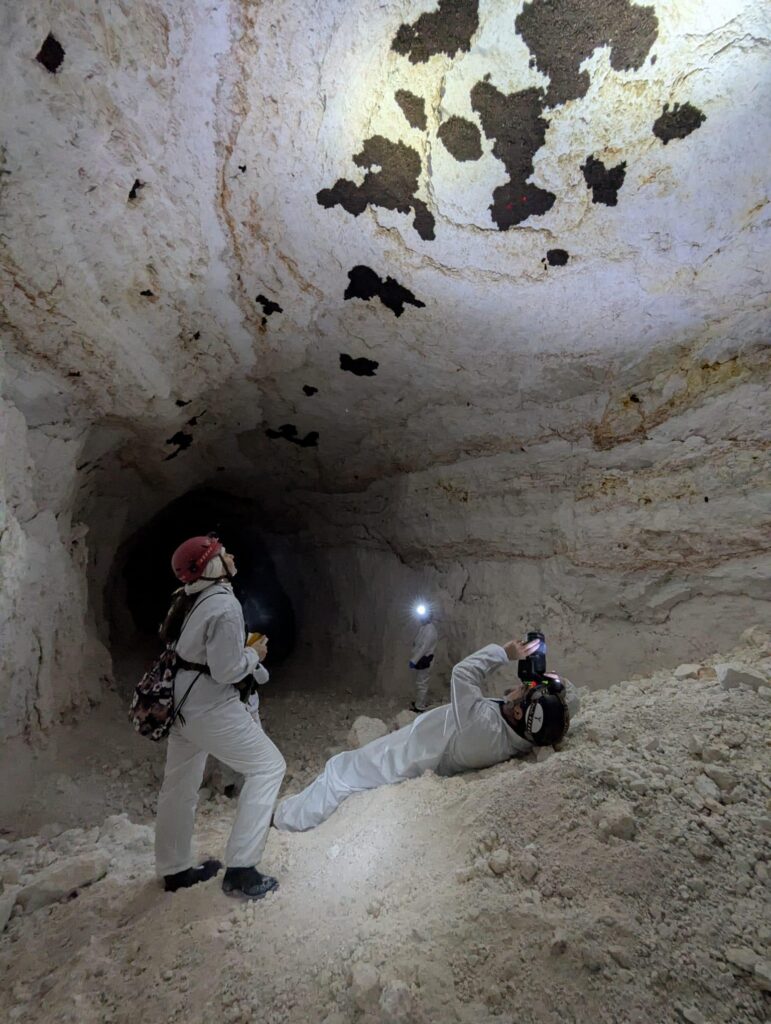
Deep beneath the surface, where light disappears, and sound carries differently, the air is colder, heavier. The ground is uneven, the walls stretch high overhead, and in the distance, faint, high-pitched calls echo through the dark. In abandoned copper mines in Michigan’s Upper Peninsula and sprawling hibernacula in southern Illinois, life clings to these spaces in ways most people will never witness. Thousands of bats cluster along the walls, packed tightly together, waiting out the winter in stillness, or, occasionally, stirring all at once in a sudden rush of movement.
But these spaces are not just home to bats. They are also at the center of one of the most pressing conservation challenges in North America.
Over the past two decades, bat populations have declined at alarming rates due to white-nose syndrome, a fungal disease that has devastated species across the country. In some cases, populations have dropped by as much as 98 percent. The fungus spreads in the cold, damp environments where bats hibernate, infecting them during the winter months and often leading to death before spring.
It is within this context that students in Ball State’s wildlife biology and conservation program step into the field, not just to observe, but to actively contribute to research aimed at slowing these declines. Under the mentorship of Dr. Tim Carter, students are participating in ongoing efforts to monitor bat populations, track the spread of disease, and test potential treatments that could improve survival rates.
Solving the Problem, One Bat at a Time
For Emily Peterson, these trips represent more than just fieldwork, they are an opportunity to directly engage in conservation research. Inside these mines, Peterson participates in data collection efforts that support long-term monitoring of bat populations. This includes observing bat behavior, assisting with counts, and helping document species presence within specific sites.
These efforts are critical. Understanding how many bats are present, which species are using certain hibernacula, and how those numbers change over time allows researchers to track the progression of white-nose syndrome and evaluate whether intervention strategies are making a difference.
Peterson’s role also contributes to broader conservation goals. By collecting accurate data, researchers can advocate for habitat protection, inform wildlife management decisions, and guide future research initiatives. What may seem like small tasks in the moment — counting bats, recording observations — becomes part of a much larger effort to protect vulnerable species.
But the work is not easy.
One of the most challenging aspects of Peterson’s experience is learning how to identify bat species in the field. Many species look nearly identical, especially when they are roosting high on mine walls or partially obscured by clusters. Developing this skill requires repeated exposure, attention to detail, and a strong understanding of subtle physical differences.
This isn’t just a technical exercise — it also has practical, real-world implications. Different bat species are affected by white-nose syndrome in different ways. Some experience more severe population declines, while others show signs of resilience. Being able to accurately identify species allows researchers to better understand these patterns and tailor conservation efforts accordingly.
For Peterson, this process has also reshaped how bats are perceived. Bats are often associated with fear, disease, or negative cultural stereotypes. However, spending time observing them in their natural habitat reveals a different reality. They are highly specialized, ecologically important animals that play a key role in controlling insect populations and maintaining ecosystem balance.
By learning to identify species and understand their behaviors, Peterson is not only gaining a technical skill but also challenging those misconceptions, both personally and within broader conversations. The more familiar these animals become, the harder it is to view them as something to fear.
The Heart of the Experience
While Peterson’s experience highlights the technical and problem-solving aspects of the work, Abby Yake’s perspective captures its emotional impact.
Working alongside Dr. Carter in southern Illinois, Yake helped organize and conduct a population survey at one of the largest known Indiana bat hibernacula in the country. With over 80,000 bats roosting there during the winter, the site provides a critical opportunity to assess population health and monitor long-term trends.
The purpose of this survey is clear: to estimate population size, track changes over time, and better understand how species are responding to ongoing threats like white-nose syndrome. These data are essential for conservation planning and for evaluating whether current strategies are effective.
Yake’s role as a camera assistant placed her at the center of this process. Because bats often roost in dense clusters, traditional counting methods are not always sufficient. Instead, researchers combine manual counts using clickers with high-resolution photographs of clusters, which are analyzed later to produce more accurate estimates.
This work requires coordination, attention to detail, and constant communication. Knowing which clusters to photograph, ensuring proper angles and lighting, and documenting each image correctly are all essential to producing reliable data.
But beyond the logistics, the experience itself left a lasting impression.
Standing in a section of the mine where thousands of bats were beginning to wake from hibernation, Yake witnessed something few people ever will. As bats moved through the air and their calls filled the space, the scale of the population became impossible to ignore. It was not just a number on a data sheet but rather a living, moving system.
In that moment, the purpose of the research became tangible. These were not abstract statistics or distant conservation issues. They were real animals, facing real threats, and the work being done in that mine had direct implications for their survival.
Yake describes this experience as both overwhelming and deeply meaningful. It reinforced a sense of connection to the work and to the people involved in it. Surrounded by researchers who are dedicated to protecting these species, Yake found a renewed sense of motivation and, importantly, hope.
Despite the severity of population declines, moments like this serve as reminders of what still exists and what can still be protected.
How the Work Happens
Behind these student experiences is a carefully structured research program designed to both advance conservation efforts and provide meaningful training opportunities.
As Dr. Carter explains, the work being conducted in these mines is focused on mitigation rather than elimination of the disease. White-nose syndrome, caused by a persistent and resilient fungus, cannot simply be eradicated. Instead, researchers are
exploring ways to reduce its impact and improve survival rates among affected bat populations.
One approach currently being tested involves the use of light to treat abandoned mines during the summer months. By exposing these environments to high-intensity UV radiation when bats are not present, researchers aim to reduce the amount of fungus that remains in the mine. The goal is to create a cleaner environment so that when bats return in the fall, they are less likely to be infected.
To evaluate whether this method is effective, researchers conduct fieldwork both before and after treatment. This includes capturing bats, swabbing their skin to measure fungal presence, and carefully recording data that can be analyzed in a lab setting.
Students play a central role in this process.
Fieldwork requires multiple people working together to handle bats, collect samples, manage equipment, and document data. Students assist with each of these tasks, gaining hands-on experience with research protocols and field techniques. For those who are vaccinated, this may also include directly handling bats and participating in the swabbing process.
These experiences extend beyond technical training. Students learn how to navigate remote field sites, coordinate logistics, and adapt to challenging conditions. Reaching these mines often involves hiking long distances through snow, transporting equipment across difficult terrain, and working in environments that are far removed from traditional lab settings.
Importantly, students are not simply observing this work, on the contrary, they are integral to it. As Dr. Carter emphasizes, research projects are designed with student involvement in mind. Their contributions are necessary for the success of the work, and they are treated as active members of the research team.
This approach reflects a broader philosophy within the program: learning happens most effectively when students are directly engaged in the process.
Bringing It All Together
Taken together, these experiences illustrate what the wildlife biology and conservation program aims to provide.
For Peterson, the value lies in the ability to take concepts learned in the classroom — species identification, population monitoring, conservation strategy — and apply them in real-world settings. The challenges faced in the field reinforce those concepts, turning them into practical skills that can be used in future careers.
For Yake, the impact is more personal. Through direct involvement in meaningful research and exposure to real conservation challenges, the work becomes more than academic. It becomes a source of purpose, a reminder of why the field matters, and a motivation to continue contributing to it.
And for Dr. Carter, these outcomes are intentional. The program is designed to give students not only knowledge, but experience and opportunities to participate in research that has tangible effects on conservation efforts.
The result is an environment where students are not waiting until graduation to make a difference. They are already doing it.
For those considering their academic path, programs like this offer a different kind of opportunity. They provide a way to engage with complex environmental challenges, to develop skills through direct application, and to be part of work that extends beyond the classroom.
In these dark, quiet spaces, students are not just learning about the world, but instead they are actively working to change it.
For more information about the Department of Biology, visit our website, contact our office, or follow us on Facebook and Twitter.