By Liberty Rister and Natalie Byers
A Student-Led Approach to Reducing Food Waste
As part of Ball State’s redesigned College of Sciences and Humanities first-year seminar, a group of students proposed a sustainability initiative focused on reducing campus food waste. Their project, titled Composting for a Change, aims to connect Ball State’s student-run restaurant, Allègre, with a local composting company to keep organic waste out of landfills.
The proposal centers on a pilot program that would collect pre-consumer kitchen waste, such as eggshells, vegetable peels, and food scraps, and send it to Scrapcycle, a Muncie-based composting company. Instead of being thrown away and contributing to landfill emissions, the waste would be repurposed into compost.
“My group’s project focused on implementing composting on campus to reduce the amount of compostable waste being sent to landfills,” said student Savannah Hudson. “We planned to start on a small scale with the potential for future expansion.”
The team’s proposal involved beginning composting efforts at Allègre, where the waste would be collected and processed by the local company. Once completed, the finished compost could be returned to Ball State and used by campus gardening and landscaping facilities.
“We decided to focus on composting because of the budget,” said student Lilly Dungan. “It is a very affordable, easy to implement, and highly beneficial project, so we were surprised that Ball State was not currently utilizing a food waste composting system.”
The plan would first test the system at Allègre, then evaluate whether the program could expand to other dining locations across campus. The long-term goal is to make composting both environmentally beneficial and financially practical for the university.
A Redesigned First-Year Seminar
The composting proposal is one of several projects developed in the redesigned CSHU 299X first-year seminar. Led by Associate Dean Dr. Richard Petts and faculty members David Concepción, Dr. Joshua Gruver, and Dr. Melinda Messineo, the updated course shifts the focus from general college transition skills to a more hands-on, interdisciplinary learning experience.
While the course still helps students adjust to college life, it now places greater emphasis on the three “ways of knowing” that define the College of Sciences and Humanities. These perspectives will also be part of the new Cardinal Core curriculum launching in 2026.
To put these ideas into practice, students worked in groups to design sustainability proposals that could realistically be implemented on campus. The course partnered with the Council on the Environment (COTE), which agreed to support the winning project with up to $1,000.
Finalist projects included recycling awareness posters, a campus composting initiative, and a student thrift store. Honorable mentions ranged from rain barrel installations to tree-planting efforts and a campus market concept.
Applying the Three “Ways of Knowing”
The sustainability project was not just about environmental impact; it was also designed to help students apply the College of Sciences and Humanities’ three “ways of knowing”: humanistic, social scientific, and natural science perspectives.
According to the group, the humanistic and social scientific approaches shaped many of their decisions. While the natural science reasoning behind composting was straightforward, less landfill waste and fewer carbon emissions, the team found that human behavior and social systems were more complex challenges.
“The different ways of knowing played an important role in how our group approached this project,” Hudson said. “Natural science helped us understand the environmental benefits of composting, social science guided our thinking about campus systems and community participation, and humanistic perspectives encouraged us to consider values, responsibility, and long-term cultural change.”
For Dungan, the project highlighted the importance of combining disciplines.
“Though my major is in Biology, the humanities and social science ways of knowing were crucial for creating this project,” she said. “The intersections between the humanities and natural sciences are really important. Creating a well-rounded project must use both.”
By targeting waste generated behind the scenes in the kitchen, the group designed a plan that would not rely on individual diners to sort their trash correctly. This approach reflects an understanding of both environmental science and human behavior, making the proposal more realistic and scalable.
A Meaningful First-Year Experience
Beyond the sustainability impact, the students described the project as a memorable and rewarding part of their first-year seminar experience.
“One of the most meaningful parts of working on this project was learning the value of collaboration,” Hudson said. “Working with my peers helped me see how brainstorming together leads to stronger ideas and solutions.”
Dungan agreed, noting that the group’s structure itself was unique. Two separate teams with similar ideas were combined into one larger group to create the final proposal, which required coordination, outreach, and shared decision-making.
“To make our project plan happen, we had to do a lot of logistical planning, such as research and contacting other individuals,” she said. “I feel much more confident in my ability to work with others and in a professional, project-based environment.”
Hudson also said she was surprised by how far the project progressed.
“What started as a class assignment turned into an opportunity to present our idea, which I never expected,” she said. “Being selected to present showed me that our ideas mattered and that even small projects can lead to real impact.”
Overall, the group said the project helped them feel more connected to their peers, their professors, and the campus community. Several students said the experience changed how they view their role at the university and inspired them to stay involved in sustainability efforts.
Looking Ahead
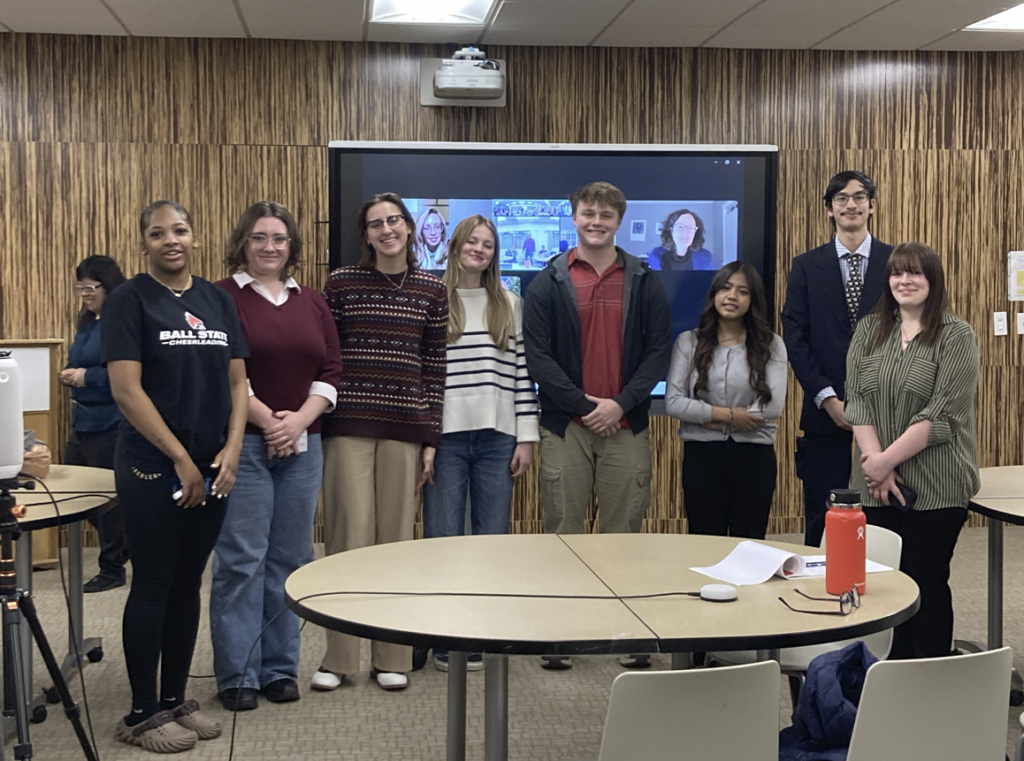
The composting proposal was developed by students Lilly Dungan, Savannah Hudson, Abby McCleery, Aaron Tanglertpaibul, Silvia Par, and Orion Lucas. Their project reflects the collaborative spirit and real-world problem-solving at the heart of the redesigned seminar.
As the finalists prepare to present their ideas to the Council on the Environment, their work highlights how first-year students can make meaningful contributions to campus sustainability right from the start of their college experience.
If implemented, Composting for a Change could mark the beginning of a broader effort to reduce food waste across Ball State, showing how small pilot projects can lead to lasting environmental impact.