By Asia White
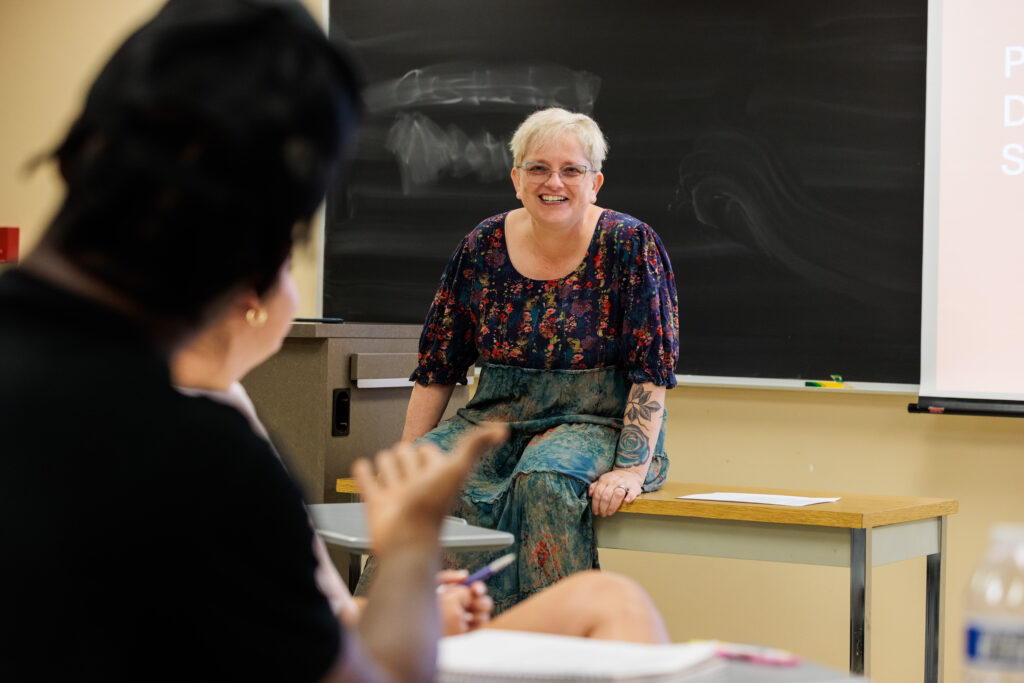
From early academic curiosity to a deeply interwoven path of research, teaching, and public service, Dr. Wendy Watson’s educational journey is one filled with purpose and passion. Dr. Watson brings a rare multidisciplinary lens to the classroom at Ball State, highlighting the interconnection of English, psychology, law, and political science.
Like many bright, ambitious students, Dr. Watson’s academic path wasn’t always clear-cut. They began their undergraduate career with plans to become a medical doctor, even enrolling in a joint BA/MD program. But by the fall of their senior year, they realized medicine wasn’t the right fit.
“I really had no plan of what I was going to do with those degrees other than be a doctor, which wasn’t going well. And so I called my mom, who had gone to law school. I was like, ‘What do I do?’
She said, “Go to law school.”
Following the familiar and trusting path her mother laid out, Dr. Watson chose to pivot into a career in law. The legal field allowed them to combine their interests in literature, psychology, and storytelling, highlighting the importance of crafting compelling narratives to tell a victim’s story within the constraints of legal procedure. “You need to be able to tell a story within the framework of the rules of evidence, which is very difficult,” added Dr. Watson.
They began their professional career in the legal field, clerking for judges in both state and federal courts in Minnesota. While Dr. Watson didn’t represent clients, their work involved in-depth legal research and writing skills, which have carried into their academic career.
Dr. Watson’s experience in the legal field sparked a keen interest in forensic genealogy, guiding them back to the academy once again. Dr. Watson earned a Ph.D. in political science, a field in which they have taught for the past two decades. They later completed a graduate certificate in Forensic Investigative Genetic Genealogy from the University of New Haven.
Bridging Law, Rights, and Real-World Impact
While Dr. Watson’s current role is teaching-focused, their research reflects a deep interest in how legal procedures affect access to justice for victims.
Dr. Watson’s doctoral dissertation examined how the U.S. Supreme Court selects unpaid petitions for review, also known as forma pauperis (IFP) petitions, filed by individuals unable to pay court fees. Their research analyzed petitions from 1976 to 1985 and found that IFP cases, often involving criminal or civil rights issues, were significantly less likely to be granted review than paid petitions. These findings unveiled a systemic disparity whose issues reach the Court, especially in cases involving minority rights, family law, and access to welfare benefits.
Dr. Watson explained how this work laid the foundation for their ongoing interest in how legal systems balance competing rights. Their later research on the Native American Graves Protection and Repatriation Act (NAGPRA) examined tensions between cultural & religious traditions and scientific advancement.
“Our society requires us to balance competing rights all the time, and the way in which we do that intrigues me,” they explained.
Dr. Watson’s interdisciplinary approach to research, drawing on sociology, psychology, and political science, has shaped their teaching by connecting theory with practice.
“I love to draw on theoretical perspectives from a wide range of disciplines, and I always hope that students do the same. I usually ask students about their majors and encourage them to reference what they are learning in other classes while in my classes.”

While Dr. Watson’s future is pedagogical, they hope to engage students in collaborative, real-world research projects, continuing their commitment to education through interdisciplinary teaching.
Creating Connections in Coursework
From the University of Michigan to The Ohio State University, Dr. Watson’s path reflects a deep commitment to understanding the intersection of people, policy, and justice. Naturally, that holistic approach to learning led them to Ball State, a university known for its commitment to immersive student-centered education.
“There’s a lot of room for students from political science to take criminal justice classes and students from criminal justice to take political science or psychology, or even English, to look at how authors portray the criminal justice system. So there’s lots of room for overlap, and I’m a big fan of interdisciplinarity,” they added.

This fall semester, Dr. Watson draws on their diverse academic background to guide students through the complexities of the American legal system in three dynamic courses, encouraging them to critically explore how laws are created, interpreted, and applied in real-world contexts.
In CJC 250: Introduction to Criminal Courts, Dr. Watson introduces students to the structure and function of the American criminal court system, focusing on key factors such as judges, prosecutors, defense attorneys, and the decision-making processes that shape legal outcomes. With their education in both psychology and law, Dr. Watson offers students a unique perspective on why people in the courtroom make the decisions they do; not just what the legal process is, but also how human behavior, ethics, and institutional bias influence outcomes.
This approach is critical to helping early undergraduate students understand that they must study their course content in the context of human experience. By drawing connections between psychology, law, and personal experience, students gain a deeper understanding of how legal decisions are made and why they matter beyond the textbook.
Additionally, Dr. Watson’s Juris Doctorate in public policy provides students with a strong foundation for understanding not only what the law is, but also why it exists and how it evolves in CJC 251: Criminal Law. Dr. Watson’s experience within the legal field guides students to consider criminal law within broader political and societal frameworks, giving real context to legal principles and statutes.
Lastly, in CJC 350: Criminal Evidence & Procedure, students explore federal rules of evidence and constitutional protections governing criminal procedures. Dr. Watson’s advanced education in forensic investigative genetic genealogy and their training in constitutional law allow them to engage in conversations at the intersection of science, criminal justice, and courtroom procedures.
With their blended approach to teaching, students are challenged to think critically about the balance between public safety and criminal law.
Genealogy Meets Justice
One of the unique factors that drew Dr. Watson to Ball State was the opportunity to further pursue their growing interest in forensic investigative genetic genealogy (IgG), an area in which they volunteer their expertise on real-world cases.
“Most IgG for unidentified human remains is crowdfunded. The genetic genealogists work for free, but the lab work to get to the genetic genealogy [costs] 8 to 15 thousand dollars. And so we fundraise all the time.”
Dr. Watson works with an organization called Moxxy Forensic Investigations, which fundraises for cases individually. Most of these fundraisers include a case photo of the unidentified individual, but Dr. Watson began to notice fluctuations in donations based on the victim’s demographics.
They have a growing research interest in donor behavior, including why some cases receive more donations than others and the factors that contribute to a person’s likelihood of donating to specific cases. For instance, one case Dr. Watson has been working on is known as Fort Bend John Doe (2000), a Latino man in his early 20s; however, his case has raised only about $160 of the nearly $7,000 goal.
“I think it’s interesting for me to see how my psychology background, my legal background, my political science background, they all kind of weave together somehow,” said Dr. Watson.
By applying their background in these disciplines, they’re able to explore the patterns in hopes of identifying fundraising strategies to support victim identification. Additionally, they hope to encourage students to break out of academic silos and embrace interdisciplinary learning to explore connections among criminal justice, political science, psychology, and even English.

Transformative Teaching
Dr. Watson’s journey to Ball State offers both a roadmap and a source of inspiration for faculty and students alike. They demonstrate that academic success isn’t about fitting into one discipline; it’s about drawing connections, asking better questions, and realizing that the most influential insights often live at the intersection of those fields. By bridging English, psychology, law, and political science, they’ve created a unique approach to address the intersection of each discipline.
In Dr. Watson’s classroom, students are encouraged to see how their various interests can come together in meaningful and impactful ways. Through both their research interests and teaching, Dr. Watson continues to model the value of interdisciplinary thinking, encouraging every student to do the same.
“I hope the students come away realizing how smart they are. And that their background may not be fancy, they may not have connections in the legal world or anything like that, but that doesn’t matter,” shared Dr. Watson, “You know, grit, curiosity, and a willingness to learn are all you need.”
Read more about our wonderful faculty.
To learn more about Dr. Watson’s work with Moxxy and to follow the story of Fort Bend John Doe (2000), visit www.MoxxyForensics.com/casework.