
Learn how to foster student agency and connection by integrating peace-centered pedagogy into your classroom.
When I first began teaching, my father passed along an influential piece of advice he had received from my mother: “Be the teacher you wish you’d had.” What do our students need today? What does the world need from our students today? These questions became my impetus for developing peace-centered pedagogy.
Peace-centered pedagogy strives for restorative justice and involves three steps: encounter, repair, and transform. It allows us to teach our students necessary conflict resolution skills through our disciplines, which can positively affect their relationships with and within systems of higher education, as well as beyond academia.
Key Terms
- Restorative justice: Rooted in indigenous justice practices, this approach responds to wrongdoing by prioritizing repairing harm and recognizing that maintaining positive relationships with others is a core human need.
- Encounter: Engaging with individuals to converse freely and without judgment about the harm that has been done, with a goal of restoring justice (step 1)
- Repair: Actions to contribute to healing occurrences of harm, addressing the various aspects of human needs: physical, emotional, social, etc. (step 2)
- Transform: Addressing structural and systemic issues that perpetuate harm and working to change them (step 3)
Applying criminal justice procedures to our students can be problematic. Moreover, applying an Indigenous practice to our Western classrooms risks cultural appropriation. I would like to make clear that this process was developed after intense study of restorative justice, both from perspectives in Criminal Justice and Criminology, as well as Peace Studies and Conflict Resolution. It is used as a model because it speaks to values that our classrooms need.
Classroom Applications
Peace takes time and sustained work; we cannot expect it immediately. Similarly, we cannot be expected to overhaul our teaching to enact these practices in a short time: we must take time to reflect on our teaching practices. As I’ve developed peace-centered pedagogy, I’ve cultivated the following insights and recommended practices:
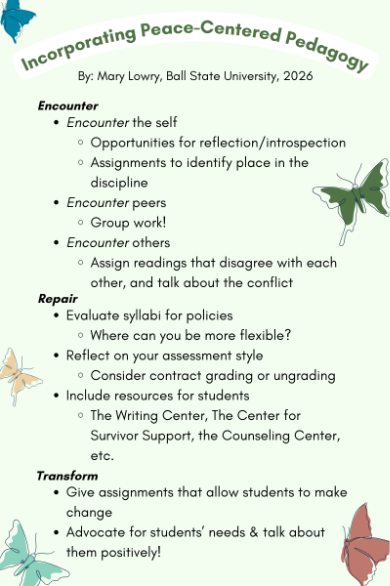
Encounter
There are three ways to consider encounter in our classrooms: encounter of the self, with peers, and with others.
For encounter of the self, make space for introspection or investigating identities. Give students the chance to think about their place in the discipline. When students better understand themselves, they can better understand others.
To encounter peers, get students involved with one another! Group work and activities are a great method. Chances are, you have group work already embedded in your course, so the framework is in place.
You likely already have encounter with others implemented, too. Expose your students to a wide variety of readings, professionals, and ideas. Consider assigning authors in your field who hold conflicting viewpoints and discuss that conflict. Academic discourse can emerge from disagreement, so encountering that contradiction is a great way to exemplify how we can disagree productively.
Repair
The easiest place to start with classroom repair is reflecting on your syllabi. This is often the first thing students read in our course, so it should set the tone for a welcoming, exciting space to learn.
Your voice in writing is incredibly important, and the way you write can bring your students in or make them hesitant to participate. Does your syllabus reflect your voice, or is much of it copied and pasted?
You might also review what resources you’ve included in your syllabus. Do you include only the required elements, or are there resources like the Counseling Center, Office of Survivor Support, or the Writing Center you might add to support students?
Finally, you can examine policies related to attendance/participation, assessment, and late work. If you’re concerned about creating flexible policies because you feel they don’t replicate the “real world,” try framing policies in terms of natural consequences. For example, it’s hard to pass a class or keep a job if you don’t show up or meet expectations. We can give our students opportunities for flexibility and still prepare them for life beyond college. For assessment options, I recommend checking out Vanessa Lanning’s Teaching Innovation Blog article on ungrading or Asao Inoue’s work on contract grading.
Transform
In our classrooms, we can empower our students by providing opportunities to talk about, inspire, or create widespread change. Consider assignments that allow students to propose institutional or community change. You might take advantage of high-impact practices, such as Immersive Learning at Ball State, where students can engage directly in the community.
At an institutional level, working for transformation could look like advocating regularly for students’ needs. We can also work to challenge negative talk about students. In “The Language of Exclusion,” Mike Rose writes that, when we refer to our students as illiterate, “such talk in certain political and decision-making settings can dramatically influence the outcomes of deliberation” (Rose 1985, 354). Any word can be substituted for “illiterate.” When we describe students as lazy, incapable, cheaters, disruptive, etc., we’re reinforcing and spreading that view.
As a writing teacher, I know the power of language. When we acknowledge students as capable, empowered, and smart, we can stop using oppressive language against them. This shift could have drastic implications for them, as individuals and as a group.
Benefits
In adopting peace-centered pedagogy, I have noticed a shift. My students come to class excited to be there. I teach first-year writing. I cannot overstate how frequently students enter the course unenthusiastic about spending the semester researching and writing. But when they realize they get to make choices and participate actively in the classroom, they feel valued, and they develop enthusiasm–which, incidentally, the U.S. Department of Labor (2026) identifies as a key interpersonal skill. That enthusiasm becomes a place from which students can develop the NACE Competencies (Ball State Career Center 2026) in meaningful, identifiable ways.
Peace-centered pedagogy invites us to focus on the good in our students. We see their power and potential, and we believe in them. Our hope gives them hope. When this happens, we create a more joyful place to teach and learn.
References
Ball State Immersive Learning. n.d. “Immersive Learning,” Accessed April 2, 2026. https://www.bsu.edu/about/administrativeoffices/immersive-learning
Inoue, Asao B. 2024. “Labor-Based Grading Resources.” Asao B. Inoue’s Infrequent Blog, February 27, 2024. https://asaobinoue.blogspot.com/p/labor-based-grading-contract-resources.html.
Lanning, Vanessa. 2023. “Less Worry, More Learning: How Ungrading Has Changed My Student Experience.” Teaching Innovation Blog (Ball State University), January 25, 2023. https://blogs.bsu.edu/teaching-innovation/2023/01/25/less-worry-more-learning-how-ungrading-has-changed-my-student-experience/.
Rose, Mike. 1985. “The Language of Exclusion: Writing Instruction at the University.” College English 47 (4): 341–59. https://troyspier.com/assets/files/bibliographies/teaching/rose_language_exclusion.pdf.
United States Department of Labor. n.d. “Soft Skills: The Competitive Edge.” Accessed March 19, 2026. https://www.dol.gov/agencies/odep/publications/fact-sheets/soft-skills-the-competitive-edge.

Comments: