
For many first-year students, college begins before their first semester on campus. As discussed in the introduction to this blog series, students may earn college credit in high school through dual credit courses, Advanced Placement examinations, International Baccalaureate courses, or other opportunities. Our analysis of incoming first-year students at Ball State from Fall 2015 through Fall 2024 explored patterns in how much pre-credit students bring with them, what kind of credits, and which students were most likely to enter with credit.
Most students entered with at least some credit
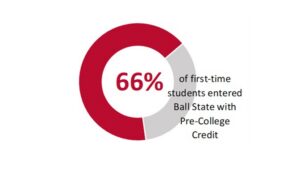
Most students entered with at least some credit. Across the study period, 65.8% of incoming first-year students entered Ball State with some amount of pre-college credit.
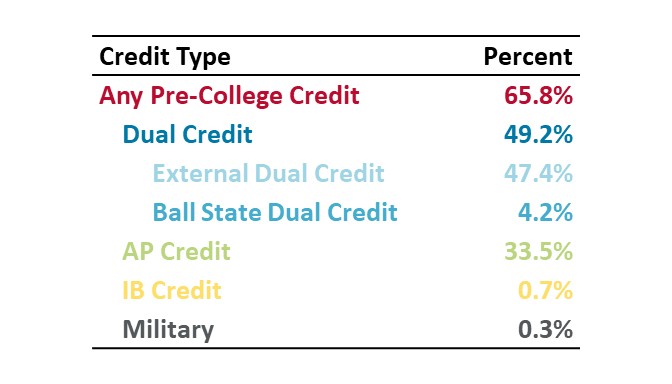
Dual credit was the most common type. Nearly half of students, 49.2%, entered with at least one dual credit. Most dual credit was awarded by colleges and universities other than Ball State. Approximately 47.4% of students had “external” dual credit, compared with 4.2% who had credit from Ball State dual credit courses.
AP credit was also common, although less so than dual credit. About one-third of students entered with AP credit. Because students can bring credit from more than one source, some students were included in both the dual credit and AP groups. IB and military credits were rare, with fewer than 1% of incoming students bringing those types.
Dual credit has become increasingly common
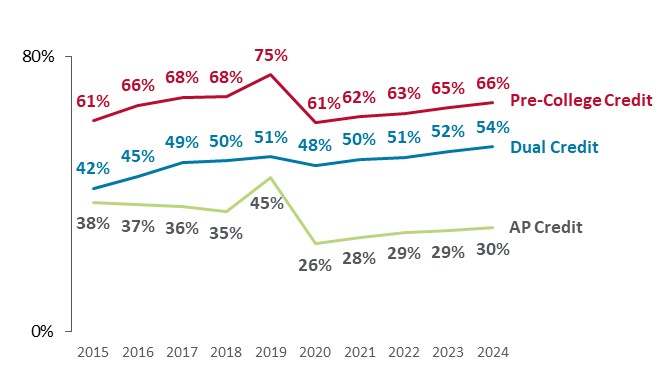
The share of students entering with any pre-college credit increased slightly over the decade, from 61% in Fall 2015 to 66% in Fall 2024. The overall rate reached a temporary high of 75% in 2019 before declining in the following years.
The trends for dual credit and AP differed a bit.
Dual credit participation increased more steadily, rising from 42% of incoming students in 2015 to 54% in 2024. By the end of our study period, more than half of incoming first-year students entered with at least one dual credit.
With AP, the share of students entering with credit reached 45% in 2019, dropped sharply in 2020, and remained lower in subsequent years. By 2024, 30% of incoming students entered with AP credit.
Students entered with widely different amounts of credit
Knowing whether a student had any pre-college credit tells only part of the story. The number of credits students brought with them also varied substantially.
Students with no pre-college credit made up the largest single group, accounting for approximately 34% of incoming students. Other students entered with only a few credits, but many arrived with the equivalent of a semester or more of college coursework already completed. Smaller groups entered with particularly large totals, including more than 30 or even more than 45 credits.
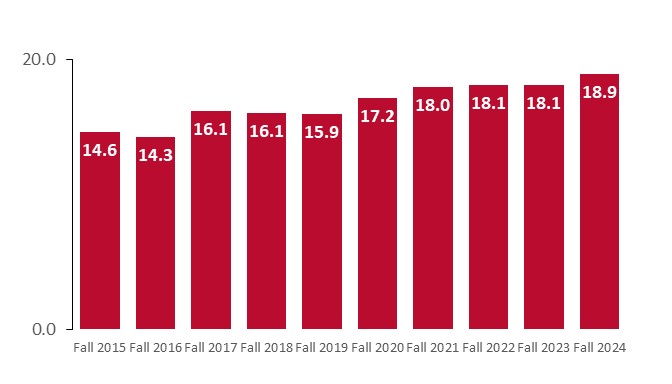
The average amount of credit also increased over time among students who entered with at least one credit. Students in the Fall 2015 cohort brought an average of 14.6 pre-college credits. By Fall 2024, that average had risen to 18.9 credits, an increase of more than four credits.
In other words, pre-college credit became somewhat more common over the decade, but the students who participated also tended to arrive with larger credit totals.
Academic preparation was strongly connected to pre-college credit
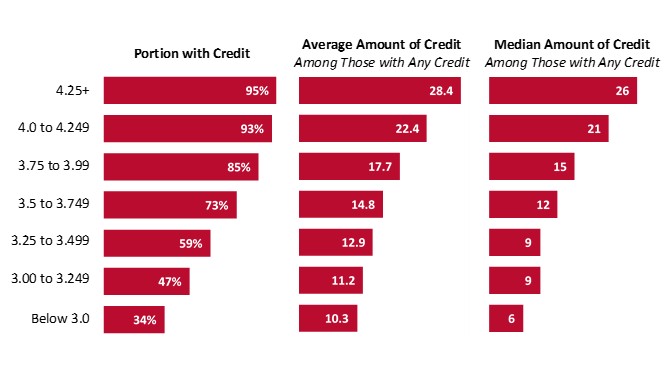
One of the clearest patterns involved high school GPA. Students with higher high school GPAs were much more likely to enter Ball State with pre-college credit. They also tended to bring substantially more credit. Among students whose high school GPA was below 3.0, only 34% entered with any pre-college credit. Among those who did, the average amount was 10.3 credits. At the other end of the distribution, 95% of students with a high school GPA of 4.25 or above entered with pre-college credit. Their average credit total was 28.4.
This pattern is important for understanding the rest of the study. Students who entered with more pre-college credit often began college with stronger records of prior academic performance. As a result, later differences in retention, GPA, and graduation cannot automatically be attributed to pre-college credit alone.
Participation also varied across student groups
Pre-college credit was not distributed evenly across the incoming student population.
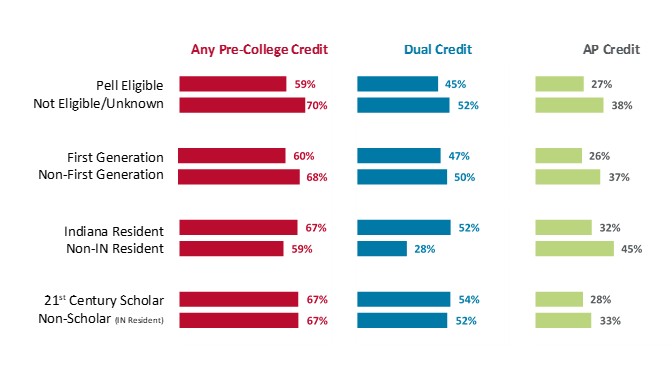
Pell-eligible students were less likely than students who were not Pell eligible to enter with any pre-college credit. The same pattern appeared among first-generation students, who were less likely than continuing-generation students to enter with pre-college credit.
These differences were visible for both dual credit and AP credit, although the size of the gaps varied. Other student groups also differed in their likelihood of entering with credit.
The descriptive findings do not, by themselves, explain why these differences occurred. Participation can be shaped by many factors, including which courses and programs are available at a student’s high school, eligibility requirements, advising, exam participation, student interests, and the likelihood that earned credits transfer to a particular university.
Still, the patterns show that access to pre-college credit—and the ability to accumulate large amounts of it—was not the same for all incoming students.
What should we take away?
Pre-college credit has become a regular part of the path to Ball State. Nearly two-thirds of incoming first-year students brought at least one credit, and many arrived with the equivalent of a semester or more already completed.
But the overall percentage can obscure substantial variation.
Dual credit became more common over the decade, whereas AP participation declined after 2019. The average amount of credit increased among participating students. Most importantly, students with stronger high school GPAs were much more likely to enter with credit and to bring larger amounts. Participation also differed by Pell eligibility, first-generation status, residency, and other student characteristics.
These differences matter when considering whether pre-college credit is associated with later success. Students do not enter college with the same academic preparation, backgrounds, or access to pre-college opportunities. The remaining posts in this series therefore consider both the outcomes students experienced and how the results changed after accounting for some of those differences.
The next post asks: Does pre-college credit help students succeed in the first year?
For the complete methodology, detailed tables, and additional findings, see the full report.
Discover more from Data Insider
Subscribe to get the latest posts sent to your email.