
As discussed in the previous post, nearly two-thirds of incoming first-year students arrived at Ball State with at least some pre-college credit. The next question is whether these students performed better academically during their first year and were more likely to return for a second year.
Students who entered Ball State with pre-college credit generally had stronger first-year outcomes than those who entered without it. Some of that advantage reflected differences in academic preparation and student background, but the overall pattern remained after those differences were taken into account.
Students with pre-college credit were more likely to return
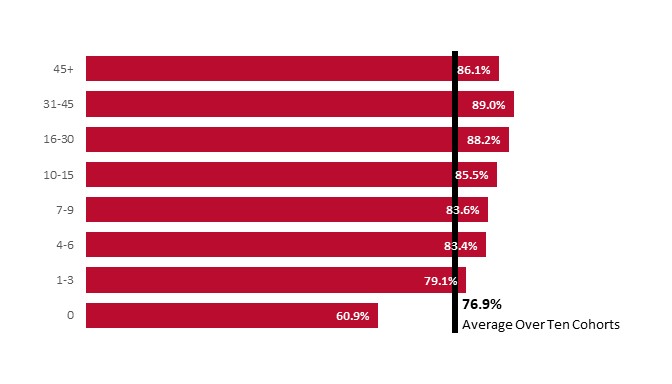
Fall-to-fall retention measures whether students who begin at Ball State in the fall remain enrolled the following fall. The descriptive results showed a clear relationship between pre-college credit and retention. About 61% of students who entered without any pre-college credit returned for their second year, compared with an overall retention rate of approximately 77%.
Retention generally increased as the amount of pre-college credit increased. The largest gains appeared among students entering with 10 or more credits, whose retention rates reached the mid-80% range. The pattern leveled off somewhat at the highest credit totals, but students with pre-college credit consistently had higher retention rates than students without it.
At first glance, these results might suggest that bringing more pre-college credit directly increases a student’s likelihood of returning. However, students who enter with pre-college credit also differ from students who enter without it.
As discussed in the previous post, students with higher high school GPAs were much more likely to enter with pre-college credit and tended to bring larger amounts. Participation also varied by Pell eligibility, first-generation status, residency, and high school characteristics. These differences make it important to consider whether pre-college credit itself accounts for the retention pattern or whether the pattern also reflects students’ prior preparation and circumstances.
The retention advantage became smaller after adding control variables
Our study used regression models that accounted for differences in student background, socioeconomic characteristics, high school GPA, and high school context.
The estimated relationship between pre-college credit and retention became smaller as these characteristics were added to the analysis. The largest reduction occurred when high school GPA was taken into account, indicating that academic preparation explained an important part of the descriptive difference.
But the relationship did not disappear.
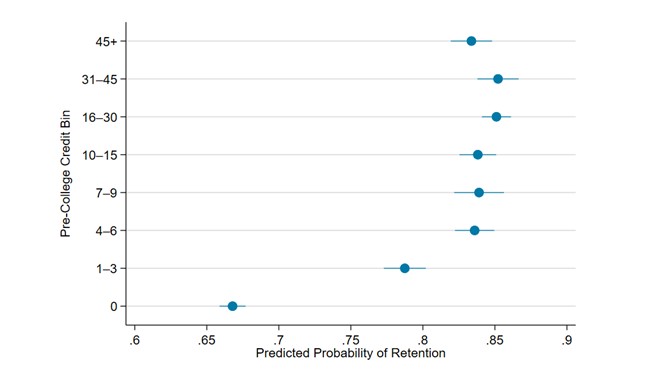
After adjustment, students with pre-college credit continued to have higher predicted retention rates than otherwise similar students without pre-college credit. Students entering with 10 or more credits had predicted retention rates of approximately 83% to 85%, compared with about 68% for students entering without any pre-college credit. The difference was smaller than in the unadjusted results, but it remained meaningful and consistent across credit categories.
First-year academic performance
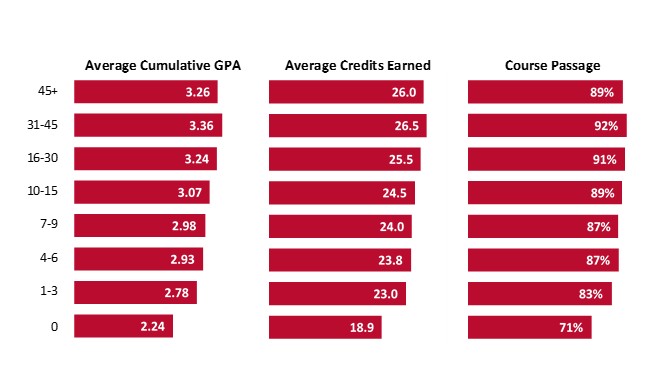
Remaining enrolled is an important outcome, but it does not show how students performed while they were enrolled. The study therefore also examined cumulative GPA, credits earned, and course passage rate, or the share of attempted courses students successfully completed.
Across all three measures, students who entered without pre-college credit had the weakest average outcomes. They had the lowest GPAs, earned the fewest credits, and passed the smallest share of their courses. Students with pre-college credit generally performed better, although the largest difference was often between students with no pre-college credit and those who entered with at least some credit. Differences among students with varying amounts of credit were generally smaller.
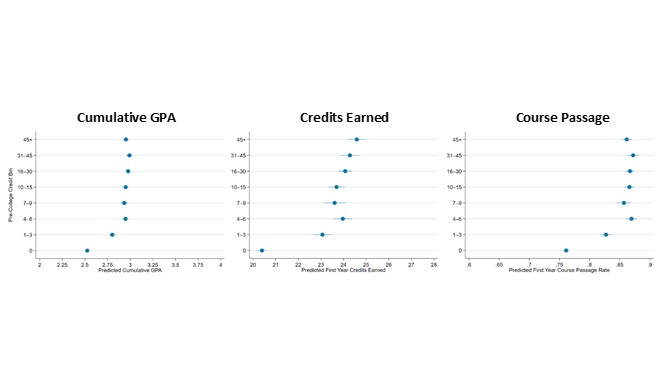
As with retention, the differences became more modest after accounting for high school GPA, Pell eligibility, first-generation status, residency, and high school context. Students with pre-college credit continued to have somewhat higher predicted GPAs, earn more credits, and pass a larger share of their courses, but the adjusted results were more tightly clustered.
This indicates that part of the observed advantage reflected differences in academic preparation and student background. High school GPA was especially important because it was strongly related to both entering with pre-college credit and performing well during the first year.
So, does pre-college credit help?
The findings point to a qualified yes. Students who entered Ball State with pre-college credit were more likely to return for their second year, earned higher grades, completed more credits, and passed a larger share of their courses. These relationships became smaller after accounting for academic preparation and student background, but they did not disappear.
At the same time, the results do not show that pre-college credit alone caused the stronger outcomes. Pre-college credit may provide genuine benefits, but it may also signal stronger academic preparation, greater access to advanced coursework, and more support before college.
Taken together, the findings suggest that pre-college credit is both a potential academic resource and an indicator of how prepared students are when they arrive at Ball State.
The next post asks: Does pre-college credit help students graduate, and does it help them graduate sooner?
Discover more from Data Insider
Subscribe to get the latest posts sent to your email.