By Natalie Byers
Picture this: you’ve spent your whole academic career in different classrooms full of fluorescent lights, rows of chairs, the smell of chalk, and the hum of projectors. Every class has either been a lecture, group discussion, big exam, or a long day in a lab.
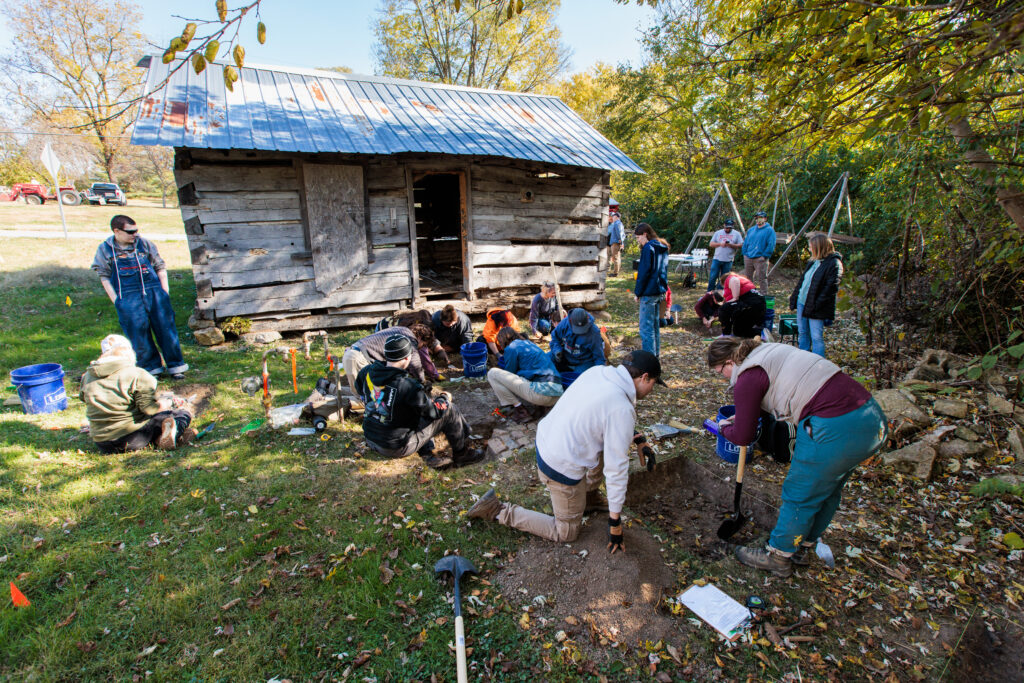
But then a professor reaches out to you about a new class for the upcoming semester, and this classroom is different. This classroom takes you to an old log house in Smithfield, 20 minutes east of Muncie: A real archaeological dig site. Lab days are spent wearing gloves, digging in excavation squares or sifting through dirt to look for artifacts; and group discussions become a guessing game, trying to figure out what the lives of this house’s owners looked like.
This course, an anthropology field school at the Daugherty Cabin, has been a one-of-a-kind immersive learning experience for its students.
“It is one thing to be sitting in a classroom and learning about archaeology and what skills to use,” Addi Arena said, “but it is an entirely different thing to actually be in the field putting those skills to use.”

The History of Smithfield
The town of Smithfield was an early settler town in the 1820s. The Daugherty site contains a standing single log house, but lidar satellite imagery examined by Lucien Kaufman indicated the foundation remains of an outbuilding west of the standing cabin. When the students began fieldwork, the location of this outbuilding was confirmed by structural debris.
During weeks four and five, students opened excavation squares in the cabin’s backyard, and since then they’ve been uncovering historic artifacts that point to the Daugherty Cabin being constructed during the middle to late frontier period. With the help of tree ring analysis done by Drs. Darrin Rubino from Hanover College and Christopher Baas from Ball State, the cabin was conclusively dated to have been built in 1846.
The site also holds lots of potential for finding prehistoric artifacts dating back to over 10,000 years ago. Smithfield is located on an ancient river terrace above the White River, which, thousands of years ago, would have been a prime habitat for mastodons. Paleo-Indians, America’s first settlers, inhabited the area between 18,000 and 10,000 years ago, hunting large animals such as mastodons before they went extinct around 12,500 BCE. Paleo-Indian and early Archaic period campsites were usually set up by prime hunting locations; thus, it is likely some are in Smithfield, waiting to be discovered.
A Look Inside the Field School
Under the guidance of their instructor, Dr. Mark Groover, students have used satellite technology, mapping strategies, and excavation techniques they’ve been learning about each semester to study the cabin lot, construct dig sites, and search for artifacts.
Small squares were constructed on the lawn of the cabin, and students worked in small groups to carefully excavate each one, looking for artifacts to uncover. Then, the dirt from the squares went through large sifting screens to catch any smaller artifacts they might have missed.

Sydney Collis has enjoyed how different the field school has been from her usual classes: “It’s allowed me to apply my knowledge and hone my skills outside of a classroom setting, or with the time constraints required when performing field work through the lab.”
Meanwhile, for Addy Cline, gaining experiences like this field school has been a test to figure out if her field is truly right for her. “Getting a chance to get hands-on experience as an undergrad and seeing how artifacts and bones look like when you find them in the field has been invaluable for me,” she said. “And considering that this is my second field work program I’ve entered, I think I am definitely in the right profession.”

Discoveries Hidden Below the Surface
Over the course of the excavation process, students have found several glass bottles, ceramic plates with painted patterns on them, handmade shell buttons, bones from past livestock, and iron hatchet head, and even multiple marbles. Addi Arena has enjoyed this part of the class the most. “The excitement when you find something good and intact is addicting in many ways.”

Addy Cline and Sydney Collis also found at least one remnant of Smithfield’s prehistoric past in week 10 when they recovered a possible late Paleo-Indian spear point in their excavation square, underneath undisturbed deposits eight inches below the surface. While ground surface finds of Paleo-Indian spear points have been found in almost every county in Indiana, sites with intact, subsurface deposits like those at the Daugherty site are very rare in Indiana and Delaware County. The spear point found at the Daugherty Cabin is possibly a Greenbrier Dalton projectile point/biface, which would date it to be between 10,700-8,000 years old.
“Getting a chance to actually work on a site before graduation has been the best experience so far,” Cline said, “but finding a pre-contact tool that’s roughly 10,000 years old is also on the top of the list.”

Dalton spear points were used as a projectile tip on spears and hafted to handles to be used as knives. The point found at the Daugherty site is most likely an example of a “nubbin”, which is used to describe spear points that have been extensively resharpened almost to the base of the point—a typical trait of Dalton points. This means the Daugherty point was likely heavily used by its owner and probably had a long life both as a spear point and a cutting tool.
Thanking the Sponsorship from the CUREs Program
This course was one of three sponsored by a grant from the Course-based Undergraduate Research Experiences (CUREs) Program, which was spearheaded by the Kahn Family Endowment. The Endowment believes that a strong liberal arts education where students are introduced to a variety of facts, values, methodologies, cultures, and perspectives is one of the best ways to prepare them to adapt and grow in an ever-changing world.
To accomplish this, the College of Science and Humanities’ CUREs Program is designed to increase students’ access to undergraduate research experiences by providing support for faculty to develop courses focusing on undergraduate research. In these courses, students engage in original, authentic research that is of interest to external organizations.
Dr. Groover’s field school was the first CUREs course offered, and it is safe to say it was a huge success. Addi Arena sums up the field school’s benefits for every student involved best: “I now feel so much more confident for jobs post-graduation because I have actual field experience, and I know how to go about certain field work expectations.”
For more information about the Department of Anthropology and Sociology, visit our website, contact our office, or follow us on Facebook and Instagram.