
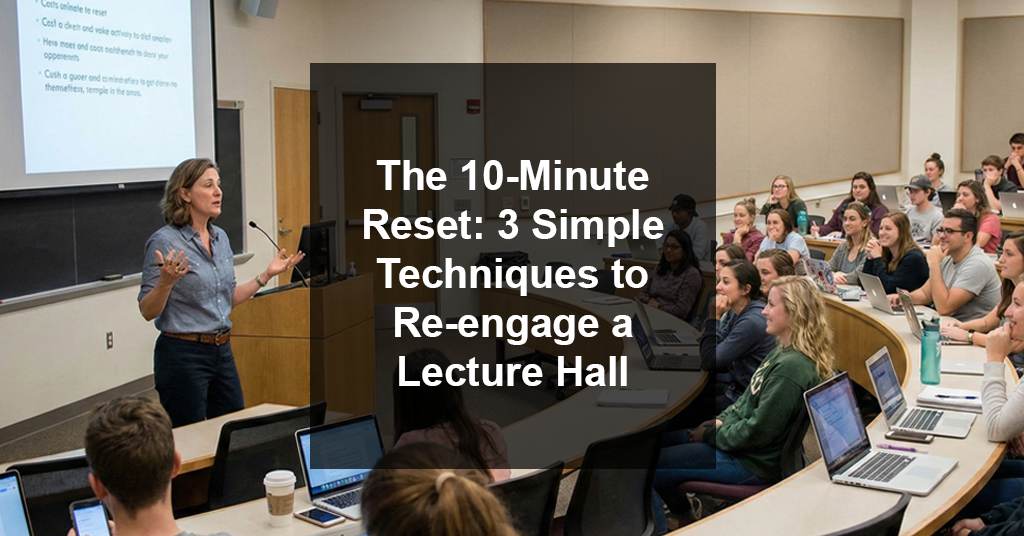
Seeing vacant stares 30 minutes into your lecture? Hit the reset button. Learn how a 10-minute active learning break can re-energize your classroom and provide you with instant feedback—no prep required.
It’s a universal experience for instructors: the mid-lecture glance reveals a sea of disengaged students, lost to phones, screens, or the middle distance. This isn’t a sign of poor teaching; it’s the central challenge of holding attention in the age of distraction. Reclaiming that focus doesn’t require a dramatic overhaul of your curriculum. This blog article provides a practical guide to implementing quick, effective active learning breaks designed to combat fatigue, deepen comprehension, and provide you with invaluable, real-time feedback on student understanding. Learn how to quickly re-engage every student and turn vacant stares into active learning.
The Glaze Over
It’s 35 minutes into your 75-minute lecture. You’re deep into explaining a complex concept. You look up and see it: The Glaze-Over. Half the class has a vacant stare, several are on their phones, and one student in the front is subtly checking the time. It’s not you—it’s neuroscience. Attention spans naturally wane after 10-15 minutes of passive listening.
Do you plow through, hoping someone is still with you? Or do you hit the reset button?
The Solution: 10-Minute Active Learning Break
This isn’t a major pedagogical overhaul. It’s a strategic pause. A brief, structured activity that forces students to process the material you just delivered.
- For Students: It breaks passivity, improves retention, provides instant feedback on their understanding, and increases energy.
- For You: It’s a real-time check for understanding. You see what they’re grasping and what’s still muddy. It takes almost no prep time.
Technique 1: Think-Pair-Share
What it is:
- Pose a provocative question or problem-solving prompt. Students first think on their own, then pair off to discuss their ideas with a neighbor or two, and finally, a few groups share their conclusions with the whole class.
How to do it: Create a prompt.
- “Okay, everyone, let’s pause for a minute. Based on what I just lectured about [concept X], turn to your neighbor and explain why [Z] would be a logical consequence.” Or “Debate with your partner: is argument A or argument B stronger and why?”
- Give them 60 seconds to think on their own, then allow two minutes for them to pair and discuss. Then call on a few groups to share.
Total time: 5-10 minutes.
Why it works: It lowers the barrier to participation. Everyone talks to one or two people before being asked to speak to the whole room. It generates energy and noise.
Pro-tip: Don’t skip the think stage. It ensures everyone has an idea before the talkative student dominates the pair.
Technique 2: The Minute Paper
What it is:
- Students take one minute to write a short, focused response to a prompt. No grades, just participation.
How to do it: Create a prompt.
- “Take out a piece of paper. In one minute, answer this: What is the most important point from today’s lecture so far?” or “What is one question you still have?”
- Give them 60 seconds of silent writing time. “Okay, pencils down. Turn to your rows, and share your responses/questions.”
- Have one student from each row share a common theme.
Total time: 5-10 minutes.
Why it works: It forces students to retrieve and synthesize information, solidifying memory. It gives you incredible feedback. If students write that they’re confused about the same thing, you know to clarify it now.
Pro-tip: You don’t have to collect them all. Have a few students share their answers aloud. It validates their input and often answers other students’ unasked questions.
Technique 3: The Muddiest Point
What it is:
- This is a specific type of minute paper that asks students to identify the most confusing part of the lecture. This is your direct line into what isn’t landing.
How to do it: Create a prompt.
- “On a notecard or a scrap piece of paper, complete this sentence: The muddiest point for me right now is…”Or The thing I am still confused about is…”
- “Quickly, 60 seconds. Be honest. It helps me to help you. “
Total time: 3-7 minutes.
Why it works: It’s effective. Students are often reluctant to raise a hand and say, “I don’t get it.” This anonymous(ish) method uncovers the sticking points you might completely miss.
Pro-tip: Skim the responses immediately. If you see a common theme, address it right away. “Okay, I am seeing that a few people are fuzzy on [concept Y]. Let me try explaining that another way.” This shows students you actually value their feedback.
Making It Work
Adopting a new teaching technique is like learning a new piece of software: the initial hesitation is about the learning curve, not the ultimate payoff. Let’s address the most common concerns before they become obstacles:
“I don’t have time!”: This saves time. Spending 5 minutes clarifying confusion now prevents 20 minutes of remedial emails and poor exam performance later. Possibly even emails about extra credit.
“It will get too loud/chaotic!”: Embrace a controlled hum of productivity. It’s a sign of learning. Be clear about time limits and use a signal (e.g., a countdown timer on the screen or a simple “wrap it up”) to regain attention.
“Students won’t do it.”: Start small. Explain why you’re doing it. “We’re going to take a quick learning break to make sure this is clicking.” Frame it as a tool for their success. Their buy-in will increase after the first try.
Putting It Into Practice
Your next lecture is coming up. Pick one of these techniques. Write your prompt on a sticky note as a reminder. Try it just once. You might just reset your entire classroom dynamic.





References
Freeman, Scott, Eddy, Sarah L., McDonough, Miles, Smith, K., Okoroafor, Nnadozie, Jordt, Hannah, & Wenderoth, Mary Pat. “Active learning increases student performance in science, engineering, and mathematics,” Proc. National Academy of Sciences. U.S.A. 111 (23) 8410-8415, https://doi.org/10.1073/pnas.1319030111 (2014).
McKeachie, Wilbert J. “Research on college teaching: The historical background.” Journal of educational psychology 82.2 (1990): 189.

Comments: