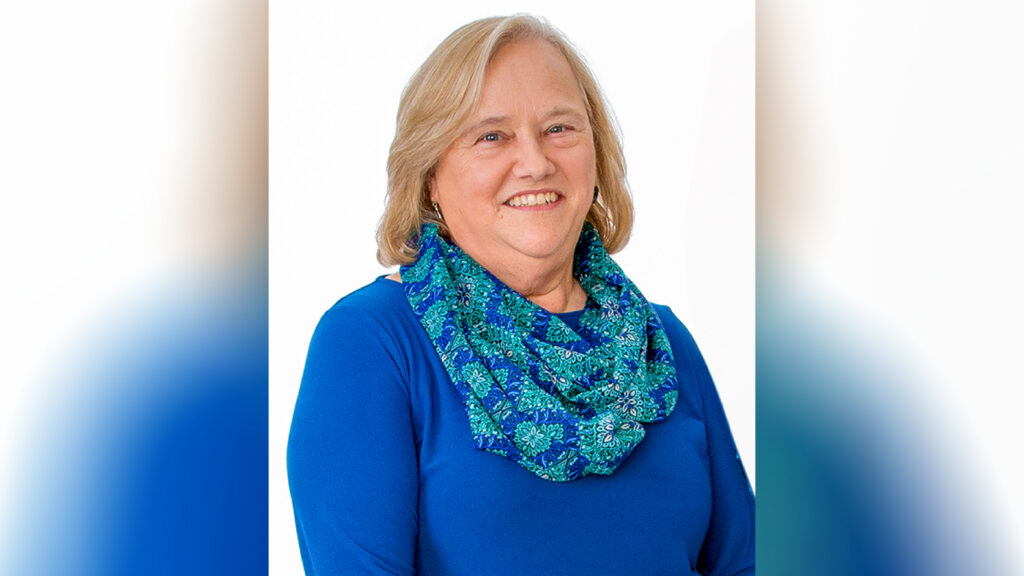
The 2026–2027 Teachers College Distinguished Service Award recipient spent nearly 30 years helping future educators learn from the communities they serve while building partnerships that connected Ball State, local schools, and families.
As Ball State University celebrates Homecoming, Teachers College is recognizing three outstanding individuals through its 2026–2027 Alumni Awards. Throughout the week, we’re introducing each honoree and exploring the experiences, contributions, and commitments that have made a lasting impact on education and the Teachers College community. Our final honoree is Patricia Clark, Professor Emerita of Early Childhood, Youth, and Family Studies and recipient of the Teachers College Distinguished Service Award.
Presented to a non-alum in recognition of outstanding service and support for Teachers College, the award reflects a value that has guided Clark throughout her life: a responsibility to give back to the communities of which she is a part.
“I have always felt that it is important to give back to your community, whether that is family and friends, your neighborhood, or the broader communities in which you live and work,” Clark said.
For nearly 30 years, Ball State was one of those communities.
She found colleagues who became lifelong friends, students who inspired her, and mentors who guided her. In return, Clark devoted her career to serving students, strengthening teacher preparation, and building relationships between the university and the communities surrounding it.
“That I could, in some way, give back to the students, colleagues, and the university was fulfilling a personal responsibility and commitment,” she said. “It is an honor to receive this recognition for something that has meant so much to me.”
Finding Her Way to Education
Patricia Clark looks on as a young student is read a Goldilocks and the Three Bears pop-up book during a classroom activity.
Teaching was not Clark’s original plan.
She earned a bachelor’s degree in Spanish from Indiana University and later worked at the ERIC Clearinghouse on Teacher Education in Washington, D.C. There, she learned about bilingual education, an area receiving significant federal attention and funding at the time.
The experience changed the direction of her career.
Clark returned to school to earn a master’s degree and an elementary teaching license, then began teaching as a bilingual kindergarten teacher in Boston.
After her own children were born, she started a preschool. Her experiences there led to increasingly complex questions about education.
How did a child’s culture and community affect their experiences in school? Why did some children have different opportunities for success? How did classroom practices reflect assumptions about how children learn and live?
Those questions eventually led Clark to doctoral study at the University of Illinois, where she focused on early childhood education and the influence of culture and community on childrearing and learning.
She emerged wanting to share what she had learned with future teachers.
Clark hoped they could enter their classrooms better prepared than she had been when she began her own teaching career.
Finding a Home at Ball State
Clark arrived at Ball State in 1993, drawn by the University’s emphasis on excellence in teaching.
Although she enjoyed research, she wanted to work at an institution where teaching was equally valued. Once here, she found other reasons to stay.
One was the collaborative environment. Clark found colleagues who wanted to work together, experiment with new approaches, and improve experiences for students.
The other was the opportunity to try different things.
Throughout her career, those opportunities included introducing undergraduate and graduate students to new cultures, developing community-engaged approaches to teacher preparation, mentoring doctoral students, working with local organizations, supporting school partnerships, and serving in leadership roles.
When Clark first arrived, however, opportunities for teacher candidates and faculty to work in local schools were much more limited.
“When I first came to BSU in 1993, students and faculty in our department were not involved in the schools off campus, except for student teaching,” Clark said. “I am thankful that I was here during the time that began to change and a part of efforts involved in the process.”
Clark would become one of the people helping drive that change.
Learning With a Community
Faculty explore the Shaffer Chapel Museum, located inside the historic Shaffer Chapel African Methodist Episcopal Church in Muncie’s Whitely neighborhood. The museum, which traces African American history in Muncie beginning in 1839, was among the community sites visited by Ball State students participating in the Schools Within the Context of Community program.
One of the defining projects of Clark’s career began with a question she shared with colleague Dr. Eva Zygmunt: How could future teachers develop a deeper understanding of the communities where they would teach?
The two initially considered creating a block of early childhood courses that would include a more extensive practicum experience. At the same time, Ball State was developing its immersive learning initiative.
The timing created an opportunity.
Clark and Zygmunt received funding to develop what became the Schools Within the Context of Community program, a semester-long immersive experience bringing together courses, fieldwork, faculty, schools, and community engagement.
The program partnered with Muncie Community Schools and the Whitely neighborhood. Teacher candidates did not simply enter the community to complete assignments. They learned its history, built relationships with residents, worked with local organizations, and examined their own assumptions about the children and families they would serve.
The goal was to prepare teachers to understand something Clark considered essential: knowing a community makes a difference in how educators reach and teach its children.
“We learned about the rich history of the Whitely neighborhood and its ongoing commitment to its children and families,” Clark said. “We all learned about our own biases and stereotypes and how those can impact our behavior, including our teaching.”
Relationships That Changed Teacher Preparation
A suggestion from Whitely community leader Mary Dollison during the program’s first year helped create one of its most meaningful components.
Dollison suggested recruiting residents to serve as community mentors for Ball State students.
She reached out to friends and neighbors, and those mentors began inviting teacher candidates into their lives. Students visited their homes, attended church, went to their children’s activities, participated in neighborhood events, and experienced the community in ways that no traditional university assignment could replicate.
“Mentors were gracious hosts who brought our students into the community in an authentic way that would not have been possible otherwise,” Clark said.
The relationships often lasted beyond the semester.
Some students remained in contact with their community mentors. Others went on to teach at Longfellow Elementary School and elsewhere in Muncie. Faculty members continued participating in community organizations and initiatives even as their university roles changed.
The partnerships also resulted in projects identified with the community, rather than simply for it. Ball State faculty and students worked alongside residents to support the community center, develop afterschool and summer programming, select culturally relevant books for children, and create a timeline documenting local civil rights history.
For Clark, that distinction mattered.
She believes educators can enter communities with good intentions and still make the mistake of deciding what people need without first listening to them.
Future teachers, she said, must learn to recognize their own biases while also understanding the knowledge, experiences, and strengths children bring into the classroom.
“I would wish that future teachers would enter classrooms without a ‘deficit perspective’ of the children, families, and communities in which they will teach,” Clark said, “and would instead take the time to get to know the community and understand the strengths that children bring with them.”
An Idea That Traveled Beyond Muncie
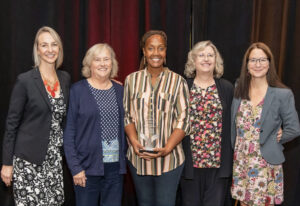
Patricia Clark, second from left, and colleagues celebrate as Ball State Teachers College receives the 2018 Excellence in Faculty Community Engagement Award from the Engagement Scholarship Consortium for its Schools Within the Context of Community program.
Schools Within the Context of Community eventually received 10 national awards, bringing attention to an approach that had grown from relationships among Ball State, Muncie Community Schools, and the Whitely neighborhood.
For Clark, the greatest value of that recognition was not the awards themselves. It was the conversations they generated.
Educators around the country became interested in community-engaged teacher preparation and wanted to understand how the Ball State program worked.
For four years, Ball State hosted the Summer Institute on Community-Engaged Teacher Preparation, welcoming participants who wanted to explore similar approaches at their own institutions. Some went on to develop community-engaged teacher education initiatives elsewhere.
The work also led Clark and her colleagues to share what they had learned through scholarship.
Clark co-authored Transforming Teacher Education for Social Justice, which received the 2016 Outstanding Book Award from the American Association of Colleges for Teacher Education. She later co-edited The Power of Community-Engaged Teacher Preparation: Voices and Visions of Hope and Healing, which explored approaches being developed at universities around the country.
Learning about those programs broadened Clark’s own understanding of what community-engaged teacher preparation could look like while helping identify principles shared across different approaches.
Her hope was that the work would encourage educators to recognize the strengths already present within communities and prepare future teachers to build upon them.
Listening to What Families Need
The relationships built through Schools Within the Context of Community also created opportunities to respond to needs identified by families themselves.
During a community event hosted by Ball State students, families were asked what they wanted for their children.
Their answer was straightforward: more opportunities for children after school and during the summer.
Clark and Zygmunt listened.
They pursued funding through the 21st Century Community Learning Centers program and created the Muncie P3 afterschool and summer program. Its first cohort entered kindergarten in 2010.
The program focused on helping children read on grade level by third grade and was highly successful in reaching that goal. But Clark saw another kind of growth that mattered just as much.
As children progressed through the program together, they formed strong relationships. The social and emotional benefits became as meaningful as the academic ones.
For Clark, P3 demonstrated what can happen when universities begin by asking communities what they need and then use their resources to help make those ideas possible.
Across her career, Clark helped secure more than $5 million in funding to support programs for children in the Muncie community.
Service Beyond the Classroom
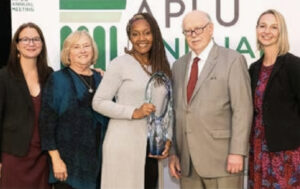
Patricia Clark, second from left, and colleagues accept the 2018 C. Peter Magrath Community Engagement Scholarship Award from the Association of Public and Land-grant Universities in recognition of the Schools Within the Context of Community program.
Clark’s commitment to community did not stop with her faculty responsibilities.
Her parents had modeled service throughout her childhood, teaching her that contributing to a community was a responsibility. She carried that lesson into her work in Muncie.
Clark served with organizations including Huffer Memorial Children’s Center, Muncie BY5, the Whitely Community Council, and United Way of Delaware County.
Those experiences introduced her to people throughout Muncie who shared a commitment to supporting children and families.
“I am continually impressed by the generosity of individuals and philanthropic organizations in our community,” Clark said.
She also found ways to connect university expertise with the needs of local schools.
Clark provided consultation as Muncie Community Schools developed the Dual Language Immersion program at West View Elementary, sharing research, resources, and examples alongside a colleague from Ball State’s English Department.
She was also involved in expanding Teachers College’s Professional Development School initiative.
Through those experiences, Clark saw the many roles a university can play as a school partner, from providing research and expertise to listening, collaborating, and supporting ideas developed by educators themselves.
Expanding Students’ Worlds
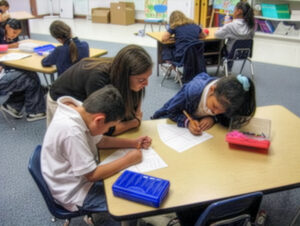
A Ball State student works with young learners in a classroom in El Paso, Texas, during a five-week summer program led by Patricia Clark that gave teacher candidates the opportunity to learn and teach in the community.
Some of Clark’s most meaningful teaching experiences took students much farther from Muncie.
She led field studies to Mexico and Texas, as well as Jamaica, Costa Rica, and Germany. The destinations differed, but Clark’s purpose remained connected to the questions that had shaped much of her career.
She wanted future educators to encounter people, communities, and cultures beyond their own experiences.
“One of the most rewarding things to me as a teacher was always seeing students make new connections and come to new understandings about other cultures and, often, how that impacted their understanding of who they were,” Clark said.
Those experiences left lasting impressions on students.
One of them was Holly Hullinger, the 2026–2027 Teachers College Young Alumni Award recipient. As a Ball State student, Hullinger traveled with Clark to El Paso and Mexico for a summer methods experience. Clark later became Hullinger’s department chair and a mentor as Hullinger began her own career in higher education.
It is one example of how Clark’s influence continued beyond individual courses, as the educators she taught and mentored carried those experiences into their own classrooms and careers.
Preparing the Next Generation
Clark’s influence also extended to hundreds of doctoral students.
She enjoyed the depth of those relationships: discussing readings, introducing students to research methods, and watching them develop questions and conduct research of their own.
Years later, one of the greatest rewards came when Clark attended conferences or state meetings and encountered graduates of Ball State’s doctoral program serving as faculty members and educational leaders across Indiana.
Her own learning continued alongside theirs.
Clark credits Ball State colleagues with teaching her about educator preparation, leadership, and the meaning of community. She saw excellent teachers model their craft and worked with mentors and colleagues who challenged her thinking.
When asked what advice she returned to throughout her career, Clark thought of words her father often shared:
“It is better to light a candle than to curse the darkness.”
The sentiment reflects an approach Clark has carried throughout her career: identify where you can contribute, then do something to help.
A College Built on Collaboration
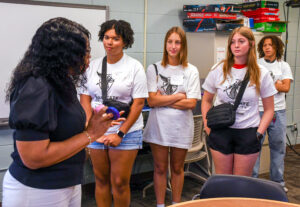
First-year Teachers College students visit the Centennial Library in Muncie’s Whitely neighborhood during a community bus tour designed to introduce them to local resources and the communities their future students may call home. The experience reflects Teachers College’s continued emphasis on connecting teacher preparation with the broader Muncie community.
After nearly three decades in Teachers College, Clark points to several qualities that made the college special to her.
She saw faculty members willing to collaborate to improve programs for students. She worked in an environment that valued excellent teaching and included faculty who demonstrated it themselves. And she found support for trying new approaches.
Those qualities gave Clark room to pursue ideas that did not always fit neatly within the walls of a university classroom.
They also gave her a community.
Her colleagues became friends. Her students became educators and leaders. Partnerships developed into lasting relationships with schools, families, and neighborhoods.
Receiving the Distinguished Service Award has given Clark an opportunity to reflect on those connections and what they have meant throughout her career.
“I am just very honored to receive this award and very appreciative of the wonderful colleagues, now friends, who encouraged me, supported me, and made the work so enjoyable along the way,” she said.
“He Served”
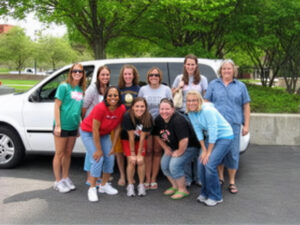
Patricia Clark and a group of Ball State teacher candidates prepare for a five-week experience in El Paso, Texas, where the students practiced teaching in a bilingual school. Among the students pictured is Holly Hullinger, front row at far right, who joins Clark among Teachers College’s 2026–2027 award recipients.
Of all the work Clark accomplished throughout her career, she remains especially proud of Schools Within the Context of Community, both as a faculty member directly involved in the program and later as a department chair who could support its growth.
Its legacy continues in the educators it prepared, the relationships it built, and the idea it helped advance: teachers cannot fully understand their students without making an effort to know and value the communities that shape their lives.
Clark hopes future teacher educators continue building upon that work.
She also hopes her own legacy can be expressed much more simply.
During a five-week summer program in El Paso, Clark and her students met a school principal who made an observation she has remembered ever since.
He said that when he died, he wanted his tombstone to contain just two words:
“He served.”
“I have thought of that often,” Clark said, “and hope that I could be remembered that way also.”
For a career shaped by giving back, listening to communities, supporting students, and bringing people together, it is a fitting aspiration.
And when Clark thinks about what she might tell the young educator she once was, before she knew where all those questions about children, culture, and community would lead, her message is simpler still:
“What fun you are going to have!”
Comments: