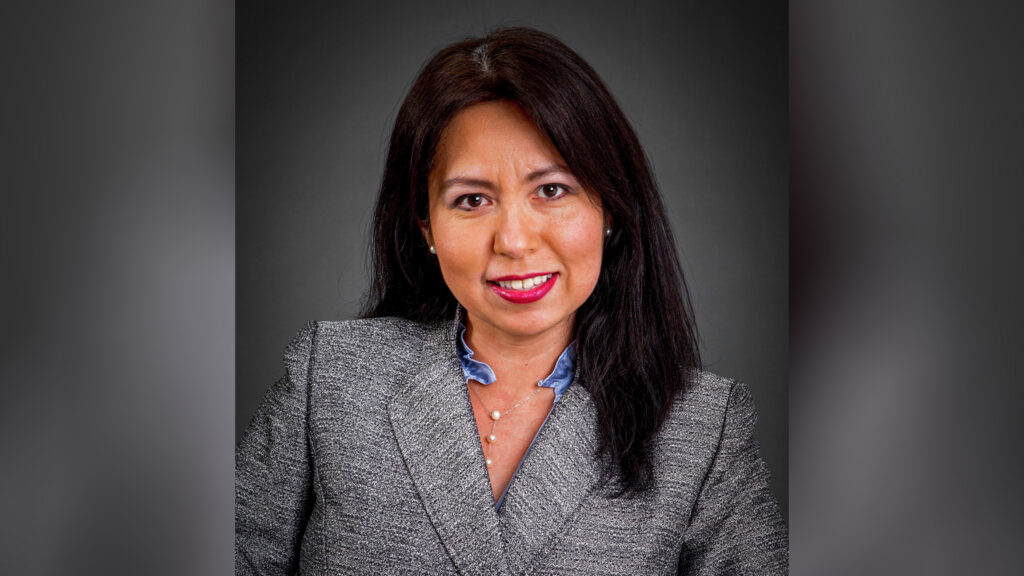
An opportunity that changed her life. Research partnerships spanning continents. And an ambitious new project exploring how artificial intelligence could help multilingual children learn mathematics. For Ligia Gómez Franco, the connections between language, culture, and learning continue to open unexpected doors.
Gómez Franco attends the 2025 International Technology, Education and Development Conference.
When Dr. Ligia Gómez Franco received a Fulbright fellowship to pursue her doctoral studies in the United States, she could not have anticipated just how far that opportunity would take her.
Born and educated in Bolivia, she had developed an appreciation for languages and a fascination with how children learn. The fellowship brought her to Boston College, where she pursued a doctorate in Applied Developmental and Educational Psychology. It also set in motion a series of connections that would shape her career, from international research partnerships to her current work exploring the possibilities of artificial intelligence in early childhood education.
“I think the most influential experience I had was being awarded the Fulbright fellowship,” she reflected. “It literally changed my life.”
Today, Gómez Franco is an assistant professor in the Ball State Teachers College Department of Educational Psychology, where her research bridges language development, culture, and emerging educational technologies.
Her latest endeavor, supported by a grant from the U.S. National Science Foundation (NSF), could help change how multilingual children experience one of their earliest academic challenges: learning mathematics.
What If Math Could Speak Your Language?
Members of the NSF grant team meet with the Community Advisory Board at the University of the District of Columbia.
For young children, learning math involves much more than recognizing numbers or solving equations. It also requires understanding language, interpreting instructions, and communicating ideas.
For children growing up speaking both Spanish and English, those skills develop across two languages, each carrying its own cultural experiences and ways of expressing ideas.
Gómez Franco wants to explore how technology can support that learning rather than create additional barriers.
Her NSF-funded project, CALM: Community-Aligned Learning in Math: Building a Multilingual Informed Conversational Companion, investigates how generative artificial intelligence (GenAI) could support mathematical learning among multilingual children in kindergarten through second grade.
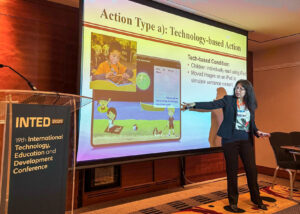
Gómez Franco presents research at the 2025 International Technology, Education and Development Conference in Valencia, Spain.
The project brings together Gómez Franco and two researchers from the University of the District of Columbia and Emory University. The three met during CIRCLS, an NSF-sponsored activity, in 2022 and spent several years developing their research idea.
Securing an NSF grant had been a longstanding professional goal for Gómez Franco, making the team’s selection for the NSF Finders Foundry program especially meaningful.
The project also represents a natural extension of her earlier research.
“My area of research is primarily in language development in monolingual and bilingual children,” she explained. “This interest comes from my appreciation for languages and the important role reading plays in building cognitive skills.”
When the team began discussing mathematics, she immediately recognized the connections to her own work. Mathematical reasoning depends on specialized vocabulary and language skills, creating an opportunity to investigate how a multilingual conversational companion might help children understand and discuss mathematical concepts.
But the researchers aren’t interested in creating technology that simply translates mathematical instructions from one language to another.
They want to understand how culture, family experiences, and language can inform the technology’s design from the very beginning.
Designing With Families, Not Just for Them
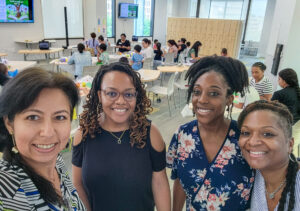
Members of the NSF grant research team gather for a selfie during a parent-child co-design workshop at the University of the District of Columbia.
Imagine being invited to help shape an educational tool your child might someday use in the classroom.
That is the kind of participation at the center of CALM.
Recognizing the importance of Spanish- and English-speaking learners, a rapidly growing population within U.S. schools, the research team established a Community Advisory Board (CAB) of teachers, administrators, and parents.
Rather than designing technology in isolation, the researchers are working directly with the people who understand these children’s learning experiences.
The team has already held regular meetings with advisory board members and conducted a parent-child co-design workshop in the Washington, D.C., area.
During the workshop, families contributed perspectives that can help researchers understand what culturally meaningful, multilingual mathematics technology should look like.
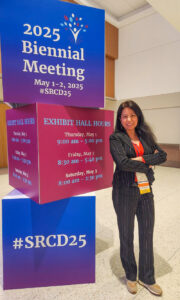
Gómez Franco attends the Society for Research in Child Development 2025 Biennial Meeting, connecting with the broader child development research community.
The researchers are now analyzing the information gathered and seeking feedback from advisory board members to improve future sessions.
Their work is expected to produce three key outcomes: a community of educators and families interested in using GenAI to support multilingual mathematics learning, a framework for incorporating cultural values into educational technology, and design specifications for a conversational companion that supports young learners.
The current grant supports this early collaborative design process. The team is now preparing a follow-up NSF proposal that would allow them to move toward developing the technology itself.
Only teams that received the initial Finders Foundry grant are eligible to apply for this next funding opportunity, and Gómez Franco is hopeful about the project’s future.
For her, the possibilities are exciting not simply because the technology is new, but because of what it might make possible for children whose languages and cultural experiences have not always been fully reflected in educational tools.
A Research Career Without Borders
Long before her work with artificial intelligence, Gómez Franco was discovering how much could be learned by collaborating across cultures and countries.
While pursuing her doctorate at Boston College, she enrolled in a course at Harvard University taught by Dr. Catherine Snow, who was leading a research project in Chile.
That classroom connection became a defining professional opportunity.
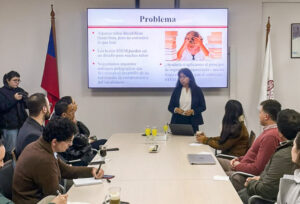
Gómez Franco shares her research with faculty at Universidad Católica de la Santísima Concepción in Chile.
Snow invited Gómez Franco to join the research team and use data from the Chilean project for her dissertation, establishing a relationship with researchers in the country that would continue long after graduate school.
Years later, while teaching at Arizona State University, Gómez Franco met additional researchers from Chile. Those connections developed into ongoing collaborations exploring language, learning, and child development.
More recently, she has returned to Chile to share her research on embodied learning with faculty and students at institutions including Universidad de Chile, Universidad Católica de la Santísima Concepción, and Universidad Viña del Mar.
The exchanges have encouraged her to look beyond familiar educational contexts and consider how children’s development and learning experiences differ across countries.
They have also reinforced something her own journey demonstrated: meaningful research often begins with a conversation, a new perspective, or an unexpected connection.
And those connections continue to influence the questions she asks.
When Learning Becomes a Full-Body Experience
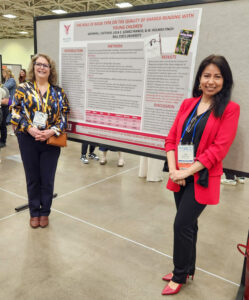
Gómez Franco and Kathryn Fletcher share research on book types and shared reading with young children at the Society for Research in Child Development 2025 Biennial Meeting. Their study was co-authored with W. Holmes Finch, professor emeritus in the Department of Educational Psychology.
What happens when children do more than read or listen to understand a new concept?
That question has driven another important area of Gómez Franco’s research: embodied cognition.
The approach explores how physical experiences and actions contribute to thinking, understanding, and learning.
In one project, she investigated how embodied cognition principles could support children’s vocabulary development and reading comprehension when learning concepts related to science, technology, engineering, and mathematics (STEM).
The findings suggested that connecting physical experiences with academic concepts holds promise for improving reading comprehension, both with and without technology.
It is an approach that expands the possibilities for how educators might introduce challenging ideas, particularly to children still developing foundational language and literacy skills.
Now, Gómez Franco is interested in extending this research into preschool settings to better understand how younger children might benefit.
Although embodied learning and artificial intelligence may appear to occupy opposite ends of the educational spectrum, they reflect a common thread in her work.
Both ask how learning experiences can become more meaningful when they connect with the ways children naturally communicate, interact, and make sense of the world.
Bringing Research Into Tomorrow’s Classrooms
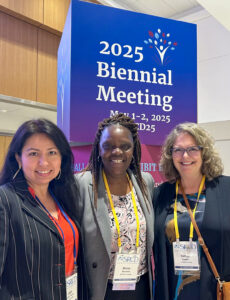
Department of Educational Psychology faculty members Ligia Gómez Franco, assistant professor; Winnie Mucherah, professor; and Kathryn Fletcher, professor, attend the Society for Research in Child Development 2025 Biennial Meeting.
When Gómez Franco joined Ball State’s Department of Educational Psychology in 2020, she found a professional community that valued the kind of collaboration that had shaped her career.
“What I have enjoyed the most since I arrived is getting to know the people in my department,” she shared.
Several colleagues have become friends, and she appreciates the willingness of faculty and staff across the University to exchange ideas and support one another.
“In general, I have been impressed with so many people across Ball State, in part because they are open to ideas, ready to help, and genuinely interested in seeing you succeed.”
That collaborative spirit carries into her teaching.
Many of Gómez Franco’s undergraduate students are preparing to become educators, which means the ideas they encounter in her classes may soon influence their own teaching practices.
She sees that responsibility as an opportunity to connect academic research with the everyday decisions teachers make.
“I think it is important for them to learn about the intersection of practice and research,” she explained.
Her hope is that students leave her classroom with more than an understanding of educational theories. She wants them to recognize how research can help them respond to challenges, make informed instructional decisions, and support the children they will teach.
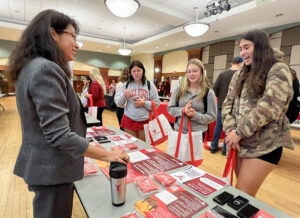
Gómez Franco introduces first-year teaching majors to programs and opportunities in the Department of Educational Psychology during the 2024 Teaching Majors Get Flying Activities Fair & Orientation.
She also encourages students to become active participants in research themselves.
Opportunities such as Ball State’s Teacher-Scholar Program, Pepsi grants, and faculty-led projects can help students develop valuable skills while discovering new interests.
For future educators, research experience can provide a foundation for asking better questions about their classrooms and finding evidence-informed ways to address them.
And drawing from her own experiences, Gómez Franco offers another piece of advice:
“If you can learn a second language, do it, it will open more doors than you can imagine.”
It is a lesson she has seen play out throughout her career, from Bolivia and Boston to Chile, Arizona, Indiana, and beyond.
The Next Opportunity Is Already Taking Shape

Gómez Franco enjoys a family visit to St. Peter’s Square in Vatican City with her husband and two children.
Even with research collaborations spanning countries and an NSF project underway, Gómez Franco continues to look for opportunities to expand her work.
She hopes to strengthen partnerships with researchers across the United States and overseas while continuing to collaborate with colleagues in the Muncie community.
Outside her professional life, she enjoys traveling with her family and finding opportunities to dance salsa, an activity she says energizes her and helps relieve stress.
And while she values the opportunities her career has already provided, she is especially enthusiastic about what comes next.
“In the near future, I am definitely looking forward to getting that second NSF grant,” she shared. “I will keep you posted.”
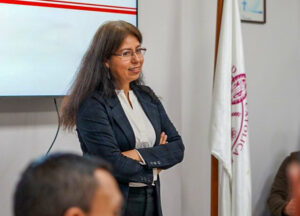
Gómez Franco during a gathering with faculty following her research presentation at Universidad Católica de la Santísima Concepción in Chile.
It is a fitting ambition for someone whose career has been shaped by the opportunities that emerge when people, languages, and ideas come together.
Years after a Fulbright fellowship first opened the door to an international research career, Gómez Franco is working to open new doors for others, this time by exploring how culturally informed technology might help young children find their own paths to learning.
Comments: