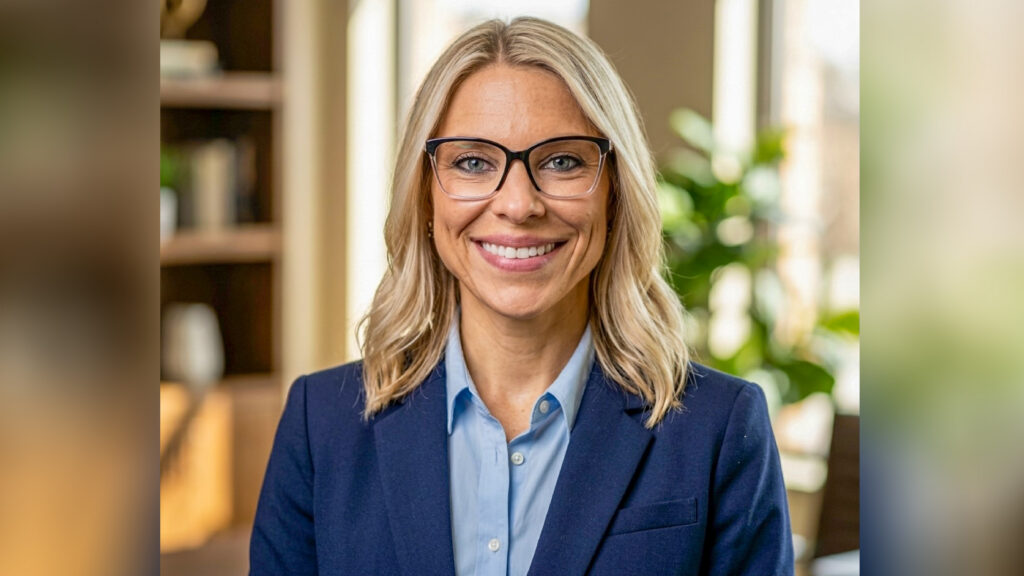
The 2026–2027 Teachers College Young Alumni Award recipient is bringing Ball State’s hands-on approach to teacher preparation to Purdue University Fort Wayne, where she helps future educators build confidence, strengthen literacy instruction, and discover the difference they can make in local schools.
As Ball State University celebrates Homecoming, Teachers College is recognizing three outstanding individuals through its 2026–2027 Alumni Awards. Throughout the week, we’ll introduce each honoree and explore the experiences, contributions, and commitments that have made a lasting impact on education and the Teachers College community. First is Holly Hullinger, recipient of the Teachers College Young Alumni Award.
A Ball State Foundation That Keeps Giving
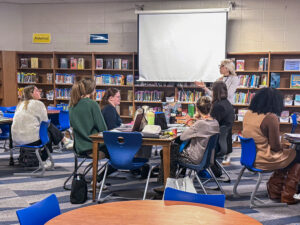
Teaching a class.
As a child, Holly Hullinger struggled with reading comprehension. For a time, she mistakenly believed those challenges meant she wasn’t smart. Later, she learned that different strategies could help her understand and succeed.
That experience helped shape the educator she would become. Today, Hullinger helps future teachers recognize that students learn in different ways and deserve the support they need to thrive. Her path to teaching began at Ball State.
Hullinger’s father encouraged her to attend the university, telling her, “If you are going to be a teacher, then you have to go to Ball State for their program of study.”
She followed his advice and built a foundation that would shape her career. Hullinger earned a bachelor’s degree in elementary education with a concentration in kindergarten and primary education. She later completed a master’s degree in school psychology, a master’s degree in educational administration and supervision, and a PhD in elementary education with a specialization in reading.
Hullinger also spent seven years as full-time contract faculty in Ball State Teachers College, from 2014 to 2021. That experience strengthened her understanding of teacher preparation and the role universities can play in supporting local schools.
Today, she carries those lessons into her work as a clinical associate professor at Purdue University Fort Wayne (PFW). There, she prepares future educators to connect what they learn in their courses with the realities of elementary classrooms.
Bringing Teacher Preparation Into the Classroom
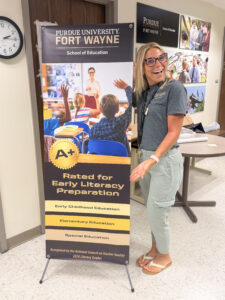
Enthusiastic about the Purdue Fort Wayne School of Education.
For Hullinger, future teachers learn best when they can apply new knowledge in real school settings. She works to make those experiences a meaningful part of teacher preparation, rather than something candidates encounter only near graduation.
At PFW, her work began with a literacy methods course at Study Elementary in Fort Wayne. The experience allows teacher candidates to learn concepts and then put them into practice with school-aged children.
The approach has since expanded across methods courses and grade levels. Hullinger wants candidates to experience authentic classrooms throughout their preparation, building their skills and confidence over time.
She also brings experiential learning into Exploring Education, an introductory course for students considering a career in teaching. Candidates visit different school settings and gain early exposure to the range of environments where educators work.
For Hullinger, these experiences are about more than observing a classroom. Future teachers must learn to build relationships, assess student needs, adjust instruction, and reflect on what works. Those skills develop through practice, feedback, and meaningful connections with learners.
Building Confidence in Future Educators
Hullinger wants future teachers to enter the profession ready to support a wide range of learners. Her own experience with reading informs how she encourages candidates to think about student strengths, challenges, and potential.
She asks them to look beyond a single assignment or assessment when deciding whether a student understands a concept. Instead, she encourages them to consider what a learner needs and how instruction can respond.

Still from a video sharing the Study Elementary experiential learning experience.
That mindset also shapes her approach to literacy. Hullinger emphasizes explicit, systematic instruction and research-aligned practices. She encourages future teachers to understand why a strategy works, rather than relying on worksheets or activities simply because they are familiar.
Her goal is to help candidates become thoughtful educators who can make informed decisions. She wants them to leave their preparation with both practical skills and the confidence to keep learning throughout their careers.
Learning From the Communities They Serve
Hullinger’s commitment to hands-on teacher preparation also reflects what she learned through immersive learning at Ball State. An experience in Muncie’s Whitely community helped her see how universities can work alongside local schools and neighborhoods.
That work showed her the importance of learning with a community, not simply learning about it. Strong partnerships require listening, building trust, and understanding the needs of the people involved.
She has carried that perspective into her work in Fort Wayne. Her goal is to create experiences that benefit both teacher candidates and the students they serve. Candidates gain practical experience while local schools receive additional support for their learners.
Building Partnerships With Local Schools
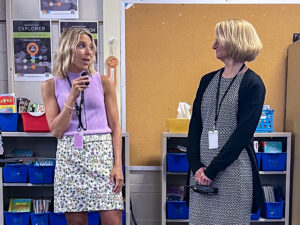
With Study Elementary Principal Elizabeth Kleber.
Hullinger works closely with Fort Wayne Community Schools to connect teacher preparation with classroom needs. The partnerships involve district leadership, school administrators, teachers, university faculty, and preservice educators.
These relationships depend on trust and flexibility. Schools must be able to identify their needs, while teacher candidates need opportunities to practice and grow. Hullinger works to ensure the experiences offer meaningful benefits to everyone involved.
The partnerships also help future teachers understand the communities where they may one day work. Candidates can build relationships with students, learn from experienced educators, and see how instructional decisions affect learning.
For Hullinger, that real-world context is essential. It helps candidates move beyond theory and understand the responsibility and possibilities that come with teaching.
Putting Partnership Into Practice
One example of this collaboration involved preservice teachers providing one-on-one literacy interventions for third-grade students preparing for IREAD-3, Indiana’s statewide reading assessment.
Teacher candidates used progress-monitoring data to guide their instruction and respond to individual student needs. They also helped make the experience encouraging for young learners. During testing, the school offered a daily “breakfast boost,” and students received motivational bracelets.
The work combined research-informed instruction with personal encouragement. It also gave preservice teachers a chance to see how targeted support can help students build confidence and strengthen their skills.
The majority of the students passed the assessment. Hullinger was pleased to see the partnership contribute to the school’s efforts.
“It was a joy to be a small part of the school’s success,” she said.
For Hullinger, the experience illustrates what can happen when teacher preparation is connected to the needs of local schools. Candidates gain valuable practice, and students receive support that can make a difference in their learning.
Strengthening Literacy Through Research and Practice
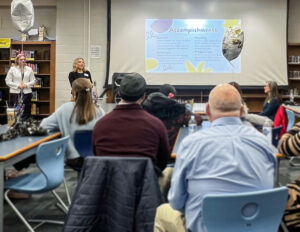
Presenting at Snider, Fort Wayne.
Literacy remains a central focus of Hullinger’s work. She helps future teachers understand the Science of Reading and apply evidence-based approaches to instruction.
Her teaching emphasizes explicit, systematic instruction and structured literacy practices aligned with current research. Hullinger also encourages candidates to consider how their instructional choices affect students’ understanding and confidence.
Hullinger’s own experiences help her communicate why this work matters. A child who struggles with reading may begin to doubt their abilities. Effective instruction and the right support can help that learner see new possibilities.
Her work extends beyond her own courses. Hullinger has contributed to her institution’s comprehensive Science of Reading review and statewide literacy initiatives. Through these efforts, she has collaborated with colleagues across the Purdue system to strengthen literacy instruction.
In 2024, she received the Seed for Success Acorn Award for her contributions to literacy work in collaboration with Purdue colleagues across campuses.
Hullinger sees this work as a collective effort. Strengthening literacy instruction takes time, collaboration, and a commitment to aligning coursework with research-based practices. She is particularly encouraged by her students’ performance on literacy licensure exams and the work they do in the field.
“If I can use my knowledge, skill sets, and training to better serve Indiana’s students, put me in coach, I am ready to play!” she said.
A Growing Vision for Future Teachers

A still taken from a 2023 video sharing information about the literacy experiential at Study Elementary.
Hullinger continues to look for ways to make experiential learning a meaningful part of teacher preparation. She wants candidates to connect coursework with classroom practice at every stage of their education.
That includes early opportunities to explore the profession, methods courses that put instructional strategies into practice, and experiences that help candidates build relationships with students and school communities.
She also wants future teachers to understand that learning does not end when they earn a degree. Effective educators keep asking questions, reflecting on their work, and adjusting their approach to meet students’ needs.
Hullinger hopes the experiences she creates will help candidates enter the profession with confidence and a strong sense of purpose. She wants them to understand the difference they can make, both for individual learners and for the communities they serve.
Making Ball State Proud
Hullinger credits much of her professional growth to the people and experiences that shaped her time at Ball State. Several faculty members helped her develop the knowledge, perspective, and confidence she now brings to her work with future teachers.
Dr. Linda Martin played an important role in Hullinger’s development as a literacy educator. Martin served as her doctoral chair and helped shape her understanding of literacy and curriculum. A curriculum redesign project connected to EDRG 400 continues to inform Hullinger’s work.
Dr. Susan Tancock, her graduate advisor and doctoral mentor, helped introduce her to teaching in higher education. That encouragement opened a path Hullinger continues to follow today.
Dr. Lynn Staley also left a lasting impression. When Hullinger faced a difficult life event, Staley offered her an opportunity to make up an exam. She also encouraged Hullinger to extend that same grace to her own students. The experience helped shape her understanding of empathy and flexibility in teaching.
Dr. Patricia Clark made a lasting impression through both teaching and mentorship. During Homecoming Week, Clark will also be recognized as the recipient of the 2026–2027 Teachers College Distinguished Service Award.
Hullinger traveled with Clark to El Paso and Mexico for a summer methods experience. Later, she worked with her during Clark’s time as chair of the Department of Elementary Education. Through these experiences, Hullinger gained valuable insights into effective leadership and received encouragement as she began her career in higher education.
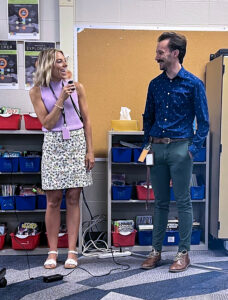
Presenting with Study Elementary Teacher Building Coach Jared Flotow.
Together, these mentors helped Hullinger see how educators can influence students well beyond a single course or classroom. Their guidance continues to inform how she teaches, supports future educators, and approaches leadership.
For Hullinger, the Teachers College Young Alumni Award is both an honor and a reflection of the education that helped shape her path.
“I am humbled and honored to be the 2026 Ball State Teachers College Young Alumni Award Recipient. This is a full circle recognition for me, as Ball State has been a great reason I have been able to find success in my current role at Purdue University Fort Wayne.”
She remains proud to be a Cardinal while embracing her work with the Mastodon community at Purdue Fort Wayne.
Advice for the Next Generation
Hullinger encourages future educators to keep dreaming, support those who may be overlooked, and never give up when learning gets difficult.
Her own experience taught her that a challenge does not define a student’s potential. She hopes the teachers she prepares will carry that lesson into their classrooms and advocate for learners who need someone in their corner.
She also wants future teachers to recognize the value of their profession. Teaching gives educators the opportunity to influence how children see themselves and what they believe they can achieve.
Hullinger’s course mantra for Fall 2026 captures the encouragement she hopes to share with her students: “GO BE AMAZING!”
For Hullinger, the Teachers College Young Alumni Award recognizes a journey shaped by learning, mentorship, and service. As she continues preparing future teachers to enter classrooms with confidence, curiosity, and compassion, she carries forward the lessons that first brought her to Ball State.
Every learner deserves the opportunity to succeed, and the right support can help make that possible.
Comments: