
The Office of Institutional Research and Decision Support’s (IRDS) institutional data efforts go beyond simply providing and using clean and reliable data. IRDS is also focused on helping to increase data literacy across campus.
Indeed, one of the long-term goals charged by the University’s MIDAS Committee is the following:
Data Literacy Training and Internal Consulting: End-user training and consultancy that educates the campus community about how to access and where to go for the data and management information they need to monitor progress and inform both strategic and operational decision-making.
With that, our journey in IRDS to bring the MIDAS Committee’s goals to fruition continues with our launch of Data Literacy 101 on November 10th.
To help understand the importance of this foundational data literacy course, let us first set the stage for where literacy efforts have taken us, and where they will continue to lead.
Our Data Literacy Goals: A Retrospective
Readers may remember a previous post detailing the launch of the Data Literacy Institute cohorts—groups of individuals across campus interested in taking their data knowledge to the next level. These cohorts engaged in a semester-long training program through the Association for Institutional Research (AIR). During the program, participants learned the foundations of asking good questions and best practices in evaluating and using data. Participants also worked in small groups throughout the semester to develop a research question the group felt was important to investigate.
For a small percentage of our data enthusiasts across campus, the Data Literacy Institute offered a hands-on, intensive opportunity during the Fall 2024 and Spring 2025 semesters to become more data literate.
Now, two years later, we aim to operationalize data literacy more broadly across the University.
The Data Literacy Series: An Overview
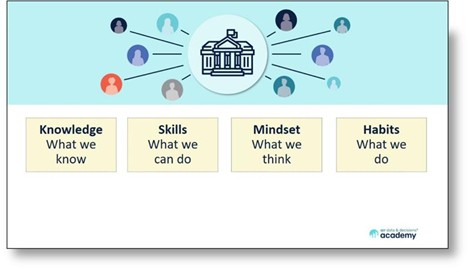
Our data literacy strategic plan is built upon our Data Literacy Series, a three-part series currently in development. In line with the objectives of the licensed training materials we received from AIR’s Data Literacy Institute, our in-house Data Literacy Series aims to empower data users and consumers on campus to master four domains: knowledge, mindset & habits, and skills (as shown below).
To accomplish this, the three-part series is tailored in a way to allow participants to:
- Understand how to effectively handle, utilize, and communicate about institutional data
- Use data effectively to support student success efforts and the institutional mission
- Build an interdisciplinary network of data-literate colleagues across campus
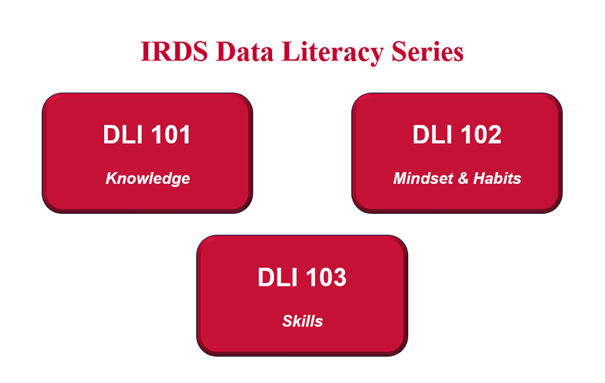
The first training in the series, Data Literacy 101, described in more detail below, will focus on building foundational knowledge about data. The second installment, Data Literacy 102, will help learners develop the right mindset and habits for consuming and using data. Finally, Data Literacy 103 will offer the opportunity to develop and refine the skills needed to use institutional data effectively.
Data Literacy 101
The first installment, “Data Literacy 101,” launches next week, Tuesday, November 10th, as part of BSU’s Fall Online Training Week.
Facilitated by our very own Caleb Grubb, this hour-long session shares with participants a high-level overview of how data operates at BSU. Participants will gain an understanding of:
- the theoretical framework for assessment and decision-making
- the journey student data takes from collection to analysis
- the data used in supporting strategic decisions across the University
Two representatives from the IRDS office, Cole Heady and Joseph Finke will also be on hand to provide practical examples of how we use data at the University.
This inaugural DLI 101 presentation is the first of many, laying the foundation to expand our reach in extending data knowledge at Ball State.
Leveling Up Literacy
In addition to our macro-literacy efforts through the Data Literacy Series, IRDS’s long-term pipeline also includes developing “micro-literacy” opportunities for campus stakeholders to strengthen their skills using available tools and resources, such as the Tableau environment.
The development pipeline includes video tutorials, “playbooks” for various user types, and step-by-step guides to optimize Tableau dashboard usage.
The primary objective for these resources is to allow users to have “on-demand” access to answers to common questions when using dashboards. These tools will help answer:
- What is this dashboard used for?
- Which dashboards will help me most in my role?
- What is the data in this dashboard showing me?
- How do I navigate the dashboard?
Although IRDS is working to make answers to questions quicker and more accessible, we remain dedicated to consultation and tailored training for groups or individuals, where appropriate.
Maximizing data-informed decision-making and working towards collective data literacy across campus is a group effort—and we are here to help make it happen!
If you would like to provide feedback on any data literacy need(s) that you or your team might have, you may reach out to irds@bsu.edu.
To register for “Data Literacy 101,” please visit the BSU Learning and Development calendar.
Discover more from Data Insider
Subscribe to get the latest posts sent to your email.