
By Eleni Bow, Blog & Communications Intern
When you walk into the Europe gallery (also known as the “Pink Room”) on the second floor west of the mezzanine, you are likely first drawn to big works like The Martyrdom of Saint Lawrence by Massimo Stanzione, which stands at over 6 ½ feet tall. However, when – if at all – do you take notice of the work in that same gallery that is just the size of a crayon?
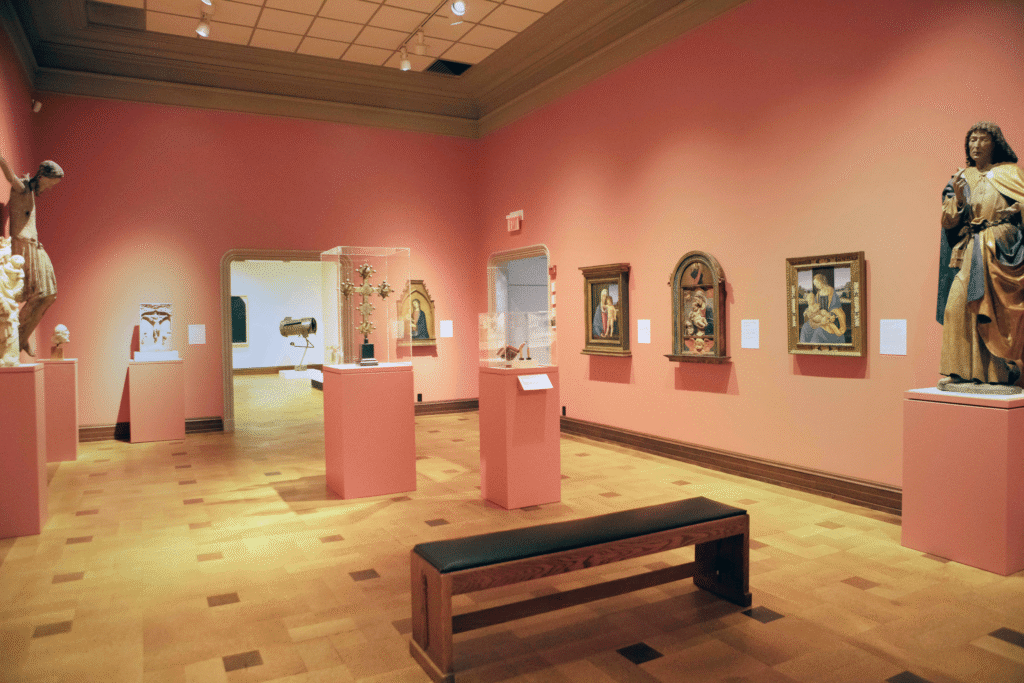
A wide-angle shot of the “Pink Room” gallery. Where do your eyes go first? (Photo by Sunday Balogun)
Dr. Ellen Langer is a professor of psychology at Harvard who studies the science of noticing. According to Langer, the practice of “active noticing” has been scientifically shown to reduce stress levels. Noticing something new naturally makes your mind present. This purposeful mindfulness can then reduce stress.
Art museums like DOMA are great places to practice active noticing. However, the idea of active noticing is to do so with greater emphasis on the quality of your attention rather than on how long you observe.
The “art” of active noticing pairs with the concept of “slow looking”. According to Claire Brown, the designer of the Thinking Museum® Approach, it can be approached introspectively or extrospectively. Taking the time to look at a single work by asking yourself questions such as “What is my reaction to this work?” and “How does historical context affect the meaning of this work?” can improve your observational skills.
The work, aforementioned to be the size of a crayon, is Knife and Fork Handles in the Form of Saints Nicholas of Myra and Margaret of Antioch by an unknown artist. Part of DOMA’s collection since 2017, this work is a great example of applying active noticing and slow looking. Let’s try it!
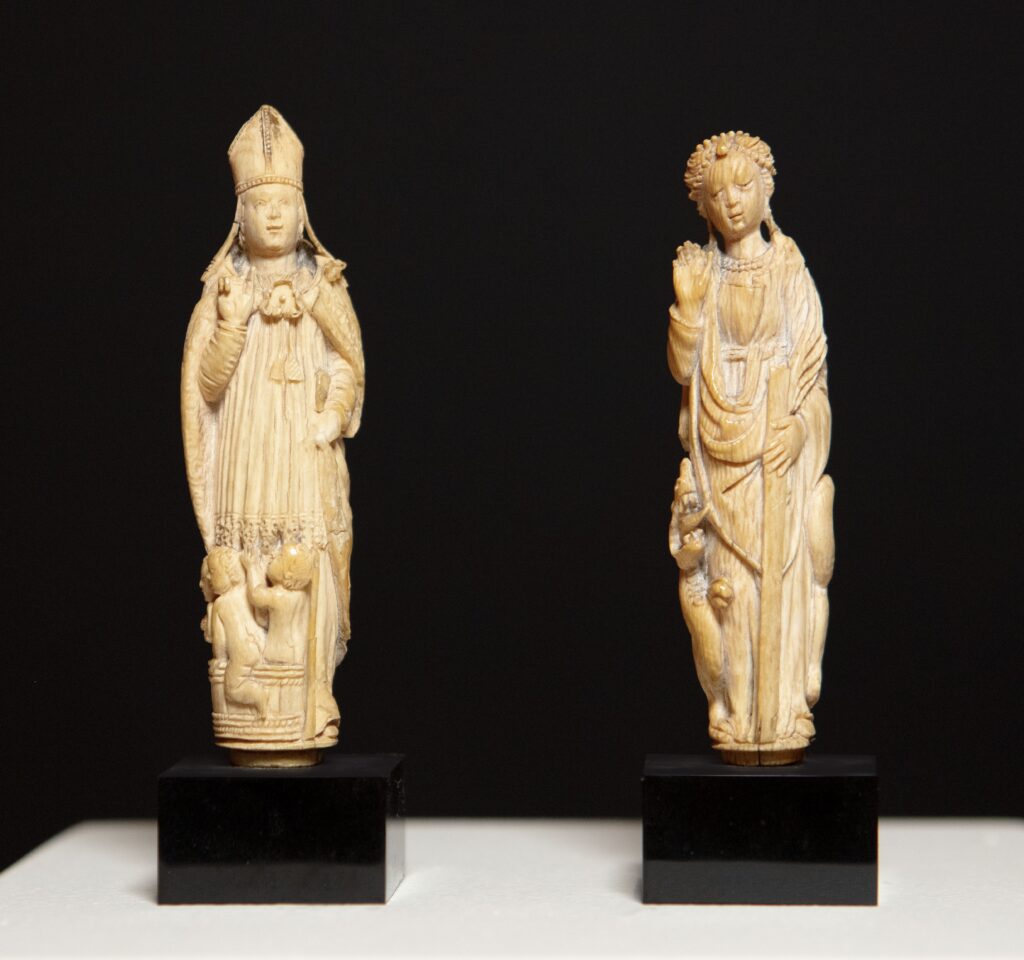
Knife and Fork Handles in the Form of Saints Nicholas of Myra and Margaret of Antioch, about 1500-1525, artist unknown, ivory, 3 1/2 x 1/2 x 1/2 in. (8.89 x 1.27 x 1.27 cm), Gift of David T. Owsley, 2017.089.000a-b.
Take a few minutes to just observe the work. How does it make you feel? Do you recognize any parts of it? Explore your thoughts on how your feelings, experiences, and thoughts are influenced by this work.
Personally, my initial feeling about the work is surprise. I want to know how the artist managed to achieve such intricate detail on a small surface. The longer I observe the work, the more things I notice. I see both figures have their right hands raised, which signals an attitude of blessing.
After observing the work introspectively, shift your attention to extrospective observation. The title of the work tells us that the people depicted are Saint Nicholas of Myra [left] and Saint Margaret of Antioch [right]. Who were these people? Why are they significant? This is the time to explore thoughts on the work’s artist, medium, historical context, and other layers of meaning.
Although the work’s artist is unknown, research has told us that the two pieces are made exclusively out of ivory, likely about 1500-1525 AD. A lot of information about the figures is available through print and digital resources.
Saint Nicholas of Myra is known as the patron saint of children. His figure includes three children standing in a barrel. It is said that he resurrected three children after they were butchered and dumped into a barrel during a famine. The hat he wears is an Eastern Orthodox mitre, which is a symbol of holding an office.
Saint Margaret of Antioch is known as the patron saint of expectant mothers, particularly those experiencing difficult labor. Her figure includes a dragon, representing one of her trials. It is said that Satan disguised himself as a dragon and swallowed Maria. However, his stomach rejected her, and she was let out unharmed.
Now that we’ve observed the work contextually, it makes sense that these two saints were chosen to be carved together, as they both relate to childhood. Another angle to observe the work is through its medium.
Before being placed under environmental and ethical restrictions as it is today, ivory was once a very popular art medium. Its pearly, lustrous surface made the exotic material perfect for creating luxurious objects. Although we cannot pinpoint the exact animal from which this work’s ivory came, possibilities include elephants, walruses, hippopotamuses, etcetera.

Eleni stands next to Saints Nicholas and Margaret to give a sense of scale. (Photo by Sunday Balogun)
As you can see, so much thought can be devoted to a single work. Taking the time to notice and observe Knife and Fork Handles in the Form of Saints Nicholas of Myra and Margaret of Antioch has allowed us to stretch our active thinking muscles.
You’ve now been immersed in the arts of “active noticing” and “slow looking”, why don’t you try it yourself with any one of the thousand works on display at DOMA?
Comments: