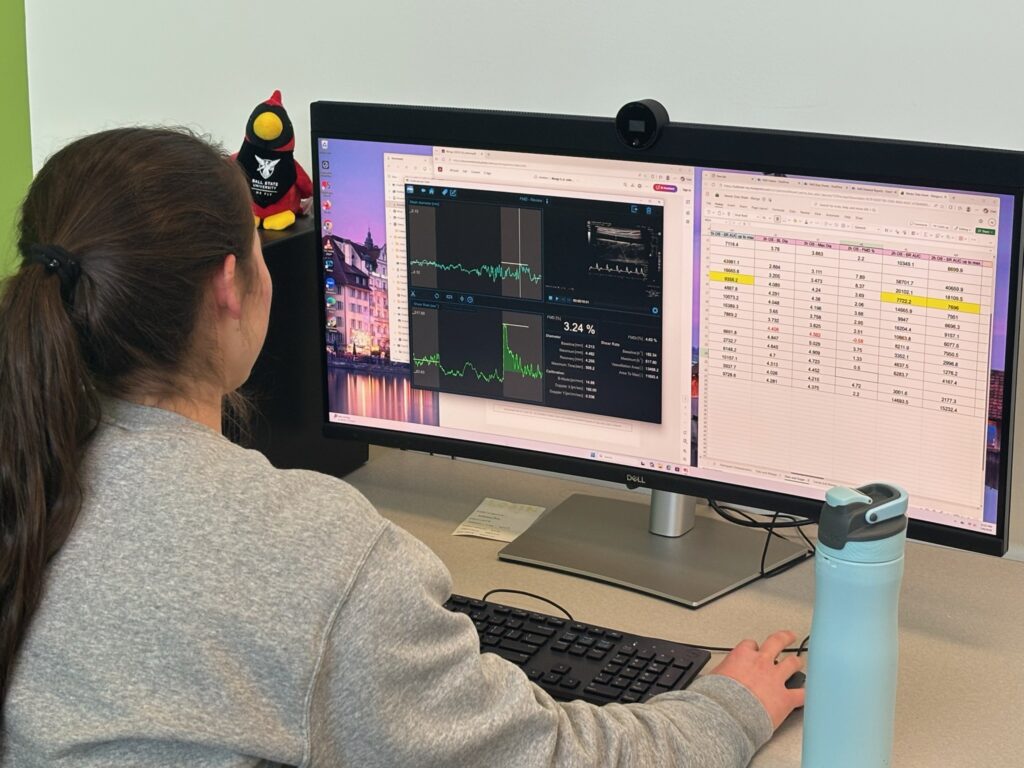
Designed to bridge academic theory and real-world application, the NHS Student Technology and Research Suite serves as a high-impact workspace within the department office suite. The primary motivating factor for establishing this area is to foster cross-disciplinary innovation and give students hands-on experience solving complex computing problems before graduation with faculty mentors nearby to support and accelerate learning.
The Student Technology and Research Suite is in a pilot phase, but when completed will house hardware and software to support 1) data visualization, 2) measurement of vascular health from ultrasound videos 3) thematic analysis of qualitative data 4) measurement and analysis of food intake data, and 5) statistical analysis, including analysis of epidemiological studies and high-performance computing, with dedicated terminals for each modality. Workstations include access to industry-standard licensed software specific to department needs. These new tools will support the work of student faculty teams throughout the NHS department. The idea emerged from an in-house call to faculty for technology needs to support their work with students. Faculty responded in a synchronous online discussion and collectively reported technology needed to effectively and efficiently train students in department research areas, including maternal child health, obesity, chronic diseases. Interest in developing the STARS lab coalesced when the list was compiled; there were 5 common themes which could be supported by designated workstations and housed adjacent to faculty offices to promote convenient and structured faculty-student mentoring.
To maximize its impact while maintaining an optimized collaborative environment, the STARS lab actively serves approximately 10 students this summer, including undergraduate researchers, and capstone project teams in concert with their faculty mentors, with capacity to serve 15 faculty-student teams, depending on the project, per semester. In the fall, STARS will additionally support department Teacher-Scholar teams. Assistant Professor Bryant Keirns notes, “The STARS lab has allowed us to increase the number of undergraduate students engaging in the research process substantially. Rather than competing for one workstation, multiple students have the opportunity to conduct diet analyses, study vascular health, and run statistics simultaneously.”
The Department of Nutrition and Health Science receives external support through grant awards from American Heart Association, National Institutes of Health, Commodity boards, and various Indiana state agencies and local nonprofit organizations; however, these awards are only possible by demonstrating solid infrastructure and facilities in the department, college and university to support them. (This article was drafted using Gemini.)
If you wish to make a gift to support the STARS lab, new faculty start-up resources, or other projects in the Department of Nutrition and Health Science, please consider a donation to the Ball State University Foundation, Nutrition and Health Science General Fund #069010F. If you have questions about any of the Department projects reach out to Alyce Fly, Professor and Chair, adfly@bsu.edu.