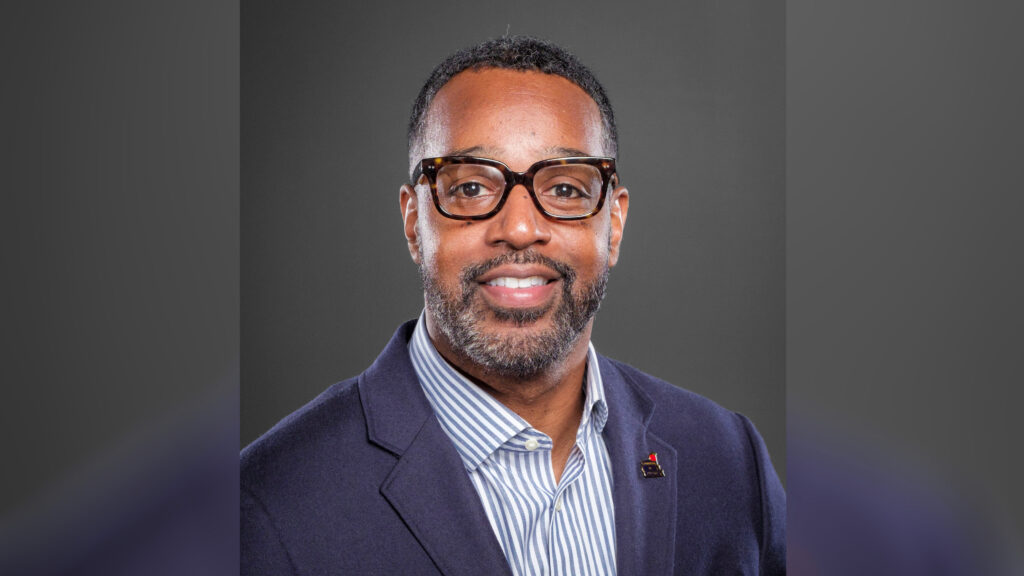
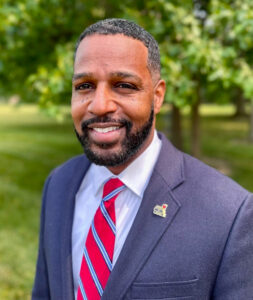
Four Ball State degrees, nearly two decades in education, and a belief in the power of relationships have shaped Jeremy Coleman’s journey. Now, as Superintendent of University Schools, he’s bringing those lessons to a new chapter of educational leadership.
During his first semester at Ball State University, Jeremy Coleman found himself on academic probation.
He was a young undergraduate still figuring out what he wanted to do with his life, and his college experience wasn’t unfolding quite as he had imagined.
More than two decades later, that same student holds four Ball State degrees, including a doctorate, teaches future educational leaders in Teachers College, and has taken on a new role as Superintendent of University Schools.
It’s a journey his younger self never would have predicted.
“During my undergraduate experience I was still trying to navigate life as a student and I had no idea what I wanted to make a career of,” Coleman recalled. “The idea that I was thinking about coming back to Ball State as a faculty member would be a stretch.”
But what began as an uncertain path became a career built around helping others recognize their potential, particularly when they struggle to see it themselves.
“Before becoming a Cardinal, I had limiting beliefs about what I was capable of and what I could accomplish,” he reflected. “I’ve learned to trust myself and believe in what I am capable of.”
Today, Coleman brings that perspective to his newest position, where his influence extends across Burris Laboratory School and the Indiana Academy for Science, Mathematics, and Humanities.
His goal isn’t simply to lead two distinctive educational institutions. It’s to help create environments where students, teachers, and school leaders have the relationships, confidence, and support they need to succeed.
The Student Who Became the Superintendent

Coleman’s connection to Ball State began long before he imagined a career in education.
He earned his Bachelor of Science in Public Relations in 2003, developing communication skills that would become essential to his approach to leadership.
He still vividly remembers learning how to communicate clearly and concisely, a foundation that continues to influence how he works with students, families, teachers, and colleagues.
His career eventually led him into education, and he returned to Ball State to pursue graduate studies in Educational Administration and Supervision.
He earned his Master of Arts in 2013, Education Specialist degree in 2019, and Doctor of Education in 2021, all through Teachers College’s Department of Educational Leadership.
But collecting degrees was never the whole story.
Looking back on his evolving relationship with the university, Coleman found an interesting way to describe the experience.
“They say no person steps in the same river twice and I think that was true for me,” Coleman said. “Even though it was the same school, from undergrad to grad to now as a faculty member and superintendent, each time I experienced Ball State, it was a different point in my life, a different perspective.”
Throughout those experiences, he found one important constant: Ball State’s commitment to providing a top-tier student experience.
Lessons That Lasted Beyond Graduation
Coleman’s graduate studies also helped shape the kind of leader he would become.
He recalls an especially influential lesson from Dr. Marilynn Quick, Emeritus Professor of Educational Leadership, about the difference between directing teachers and helping them grow.
“Dr. Marilyn Quick taught us that instructional leadership really isn’t about telling, it’s about asking,” he explained. “What that means is you can get a teacher to reflect on their practice, which has much more impact than telling a teacher what to do in their practice.”
It’s a philosophy he now brings into his own classroom as Assistant Clinical Professor in the Department of Educational Leadership.
His experience as a practitioner keeps him connected to the changing realities of schools, allowing him to bring current challenges and practical insights into his teaching.
And if there’s one lesson he hopes future principals and administrators carry into their careers, it’s this:
“A reflective leader is an effective leader.”
The Student Who Changed His Perspective
Some of Coleman’s most important lessons about education didn’t come from a university classroom.
They came from the students he taught.
One experience, in particular, fundamentally changed how he understood the importance of relationships.
As a classroom teacher, Coleman had a student who appeared to be doing well. She was quiet, rarely caused disruptions, and seemed to come from a stable home environment.
There was little about her behavior that suggested anything was wrong.
Then she experienced an emotional breakdown.
Coleman discovered that she was dealing with serious challenges at home, struggles that had remained hidden behind her outward appearance.
“I just took for granted that her cover, her outer shell, her image, the way she presented, told the whole story,” he recalled.
The experience forced him to reconsider what it truly means to know a student.
“After that I realized you really just can’t look at how a student presents and assume that their lives are okay. You have to really engage and connect to develop a relationship.”
That realization became part of a larger philosophy that has guided his work ever since.
The Power of Everyday Connections
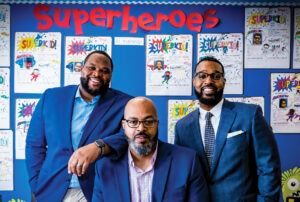
When asked why relationships have become so central to his professional life, including his work with Relational Impact and Relational Equity, Coleman offered a deeply personal response.
“No exaggeration, relationships saved my life.”
He understands firsthand that human connection can change the direction of someone’s life. In schools, he believes those connections can begin with gestures so small they are easily overlooked.
A teacher greeting a student at the classroom door, for example, may seem insignificant.
“It’s simple. It takes only seconds and yet it can really influence how that student feels about the teacher, about themselves, and about the school culture,” he said.
Multiply those moments across an entire school year, and their potential impact becomes extraordinary.
Coleman estimates that an elementary teacher may have approximately 14,000 interactions with students during a single school year.
Each represents an opportunity to build trust, reinforce belonging, or help a child feel seen.
It’s also why he believes the work of educators deserves greater recognition.
“Educators make hundreds of decisions a day, and many involve a child’s feelings,” he said. “That is hard work, and they do it well.”
A New Role, a Wider Reach

When someone Coleman deeply respected encouraged him to consider becoming Superintendent of University Schools, she recognized something that had become a defining characteristic of his leadership: his ability to build relationships.
“She knew I valued relational capacity and thought I could bring that to the role to support and empower the great leaders we have at Indiana Academy and Burris Laboratory School,” he explained.
Coleman began his new position with the 2026–2027 academic year, taking on responsibility for supporting two schools with distinctive identities and educational opportunities.
The transition has expanded the scale of his work.
“In the classroom, I could reach 25 kids. Now I can shape the conditions for hundreds of teachers and students,” he said. “The job is to build a culture where great relationships are the default.”
His priorities begin with the people already doing the work.
“Relationships first, because they make everything else work. Teachers who can build trust, repair after conflict, and hold high expectations will lift student outcomes.”
Preparing Students for What’s Next
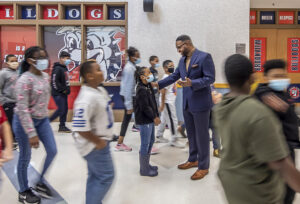
Coleman sees enormous potential in the innovative environments of University Schools.
Burris Laboratory School, in particular, has a distinctive opportunity to explore and advance teaching practices that respond to the needs of learners.
For Coleman, that willingness to innovate is essential.
Schools cannot prepare students for tomorrow simply by repeating yesterday’s approaches. Educators must continually adapt their practices to meet students where they are and prepare them for opportunities that may not yet exist.
When he imagines University Schools several years from now, he hopes their teaching practices will continue to evolve.
But he is equally committed to preserving the qualities that have made the schools successful.
“The caring approach, the attention to detail, and the innovative spirit of the schools. I hope that never changes because that is a huge part of why these schools are so successful.”
His first months as superintendent have also revealed just how much collaboration happens behind the scenes.
He’s gained a deeper appreciation for the many university and school personnel who coordinate their efforts to ensure students have the resources and support they need.
For a leader who believes relationships make everything else possible, that interconnected work reinforces the importance of his approach.
Leading Through Change
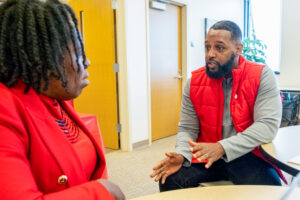
Coleman believes schools are experiencing a fundamental shift in how they must engage with students, families, and communities.
The traditional emphasis on compliance, he argues, is giving way to a greater need for relationships, shared responsibility, and meaningful participation.
Student agency and family engagement are essential to that transformation.
“If students don’t have agency they won’t engage in the curriculum,” he explained. “If families don’t feel like they are part of the community, they won’t engage in schools.”
Without that engagement, even well-designed instructional programs can struggle to achieve their intended impact.
But building those connections requires educational leaders to navigate increasingly complicated challenges.
Schools face funding pressures, demographic changes, and evolving learning needs. Teachers balance professional demands with family responsibilities, while parents and students face pressures of their own.
Coleman believes leaders must approach those challenges with empathy, including empathy for themselves.
“Everyone is having a hard time,” he acknowledged.
That understanding doesn’t eliminate the need for difficult decisions or high expectations. It changes how leaders approach them.
For Coleman, the most effective school leaders recognize the human experiences behind the challenges they face and remain willing to adapt as circumstances change.
His advice to future principals is short enough to remember long after graduation:
“The best ability is adapt-ability!”
A Sense of Belonging, Then and Now
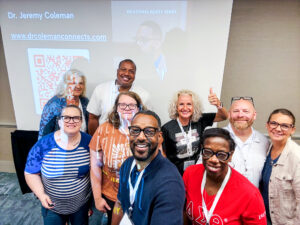
For all the professional milestones Coleman has achieved at Ball State, some of his fondest memories have little to do with academics.
He still remembers his first year living in LaFollette Residence Hall and spending time around the grassy area near Ball Gym.
The activities, friendships, and sense of community made a lasting impression.
“I was blown away by how much the students made the dorm and area welcoming and fun,” he recalled.
Those memories reflect something that has become central to his work: the importance of feeling welcomed and connected.
They also reveal a more personal side of a leader whose professional life often involves difficult decisions and complex challenges.
Coleman admits he’s easily moved by an emotional moment on screen.
“I cry tears of joy when I watch movies, even when I’m watching a really good commercial.”
It’s a small detail, but one that seems fitting for someone whose leadership philosophy places such importance on human connection.
And when he thinks about the advice he would give the young man who graduated from Ball State in 2003, his answer carries the weight of everything he has experienced since.
“You belong!”
It’s a message he learned through what educators call productive struggle, from academic probation during his freshman year to ultimately earning a doctorate.
That journey taught him that early setbacks don’t have to define what comes next.
Another Day, Another Chance
After nearly two decades in education, Coleman still finds excitement in something that happens every morning.
A new school day begins.
Yesterday’s mistakes don’t have to determine today’s possibilities. Students can try again. Teachers can adjust their approach. Leaders can reflect, learn, and improve.
“Every day we get to start over and begin again,” he said. “Doesn’t matter how poorly you did on an exam or assignment yesterday; you have a new day [to] correct mistakes and get better.”
He calls that opportunity a great equalizer.
It’s a belief that connects the struggling Ball State freshman he once was with the educator and superintendent he has become.
And as Coleman begins this new chapter at University Schools, he’s focused on making sure students, educators, and families have the support and relationships they need to make the most of those opportunities.
Because sometimes the difference between where someone starts and where they eventually arrive is having another person who sees what they’re capable of becoming.
Comments: