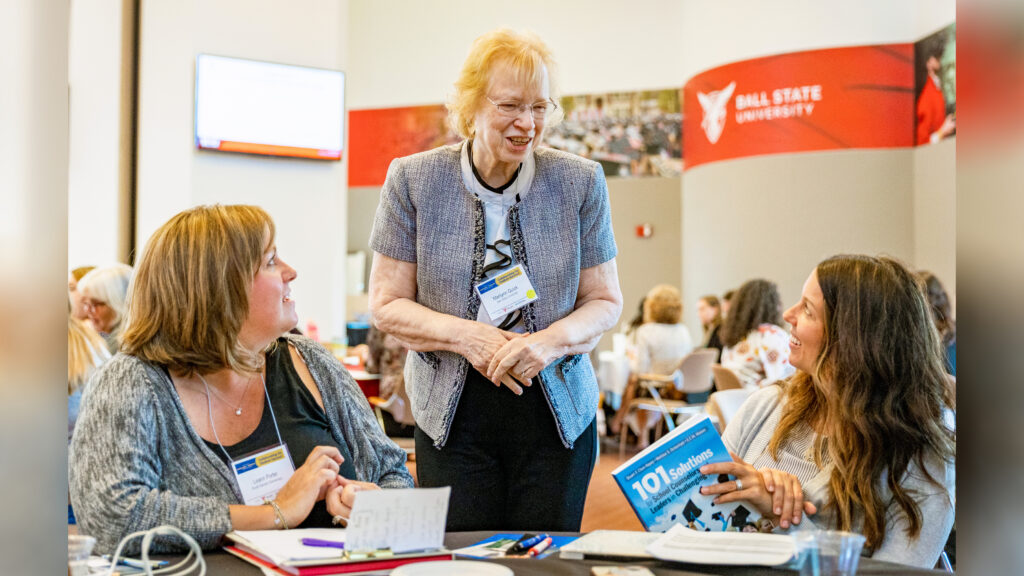
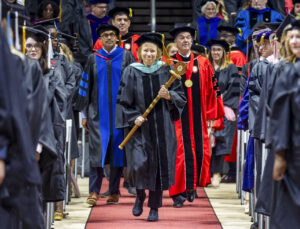
Marilynn Quick carries Ball State’s ceremonial mace at the head of the Commencement procession in Worthen Arena, an honor traditionally given to a distinguished faculty member.
For Dr. Marilynn Quick, leadership has never been a solitary pursuit.
Throughout a career spanning P-12 schools and higher education, mentors encouraged her to take the next step. Colleagues helped her navigate unfamiliar challenges. Students gave new meaning to her work. And at every stage, Quick found opportunities to extend that same support to someone coming behind her.
Now, the Teachers College Emeritus Professor of Educational Leadership is carrying that philosophy into a new generation.
In 2025, Quick established the Marilynn Quick Endowed School Leadership Fund, creating a lasting source of scholarship support for graduate students in Ball State University’s Department of Educational Leadership, with preference given to students who demonstrate leadership qualities.
For Quick, who has supported Ball State for 18 years, establishing the fund was a natural extension of a career devoted to developing leaders.
“Leadership matters,” she said, “and it’s my time to return the favor to all those who supported me in my career.”
A Tap on the Shoulder
Joining colleagues during the 2022 Indiana School Counselor and Administrator Collaboration Institute at the Ball State Alumni Center.
Quick spent more than 30 years in P-12 education before joining Ball State’s faculty in 2002. Her path took her from teacher and reading specialist to principal, assistant superintendent, and superintendent.
But educational leadership was not necessarily where she expected that path to lead.
Like many educators who eventually find themselves in leadership positions, Quick remembers someone recognizing her potential before she necessarily saw the next step herself.
“One of my principals tapped me on the shoulder and mentored me as a teacher leader,” she said. “He encouraged me to pursue a principal’s license.”
That encouragement opened a door.
“Education became an addiction after turning around my first failing student, struggling teacher, and failing school,” Quick said.
Along the way, she learned lessons that would shape both her leadership and, eventually, the way she prepared educational leaders at Ball State.
One of the earliest came while working in the University of Arizona’s Reading Lab. Quick worked with a seventh-grade student with a 142 IQ who, despite extensive tutoring, was reading at a kindergarten level. Traditional phonics instruction simply had not worked for him.
By trying different approaches, Quick helped the student gain four academic years of reading progress in one summer.
The experience reinforced a principle that would remain central throughout her career: when something is not working for students, educators must be willing to change their approach.
That commitment to continuous improvement became one of the defining themes of Quick’s work.
“Our organizations cannot maintain status quo,” she said. “Either we improve or go backwards.”
Leadership Built With Others
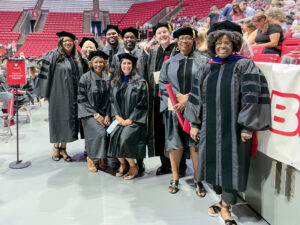
Celebrating with Educational Leadership faculty and graduating doctoral students before Commencement in Worthen Arena.
Quick also learned early that improvement rarely happens alone.
During her first year as a superintendent, a superintendents’ study council in northeast Indiana, chaired by Ball State’s Dr. Jay Thompson, became an invaluable network of mentors. Whenever she faced a challenge, she had trusted colleagues she could turn to for advice on community and board relations, finance, legal questions, and more.
“I once told these mentors not to compare notes, or they might realize they were due a sizable portion of my salary that year,” she joked.
Another important mentor was Betty Poindexter, an accomplished superintendent and Ball State alumna who helped Quick navigate leadership at a time when far fewer women held those roles.
Quick often returns to a line from Alfred, Lord Tennyson: “I am part of all that I have met.”
The words capture something fundamental about her view of leadership. The people who invest in us become part of what we carry forward.
That philosophy followed Quick to Teachers College.
Returning to Her First Love
When Quick joined Ball State in 2002, she began what she describes as a rewarding second career. After decades of working in schools and school systems, the position also brought her back to where she had started.
“I’m so grateful to Ball State and the Department of Educational Leadership for giving me the opportunity to enjoy such a rewarding second career in higher education,” Quick said. “The BSU position also allowed me to return to my first love, teaching.”
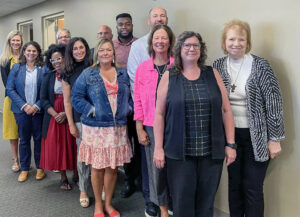
Quick, far right, with faculty and staff from Ball State’s Department of Educational Leadership.
At Ball State, she taught future school leaders in areas including instructional supervision, the principalship, organizational theory, and doctoral research. Across those courses, she wanted students to leave with more than theories of leadership. She wanted them equipped to continually make their schools better.
She emphasized setting high expectations, using data to inform decisions, observing what was happening in classrooms and schools, and building collaborative cultures centered on learning.
Her own research reflected many of those same priorities, exploring school improvement, educational leadership, and teacher and principal evaluation.
“I’m a bit of a change addict,” Quick said, “and really enjoy positive change processes where I’m growing and learning with a community of learners.”
Over the course of her career, she also came to see collaboration as one of the most powerful tools available to a leader.
“The greatest change occurs when a group of people works together to solve problems creatively,” she said. “When staff are treated as professionals and find their input is valued, the synergy in an organization can result in amazing improvements.”
From Students to School Leaders
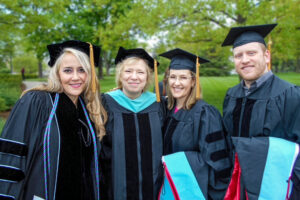
Celebrating with three graduates during Ball State’s Spring 2014 Commencement.
Ask Quick what stands out most about her years in Teachers College, however, and her answer is immediate.
“Our students!”
Those relationships did not end when students walked across a commencement stage. Even in retirement, Quick regularly hears from former students who want to share good news, ask for advice, or simply reconnect.
Her work with doctoral students created especially close bonds. Quick chaired 36 dissertations and served on the committees of 38 additional doctoral students across the College.
“Doctoral students become as close to us as our children,” she said.
After the long hours, research, writing, revisions, and defense, Quick particularly cherished one moment: hugging a student and saying, “Congratulations, Dr. …”
“Tears flowed freely before we started partying!” she said.
The real reward came later, as she watched those students put their leadership into practice.
She remembers hooding Dr. Brian Dinkins at graduation and hearing him tell her she was like a second mother. Today, Dinkins works with schools across the country through his consulting work on emotional intelligence.
She watched Dr. Stacy Smith build on doctoral research focused on improving reading scores to support a school that later received statewide recognition for literacy. She also saw Dr. Dani Barkey develop a leadership model for turning around struggling schools and use that research in work with schools across the nation.
For Quick, those stories represent something larger than individual accomplishments.
When asked what makes her most proud of her career, she points not to her own achievements, but to “the difference my students have made in the lives of their students.”
Turning Gratitude Into Opportunity
Quick began giving to Ball State 18 years ago, directing much of that support to the Department of Educational Leadership. Her giving has also included support for Social Justice Research in Higher Education and the Student Affairs Administration Program.
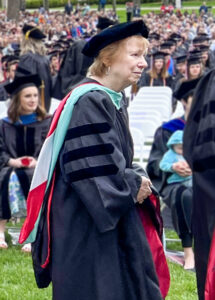
Preparing to hood a doctoral student she mentored during Spring Commencement on the Ball State Quad.
Underlying that philanthropy is the same belief that guided her work as an educator: education can change lives, particularly when educators are committed to helping every student reach their potential.
“Schools often create mission statements with the term ‘All kids can learn,’” Quick said. “The words come easily, but the actions required to ensure all kids are actually learning and being supported to reach their potential is more difficult.”
She has been especially drawn to organizations that serve marginalized populations and to the ability of educators to provide support and a voice for those who need it.
Her giving to Ball State is also rooted in gratitude.
After a fulfilling second career in Teachers College, Quick felt that “a little payback would be appropriate.”
The Marilynn Quick Endowed School Leadership Fund takes that longstanding support a step further by ensuring it can continue well into the future.
The fund is designed to support graduate students in Educational Leadership, many of whom are already balancing graduate study with demanding full-time careers.
“I’m hopeful that scholarship funds encourage them to pursue positions of even more responsibility and opportunities to improve schools,” Quick said. “I hope they feel affirmed in the important work they’ve taken on and they are able to more easily fund their career dreams.”
A Different Kind of Mentorship
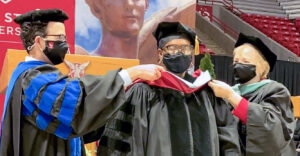
Helping hood a doctoral graduate during Ball State’s December 2021 Commencement ceremony in Worthen Arena.
Quick’s endowed fund creates another form of the “tap on the shoulder” that helped launch her own journey into leadership decades ago.
A scholarship cannot provide advice after a difficult board meeting or celebrate alongside a doctoral student after a successful defense. But it can tell a student that their potential has been noticed. It can make the next degree, credential, or leadership opportunity more attainable. And it can encourage someone already serving schools to keep moving forward.
For an educator who spent so much of her career mentoring future leaders, establishing the fund feels like a continuation of that work.
“Absolutely!” Quick said. “Again, it’s a way to pay forward the many blessings I’ve received during my career.”
The idea of paying it forward reaches back even further.
Quick credits her father with instilling in his children a responsibility to make their “little corner of the world a better place.” Throughout her career, mentorship became one way to do that.
“It’s so much easier, and more fun, to do that work with others,” she said. “I’ve been so blessed to be surrounded by so many who share the same passion.”
And she hopes the students who benefit from her generosity will eventually continue the cycle themselves.
Her message to a future recipient of the Marilynn Quick Endowed School Leadership Fund is simple:
“When you are able, the best thank you is helping the next generation of leaders.”
A Legacy That Keeps Moving
Retirement has given Quick more time to enjoy a different kind of mentoring and learning as she watches her 10 grandchildren and four great-grandchildren grow. She also remains connected to educational leadership through superintendent searches and other professional work.
But the lessons of her career continue to evolve.

Sharing a dance during a gathering with family and friends.
If she could tell her younger self something about leadership, Quick said she would spend less time trying to convince people of the right course of action and more time listening.
“The more powerful strategy is listening and building ownership in the change process,” she said.
It is fitting advice from someone whose own career was shaped by people who listened, encouraged, mentored, and opened doors for her.
Quick hopes her former students will do the same for generations to come, creating what she describes as “a fire in the bellies of their students” and a continuous chain of school improvement stretching far into the future.
Her endowed fund adds another link to that chain.
A mentor once tapped Quick on the shoulder and encouraged her to lead. Others supported her as she took on greater responsibilities. She spent decades doing the same for students and emerging educational leaders.
Now, through philanthropy, she can keep tapping future leaders on the shoulder for years to come.
And when Quick considers what Ball State and Teachers College have meant across more than two decades of teaching, mentoring, scholarship, friendship, and service, she comes back to the idea at the heart of her giving.
Gratitude.
“I’m filled with gratitude for the many rewarding experiences,” she said.
Then, in true Ball State fashion, she added:
“Chirp-chirp!”
Comments: