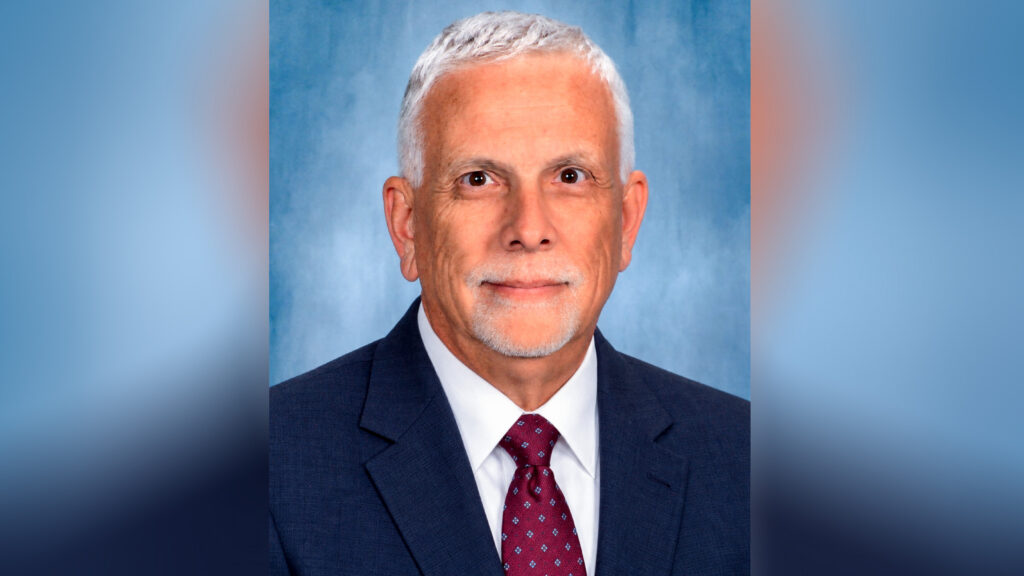
The 2026–2027 Teachers College Outstanding Alumni Award recipient has spent his career helping students experience the wonder of science while encouraging them to remain curious, think critically, and never stop learning.
As Ball State University celebrates Homecoming, Teachers College is recognizing three outstanding individuals through its 2026–2027 Alumni Awards. Throughout the week, we’re introducing each honoree and exploring the experiences, contributions, and commitments that have made a lasting impact on education and the Teachers College community. Next is David Butler, recipient of the Teachers College Outstanding Alumni Award.
A Curiosity That Started Early
Long before David Butler became a science teacher, he had a laboratory of his own.
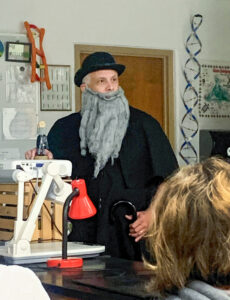
Bringing Charles Darwin to life while explaining natural selection to students in his science classroom.
As a middle school student, Butler transformed part of his family’s basement into a place where he could experiment, investigate, and satisfy a curiosity about science that had been growing since fourth grade.
“I think that young person was driven by wonder,” Butler said. “I was fascinated by the idea that the world around us could be understood through observation, experimentation, and discovery.”
The basement laboratory gave him a place to turn that curiosity into action. Decades later, the setting has changed, and his current laboratory even has windows, he jokes, but the motivation behind it remains remarkably similar.
“That same curiosity that led me to create a lab is the same curiosity I now try to inspire in my students,” he said.
Finding His Way to Teaching
Science captured Butler’s imagination early, but teaching took longer to reveal itself as his path.
He initially considered studying medical technology. By the end of his freshman year at Ball State, however, he began to recognize something that had been developing throughout his childhood.
He had already spent years finding ways to teach others. He played teacher with his siblings, tutored classmates in middle and high school, and gave swimming lessons during the summer. He eventually realized that he did not simply enjoy learning science. He enjoyed helping other people understand it.
A conversation with a close friend helped everything fall into place.
“Be a science teacher,” his friend told him.
The simple suggestion brought together Butler’s love of science and his ability to educate others. Teaching offered him the opportunity to continue exploring a subject he loved while sharing that excitement with generations of students.
His motivation has remained much the same throughout his career.
“If I could inspire even a few students to develop a lifelong curiosity about science, then I felt I was doing what I was meant to do,” Butler said.
Lessons From Ball State

At a Ball State costume party in 1986, Butler poses with his best friend and his then-girlfriend, who would later become his wife.
Butler earned his bachelor’s degree from Ball State in 1989, building a foundation in science and education that continues to influence his classroom today.
Some of that influence came from professors whose approaches showed him what effective teaching could look like.
He remembers a zoology professor who established high but attainable expectations and brought enthusiasm to the classroom. A botany professor took the time to learn about Butler’s interest in photography and invited him to help create slides for presentations.
Those relationships showed Butler that teaching was about more than delivering content.
“At the time, I didn’t fully appreciate how much those years were shaping me,” he said. “I thought I was simply learning science and how to teach it.”
Looking back, Butler recognizes that Ball State was also teaching him perseverance, professionalism, and the importance of relationships between educators and students.
His college experience challenged him to learn how to learn, a lesson he now deliberately passes along to his own students. He encourages them to develop effective study strategies, persevere when material is difficult, and take an active role in their own education.
He also tries to offer students the same combination of encouragement and challenge he experienced from his professors.
“They took the time to encourage, challenge, and mentor us,” Butler said. “As a teacher, I’ve come to understand just how important those relationships are, and I’ve tried to create that same kind of environment for my own students.”
Turning Science Into an Experience
Step into Butler’s classroom and science is unlikely to remain confined to a textbook.
His lessons have included hands-on experiments, games, costumes, unusual foods, and other experiences designed to make scientific concepts tangible and memorable.
One example is the “Amazing Human Race,” an activity inspired by the television show The Amazing Race. Advanced biology students work in teams as they move through a series of challenges centered on human evolution.
Students search the school for clues, complete “Roadblocks” and “Detours,” and earn opportunities to examine casts of hominin skulls. Using calipers, metric rulers, observations, and other resources, they analyze the evidence and determine what it can reveal about human evolution.
The activity is a race, but speed is not really the point.
Students must observe carefully, think critically, work collaboratively, and use evidence to reach conclusions. They may disagree about what the evidence means, giving Butler another opportunity to demonstrate how science actually works.
For Butler, purposeful activities like these help students move beyond memorizing information. They experience science as a process of questioning, investigating, interpreting evidence, and making discoveries.
Finding Wonder in the Living World

Graduation day, May 6, 1989. Unseasonably cold weather made for a chilly outdoor ceremony, with temperatures hovering around 45 degrees and quarter-size snowflakes falling during commencement.
Some of Butler’s favorite teaching moments are much quieter.
During one DNA experiment, a student looked at the results and offered a simple observation:
“It’s so beautiful.”
The comment has stayed with Butler because it captured what he hopes students discover in his classroom.
He wants them to understand biology, but he also wants them to develop an appreciation for the living world. Science, in his view, should help students look more closely at what surrounds them and ask questions about why things work the way they do.
“If students leave my classroom seeing science not just as a subject, but as a way of understanding and appreciating life, then I feel I’ve accomplished something truly meaningful,” he said.
That goal is reflected in a motto Butler shares repeatedly with his students: “Never Stop Learning and Wanting to Know.”
It appears in his classroom, at the end of his unit lessons, and in the graduation cards he signs for students.
For Butler, the words are both an invitation and a challenge: remain curious, continue exploring, and never lose a sense of wonder about the world.
Bringing the World Back to His Students
Butler follows that advice himself.
His learning has taken him far beyond his own classroom, including travels to the Galápagos Islands, Alaska, Canada, Costa Rica, Hawaii, and Tasmania.
Those experiences have allowed him to encounter scientific concepts in the places where they can be observed firsthand. Natural selection, ecosystems, adaptation, and geology become different when experienced outside the pages of a textbook.
“One of the greatest lessons I’ve learned is that science is best understood when you experience it firsthand,” Butler said.
He brings those experiences back to his students through stories, photographs, and videos. He can tell them what it was like to stand where Charles Darwin once stood or describe ecosystems and wildlife he has observed himself.
The stories help students understand that science is not limited to a classroom or laboratory. It is happening around them every day.
More Than Science

Holding a puppy during a student field trip to Happy Trails Kennels for sled dogs in Alaska.
As Butler’s career has progressed, his definition of successful teaching has expanded.
Early on, he focused heavily on how much science he could teach. Experience taught him that content is only one part of an educator’s influence.
“If my students leave my classroom knowing more science, that’s wonderful,” he said. “But if they also leave more curious, more confident, and more prepared to think critically about the world around them, then I know I’ve truly succeeded as an educator.”
Butler sees teachers as instructors, mentors, role models, and trusted adults. They help young people navigate academic challenges while also modeling integrity, compassion, respect, and perseverance.
Reminders of that influence surround him.
Over the years, students have given Butler photographs, letters, notes, and small gifts. He has kept them, filling scrapbooks and his classroom with reminders of the relationships formed throughout his career.
“I like to think of these as awards given to me sometimes on a daily basis,” he said.
Those keepsakes represent generations of students who have moved on to college, careers, families, and lives of their own. Some still return to visit or reach out years later.
In fact, just before completing his Teachers College Alumni Award survey, Butler received an email from a former student who graduated in 2019. Now finishing graduate school, the former student told him that an assignment asking about the people who had influenced their life immediately brought Butler to mind.
The message thanked him not only for teaching, but for listening, offering guidance, and providing support during difficult years.
For Butler, messages like that capture why relationships have become such an important measure of his career.
Learning Alongside Other Educators
Butler’s commitment to learning also extends to the larger science education community.
Throughout his career, he has been involved in science education at the local, state, and national levels through professional leadership, presentations, publications, and service. Those experiences allow him to collaborate with other educators, encounter new ideas, and bring what he learns back to his students.
“I’ve always believed that being a great teacher means first being a lifelong learner,” he said.
Butler has followed that philosophy throughout his own education. After earning his bachelor’s degree from Ball State in 1989, he continued his studies while building his career as an educator, earning master’s degrees from the University of Southern Indiana and the University of Indianapolis. Most recently, he completed a master’s degree in curriculum and instruction with a STEM focus in 2024.
His experiences have also changed the way he thinks about his fellow educators.
Earlier in his career, Butler admits he sometimes believed his approach was the right way to teach. Working alongside other educators showed him how much teachers can learn from one another.
He now encourages newer educators to gather ideas from experienced colleagues while developing an approach that is authentically their own.
“Make your classroom your own,” he tells them.
That means trying new approaches, accepting that mistakes are part of professional growth, and adapting ideas to fit their own strengths and students.
Butler has also shared his own experiences more broadly. After developing a professional development presentation featuring strategies for increasing student learning and motivation in biology and life science, he turned his materials into the book Science Strategies to Increase Student Learning and Motivation in Biology and Life Science.
His goal was to give fellow educators practical ideas while encouraging classrooms where curiosity, questioning, and active learning are valued.
A copy eventually found its way into Ball State’s Bracken Library collection, something Butler describes simply as “so cool.”
Recognition That Comes From Students
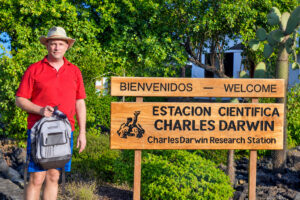
Traveling to the Charles Darwin Research Station on Santa Cruz Island in the Galápagos Islands, fulfilled a lifelong dream to visit the place that played such an important role in Darwin’s study of the natural world.
Butler has received recognition at the local, state, and national levels throughout his career. Yet one honor stands apart because of who nominated him.
In 2015, his principal asked him to come to the school library, supposedly to help the librarian with a grant.
Instead, Butler walked into a room filled with students, teachers, family members, and a local television news crew. They were there to surprise him with an Excellence in Education Award.
He later learned that the nomination had not come from an administrator or colleague.
A freshman student had nominated him.
“That meant more to me than I can adequately express,” Butler said.
He values recognition from administrators, parents, colleagues, and community members, but students experience his teaching every day. They know whether he challenged them, encouraged them, supported them, and made learning meaningful.
Knowing that a student believed he had made a difference reaffirmed why Butler chose education in the first place.
A Full-Circle Honor From Ball State
Now, another award carries special meaning.
Receiving the 2026–2027 Teachers College Outstanding Alumni Award has given Butler an opportunity to reflect on the path from the curious young student with a basement laboratory to an educator who has spent his career nurturing that same curiosity in others.
“This award reminds me how far I’ve come since I first walked on campus,” Butler said. “Looking back, I realize that many of the opportunities I’ve had were built on the foundation this school provided.”
For Butler, Ball State helped transform his love of science into a sense of purpose. The lessons he learned as a student continue to appear in the expectations he sets, the enthusiasm he brings to science, the relationships he builds, and the perseverance he encourages in his students.
“To be recognized by the institution that invested in me early in my life makes this honor especially meaningful,” he said.
The recognition has arrived at a particularly meaningful point in his career. Butler describes it as a full-circle moment and a reminder of how the choices he made as a young Ball State student grew into decades of teaching, learning, and relationships.
Never Stop Learning and Wanting to Know
When Butler considers the legacy he hopes to leave, awards and professional accomplishments are only part of the story.
He hopes students remember a teacher who believed in them, challenged them, and made them feel valued. He wants them to remember a classroom where questions were welcomed, mistakes were part of learning, and curiosity could lead to discovery.
He hopes colleagues remember someone who supported the educators around him and never stopped trying to become a better teacher himself.
Most of all, he wants the curiosity that first drew him to science to continue through the people he has taught.
That curiosity has carried Butler from a homemade basement laboratory to classrooms, laboratories, conferences, faraway ecosystems, professional leadership, and countless relationships with students. Through it all, his goal has remained remarkably consistent: inspire others to keep asking questions.
“What excites me most is that I still feel the same curiosity about science and learning that I had when I was young,” Butler said. “I don’t think that curiosity ever goes away; it simply changes as we gain more experiences.”
It is the lesson written on his classroom wall, included in his graduation cards, and woven throughout a career devoted to helping others discover the world around them:
“Never Stop Learning and Wanting to Know.”
Comments: