
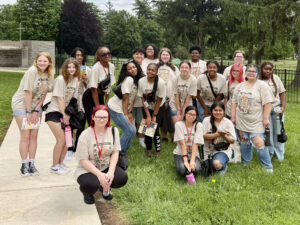
 For many high school students, choosing a career path can feel overwhelming. At Ball State University’s Teachers College, the Flight Path to Teaching Adventure gives students the opportunity to experience life as both a college student and a future educator, helping them discover whether teaching is the right fit before they ever apply to college.
From June 7-11, 2026, the five-day residential summer camp welcomed 19 rising high school juniors and seniors representing 15 high schools across Indiana. Funded through a Lilly Endowment Indiana Youth Programs on Campus grant, the program is offered at no cost, making it accessible to students from a variety of backgrounds.
Throughout the week, participants lived and dined on Ball State’s campus, explored Teachers College majors and career pathways, learned how to teach STEM lessons, and worked alongside experienced educators before stepping into classrooms themselves at Hazelwood Christian Preschool’s summer program.
 Learning by Teaching
Rather than simply hearing about what teachers do, campers experienced it firsthand.
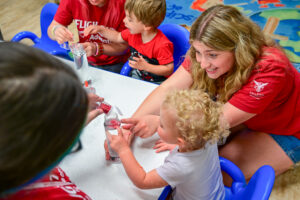
Participants chose to work with toddlers, preschoolers, or school-age children and spent more than 12 hours in classrooms observing lead teachers, assisting with lessons, and eventually teaching their own STEM activities.
This year’s lessons centered around the theme of bugs. Campers introduced children to hands-on activities that included creating bug-themed sensory bottles, completing Build-a-Bug projects, and participating in bug scavenger hunts.
The experience gives students a realistic look at the profession while helping them discover which age groups they enjoy working with most.
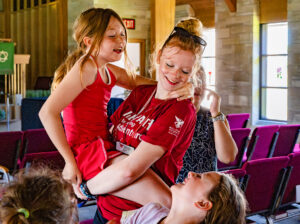 Several campers said the week helped clarify their future plans. Katie Crews, Director of Recruitment for Ball State Teachers College and one of the camp’s organizers, said one student’s experience stood out.
“One student in particular said she had an ‘AHA moment’ that she absolutely wants to become a teacher,” Crews said.
More Than a Summer Camp
While the teaching experiences are central to the program, campers also get a taste of college life.
 Students stayed in residence halls, ate in campus dining facilities, explored Ball State’s campus, and enjoyed evening activities throughout the Muncie community. Favorite outings included miniature golf and ice cream at Frozen Boulder, painting pottery at Made in Muncie, and spending an evening at Ball State’s Recreation Center.
The week also became an opportunity to build lasting friendships.
Crews recalled one memorable moment during a pickleball outing. Although multiple courts had been set up, campers decided to move the nets together to create one large court so everyone could play at the same time.
“They created a community quickly and were very inclusive of everyone,” Crews said.
That simple decision reflected the supportive environment that developed throughout the week, one where students intentionally included one another and formed friendships that may last well beyond camp.
Building Confidence and Connections
 The impact of Flight Path to Teaching Adventure extends beyond learning how to write lesson plans.
Students gain confidence navigating a college campus, living away from home, and working with children in a classroom setting. Along the way, they also develop meaningful relationships with one another.
“They leave camp with many new friends…and maybe even a college roommate,” Crews said.
 Many campers were emotional on the final day as they said goodbye to the children they had spent the week teaching. For some, those classroom experiences helped solidify their career aspirations. For others, they provided valuable insight into the age group they would or would not like to teach.
Either outcome gives students a clearer picture of what their future could hold.
Inspiring Indiana’s Next Generation of Educators
 Programs like Flight Path to Teaching Adventure are helping strengthen Indiana’s teacher pipeline by giving high school students an authentic look at the profession while introducing them to college life.
The results are already encouraging. Approximately half of all Flight Path to Teaching Adventure participants have gone on to enroll in Ball State’s Teachers College.
Crews hopes the program will continue opening doors for students who may not yet see college or teaching as possibilities.
“We hope it can continue. It opens the door to students who aren’t sure if higher education is an option and who are trying to decide if teaching is the right career for them,” she said.
For many participants, Flight Path to Teaching Adventure is much more than a week on campus. It is an opportunity to build confidence, discover a passion for teaching, and begin envisioning themselves as the educators who will inspire the next generation. 
Comments: