

In today’s fast-evolving job market, you’ve likely heard the phrase: “The master’s degree is the new bachelor’s degree.”
What used to be a distinguishing credential for specialized careers has rapidly become the baseline requirement for upward mobility, leadership roles, and salary advancement.
According to the U.S. Bureau of Labor Statistics (BLS), full-time workers with a master’s degree earn a median national salary of $95,680 per year, compared to $80,236 for those with only a bachelor’s degree. That reflects an annual earnings premium of over $15,000—adding up to more than $450,000 in additional lifetime earning potential across a 30-year career.
Beyond direct salary growth, advanced education may act as a safeguard during economic shifts. The national unemployment rate for master’s degree holders sits at just 2.2%, compared to 2.5% for bachelor’s degree holders and 4.2% for high school graduates.
Many of our popular Ball State Online master’s degree programs are your key to a better future. We’ve broken down the return on investment (ROI) on some of our most popular programs.
The Master’s Degree ROI by Industry: National vs. Indiana Data
Industry 1: Education
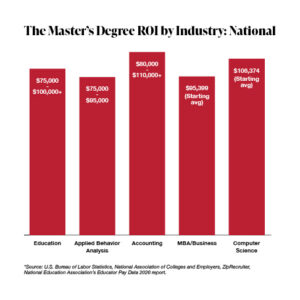
- National Picture: Master’s degrees remain standard for senior teaching tracks, specialized roles, and educational leadership. According to BLS projections, postsecondary education administrators earn median salaries exceeding $100,000 annually.
- Indiana Impact: In Indiana, school districts reward advanced degrees through structured salary schedules. While Indiana doesn’t guarantee a salary bump at a state level, increasing education often may account for decisions made in regards to raises within districts. Additionally, specialized master paths or licenses, such as Curriculum and Educational Technology—also position educators for high, demand administrative roles statewide.
Industry 2: Applied Behavior Analysis (ABA)
- National Picture: Board Certified Behavior Analysts (BCBAs) are in critical demand across healthcare and school systems. The Behavior Analyst Certification Board (BACB) requires a graduate-level degree to sit for the BCBA exam. Nationally, BCBAs command an average salary of $75,000 to $95,000, with top earners exceeding $110,000.
- Indiana Impact: Indiana has seen explosive growth in behavioral healthcare services. According to industry data from ZipRecruiter, master’s-level practitioners in Indiana earn a median annual salary of about $79,828. In contrast, specialized BCBA consultants in metropolitan areas like Indianapolis earn significantly above the state average.
Industry 3: Accounting
- National Picture: To sit for the Certified Public Accountant (CPA) exam, most states require 150 credit hours—30 more than a standard 120-credit bachelor’s degree. Pursuing a Master’s in Accounting bridges this gap directly. The BLS reports that accountants and auditors earn a median salary of over $79,880, while corporate controllers and senior CPAs holding graduate credentials routinely cross six figures.
- Indiana Impact: Indiana’s robust manufacturing, logistics, and corporate headquarters demand advanced financial talent. CPAs with a master’s degree in Indiana enjoy starting salaries 15% to 20% higher than entry-level staff auditors without advanced degrees or CPA licensure.
Industry 4: Business Administration (MBA)
- National Picture: The MBA remains one of the highest-yield graduate credentials. Graduate salary surveys from the National Association of Colleges and Employers (NACE) highlight average starting salaries for MBA graduates near $95,399.
- Indiana Impact: The median annual salary for master’s degree professionals across Indiana averages $79,828, but MBA holders in key business hubs—such as Indianapolis, Fishers, and Fort Wayne—routinely report earnings ranging from $85,000 to $120,000+ depending on managerial tier and industry focus.
Industry 5: Computer Science & Information Technology
- National Picture: Tech fields offer some of the largest pay jumps for graduate education. NACE starting salary data shows Master’s in Computer Science grads earning average entry-level salaries of $106,374. Positions like Computer and Information Research Scientists command median salaries well over $100,000 with faster-than-average projected job growth.
- Indiana Impact: As Indiana’s tech corridor grows, local demand for senior developers, systems architects, and AI specialists has surged. Master’s-level tech professionals in Indiana out-earn bachelor’s degree peers by $18,000 to $25,000 annually, creating a fast payback period on tuition investments
Maximizing Your ROI: Why Getting Your Degree Online Makes Financial Sense
When calculating return on investment, salary is only half of the equation—costs and opportunity costs make up the other half. Traditional, on-campus graduate programs often carry hidden financial strains that erode your true return. Earning your degree through Ball State Online significantly improves your ROI in three distinct ways:
1. Lower Overall Cost of Attendance
Online programs eliminate expenses tied to physical campus attendance—such as campus housing, commuting costs, parking passes, and meal plans. Ball State Online offers competitive tuition rates, allowing you to complete an accredited, top-tier degree at a fraction of traditional graduate program costs.
2. Zero Opportunity Cost (Keep Working While You Learn)
The single biggest expense of a traditional graduate degree isn’t tuition—it’s the lost income from stepping away from full-time employment for two years. Online learning offers flexible, asynchronous coursework, that lets you keep your full-time job, maintain your income stream, and apply what you learn immediately in your current workplace.
3. Potential Employer Tuition Assistance
Because online programs are designed for working professionals, many students qualify for employer tuition reimbursement programs. Many organizations may cover part of tuition through tax-free educational assistance, further reducing your out-of-pocket tuition burden.
Frequently Asked Questions About Ball State University’s Online Master’s Degrees
Do employers view online master’s degrees the same as on-campus degrees?
Yes. Diplomas issued by accredited universities like Ball State University do not differentiate between online and on-campus formats. Your diploma simply reads Ball State University, backed by the same institutional accreditation, faculty, and academic standards.
How long does it take to recoup the cost of an online master’s degree?
Given the national median master’s pay premium of approximately $15,400 annually and a typical Ball State Online graduate tuition investment ranging from $12,000 to $18,000 total, most working professionals fully recoup their tuition investment within 12 to 18 months post-graduation without ever losing income while studying.
Ready to Elevate Your Career and Earning Potential?
Investing in your education is one of the most reliable moves you can make for long-term career security and income growth. With low tuition costs, flexible schedules, and high-demand programs across Education, ABA, Business, Accounting, and Technology, Ball State Online provides a direct path to a higher ROI.
- Explore Programs: Discover our Ball State Online Graduate Programs.
- Calculate Your Cost: Estimate your program investment using the Ball State Online Tuition Estimator.