
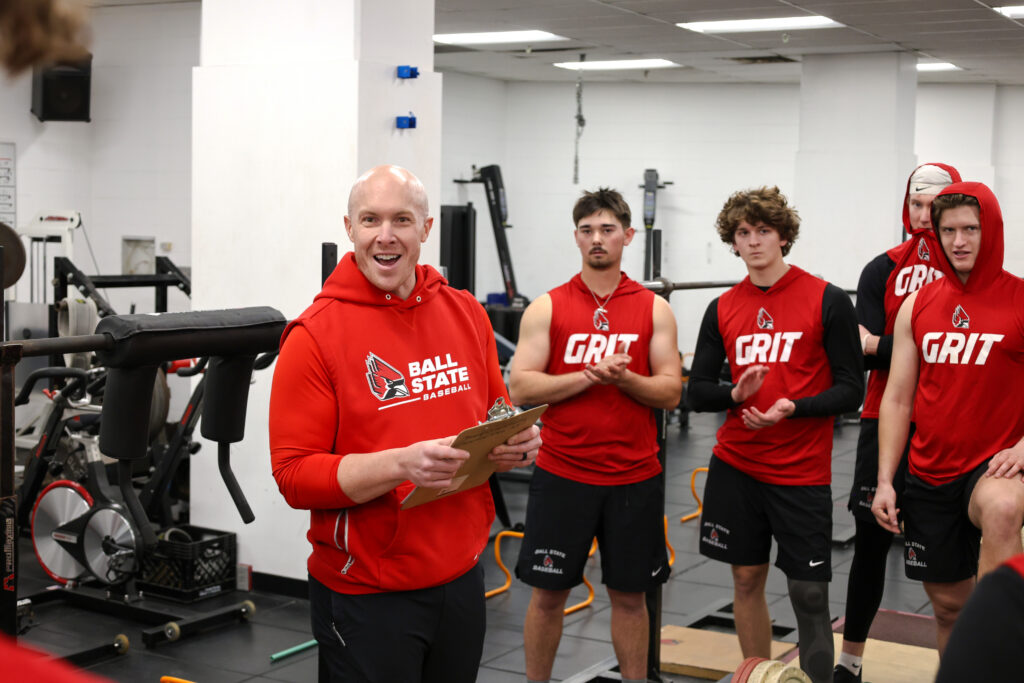
Bill Zenisek, senior lecturer of kinesiology, exercise science educator, and director of baseball performance, is now the program coordinator for Ball State University’s online Athletic Coaching Education Graduate Program.
“Growing up, [I knew] I loved sports, and I knew going into college that I wanted to do something with athletics since I figured out I was not a great athlete myself,” Bill explains.
He learned that he was a much better trainer of athletes than an athlete himself, but working in exercise science allowed him to be in an environment he loved, coaching athletes.
“It gave me that feeling of camaraderie and working toward a common vision,” he says. “That’s the one thing I try to bring into my teaching and coaching career right now as well.”
Bill completed his Master’s in Sport Administration after getting a graduate assistantship at Ball State. He completed an internship with the Indianapolis Colts, working with the team for an entire season. During that time the Colts went to the Super Bowl. That was a really exciting experience for a strength and conditioning coach.
Afterward, Bill then earned a position as a second assistant strength and conditioning coach with the Cincinnati Bengals for the next season. After two years in the NFL, he decided to switch gears and try his hand at personal training. Shortly after starting personal training, a new position opened up at Ball State in 2011 in the School of Kinesiology. He’s been here ever since, teaching, coaching, and now directing.
Bill credits Ball State with taking a chance on him and helping him get where he is in his career today. “Ball State …wanted to invest in me as a person and as a professional. [It] means a lot that they took a chance on me.”
Ball State…wanted to invest in me as a person and as a professional. [It] means a lot that they took a chance on me.
What Taking Over as Program Coordinator for the Master’s in Athletic Coaching Education Means
Initially, Bill says, taking over as program coordinator for the Master’s in Athletic Coaching Education “was one of those right time, right place types of things.” When the previous head of the program retired, the department chair reached out to Bill.
“He knew that I was passionate about coaching and…did a pretty good job with the undergraduate coaching minor,” Bill explains. “He thought I’d be a perfect fit.”
When asked what made him decide to take the position, Bill shared, “What I’ve learned…in my career [is to ask] how can I help the next generation? You know, those who have helped me get to where I am right now…I owe them a huge debt of gratitude, and I can at least repay it to the next generation somehow. I think [this is] a great opportunity to do so.”
The Vision for a Growing Coaching Program
When it comes to his vision for the Athletic Coaching Education program’s future, Bill wants to meet the demand for high-quality coaches with thorough training for those just entering the profession, as well as for those already in the field. Bill envisions modernizing the program to ensure that the curriculum is as applicable as possible for today’s coaches. That means developing an understanding of everything that being a coach encompasses, not just what is happening on the sports field.
The developing curriculum may deal with aspects of sports psychology, sports nutrition, strength and conditioning, practice plan design, general administration, and more. The goal is to give these coaches all the tools they need to go forward in their careers. “We have to make sure they’re staying as current as possible,” Bill explains. And that applies to the courses being taught at Ball State as well.
What’s it Like to be an Online Student in this Program?
The program offers enormous flexibility for students working in careers while completing their degrees. He explains that “continued education is incredibly important, whether it’s through a degree, a certification, reading articles or reading books on your own, or even networking with professionals.” The Athletic Coaching Education online program makes this possible for coaches who are working full-time in the field.
The students in the program come from a wide variety of backgrounds and ages. Bill says that variety helps expose students to different circumstances outside their own frame of reference, as the programs include a lot of collaboration and interaction.
“We have people who are brand new to the profession, who may have been athletes or are currently athletes, within the major, but we also have some seasoned veterans who have been there for a long time.”
These differing perspectives provide a well-rounded experience for students of the program. The active student body is worldwide, Bill says. “It’s pretty incredible that you can collaborate, network, and interact with people from all different backgrounds. And I think that’s one really unique aspect to this program.”
Bill prides himself on being a faculty leader who runs the program almost like a head coach. He makes a point of staying informed about what’s going on in individual courses and is open to and available for collaboration with faculty and students in the program. He welcomes students and faculty to reach out to him anytime, share suggestions and ideas, and collaborate. It’s not just about creating courses, he says. “We’re trying to create a community.”
Why Choose Ball State Over Other Programs?
“The faculty,” Bill says. “We have great faculty already, and we’re going to build that a lot more. [We have] people who are practicing what they preach. [They] bring that real-life experience into the classroom.”
We have great faculty already, and we’re going to build that a lot more. [We have] people who are practicing what they preach. [They] bring that real-life experience into the classroom.
“Once you complete that lesson in the classroom,” Bill explains, “you can take it right onto your field, to your court, to your weight room. You know, our athletic training classes are taught by people who are actually athletic trainers. Our sports psychology class will be taught by someone who’s an actual sports psychologist. So, you get to hear it from the person that walks the walk every single day.”
While coaches don’t necessarily need master’s degrees, Bill says a good coach should want one. The program takes the often-solitary life of a coach and turns it into a worldwide community of similar-minded continual learners.
“You can learn from each other, find best practices you can use, [or even] just learn a different way to think about things.”