Written By | Ruth Hartje
Watch an audio-described version of DesignWorks Summer Academy.
Immersion into Design
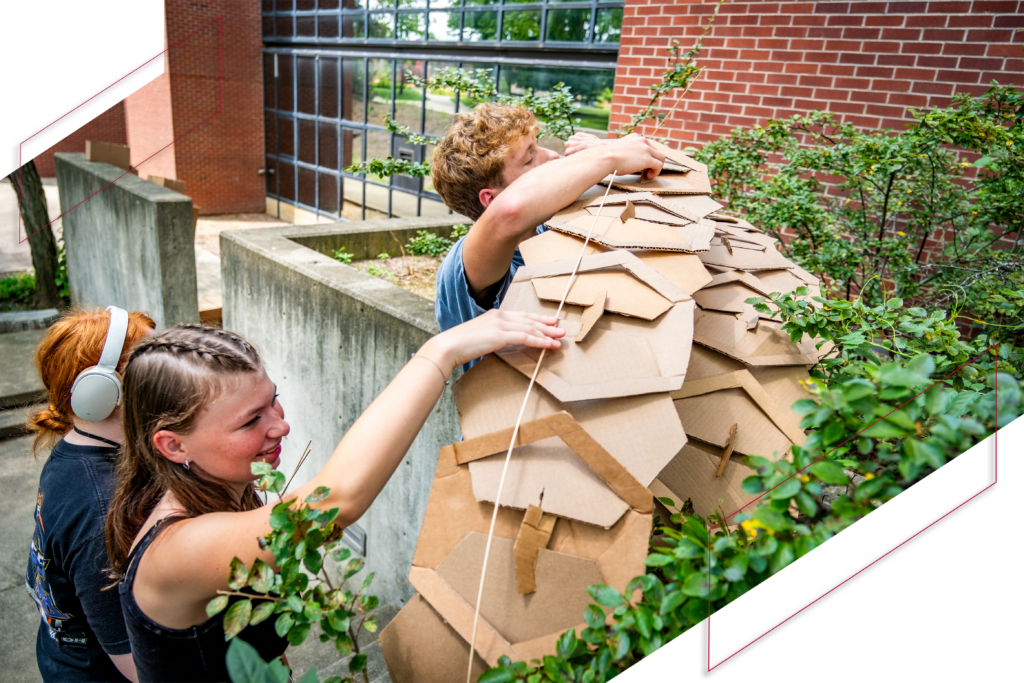
On a hot summer day, DesignWorks Academy students gather on University Green, arranging pipes and cardboard as they learn about scale in architectural design.
During the two-week residential program in July, high school students live and learn on Ball State’s campus while exploring architecture, landscape architecture, and urban planning. Chris Marlow, associate professor of landscape architecture and a five-time DesignWorks Academy instructor, guides students from the classroom to the studio and field sites.
“You’re immersed immediately into the college life experience, the studio designing experience, the professional on-the-ground, built-environment experience,” Marlow said. “It all matters in a big way.”
Now in its 46th year, DesignWorks Academy engages students through projects, field trips, and interactions with professionals and alumni.
“It starts with being creative, teaching them about the studio culture, teaching them about design principles, how to make things, how to draw, and how to experience the built environment,” Marlow said.
“The big priority is we want them to have fun. We want them to experience something that’s unique and different from what they’re used to.”
Gabi Hewlin attended DesignWorks Academy as a high school junior three years ago. She is now a Ball State junior majoring in architecture with a minor in interior design.
“My favorite part of the program was interacting with different students from different places and bouncing ideas around to get our projects and assignments done,” Hewlin said. “The program really opened my eyes to how much broader the field of architecture is. It’s not only designing houses or buildings but also looking at how people interact with a space and not just what a space looks like.”
The academy’s collaborative format reflects professional practice, where designers work in studios, visit project sites, and develop ideas with colleagues. Those experiences helped Hewlin understand what a future career in design could involve.
“Site visits showed me how to interact with people in a firm and how to collaborate on ideas,” she said.
Aria Brown, now a Ball State sophomore, also participated in the academy as a high school student. She was drawn to architecture and urban planning because of her desire to make a difference in her hometown.
“My main goals are to go back home and do something in my community,” Brown said. “I have an interest in both architecture and urban planning, partly because those are issues that face my home community.”
Brown said DesignWorks Academy helped her choose a major.
“The curricula of the program helped me choose between urban planning and architecture,” she said. “I had discussions with the program mentors about which field I wanted to go into and which aspects were being explored in those fields. It was pivotal for my decision.”
In addition to introducing students to architecture and design, the academy gives prospective students an opportunity to experience Ball State and the Estopinal College of Architecture and Planning.
The program helps the University and college attract “the most accomplished, the best, and the brightest students,” Marlow said.
Each year, between 30 and 60 students learn to work together while addressing complex design challenges.
“You get students who are used to a single correct answer for a simple problem, and now they’re encountering many correct answers to complex problems,” Marlow said.
That more nuanced way of thinking prepares students for what they may encounter in future coursework and careers.
“It’s satisfying to see that cognitive growth from high school, junior or senior, all the way through graduation,” Marlow said. “I’ve seen that growth several times over the years.”
Building on Support
Donor support helps provide materials, field trips, housing, and scholarships that make the academy experience possible.
“Philanthropy allows us to buy materials and to fund trips to Columbus, Indiana, for example,” Marlow said. “It allows students to stay in the residence halls to get that college experience.”
Brown received a scholarship that allowed her to attend the academy.
“I received a scholarship to go to the DesignWorks program,” she said. “I really appreciated that because my family wanted to send me and explore my interest in architecture and Ball State. My participation hinged on receiving the scholarship; without it, I wouldn’t have been able to attend the program at all.”
Brown’s scholarship was funded through the Strohm College of Architecture and Planning Inclusive Excellence Scholarship Fund, established in 2022 by Paul Strohm, ’80, and Leslie Strohm. Recognizing the barriers some students face when pursuing higher education, the Strohms sought to make the program more accessible, particularly for students from underrepresented and underserved areas and school districts.
Since its establishment, the fund has helped 22 students attend DesignWorks Academy.
The Strohms also established a separate fund, Strohm Scholars, to support DesignWorks participants who choose to attend Ball State and pursue an education in architecture and planning.
Their hope is that students’ immersion in design and life on Ball State’s campus will encourage them to choose the University. For those who do, the Strohms want students to know that additional financial support is available.
Brown also found a support system among her DesignWorks classmates. Those relationships helped her navigate the Ball State application and portfolio-building process.
Since the inaugural cohort, 100 percent of Strohm Scholars have continued their education into their second or third year at Ball State, demonstrating the powerful role donor support can play in students’ academic persistence and success.
DesignWorks Academy participants learn about the University, the Estopinal College of Architecture and Planning, and their own abilities and interests.
“They’re going to create all kinds of new memories, new friends, and a new confidence in their abilities to think creatively,” Marlow said.
Want to learn more about the how philanthropy is impacting Ball State University? Then, check out the FY26 Foundation Annual Report!