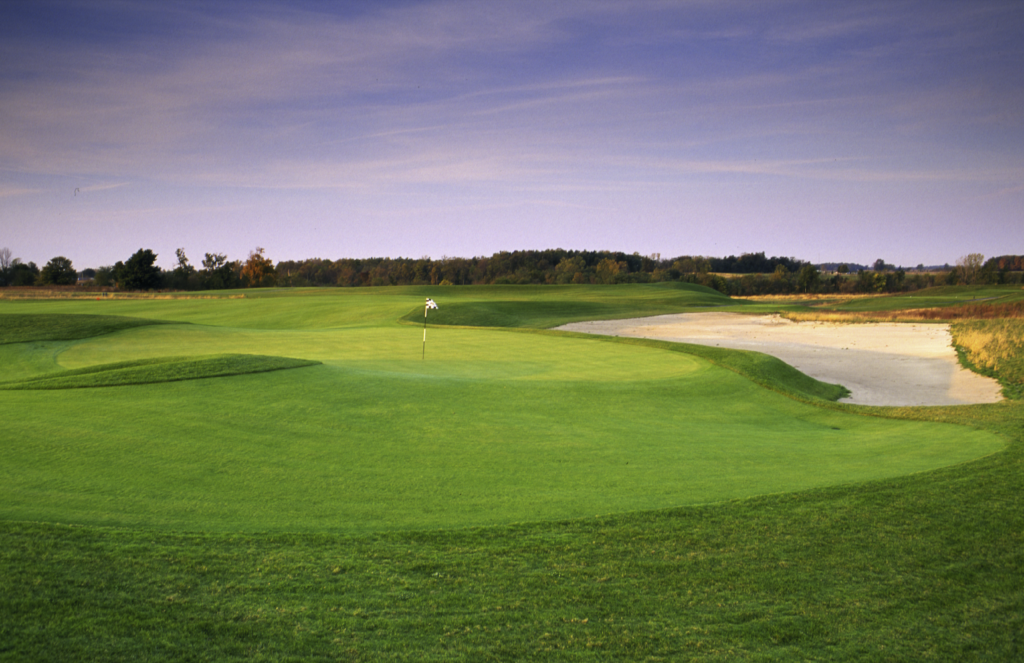
For Tim Liddy, returning to Ball State University meant another chance to finish what he had started and bring together two interests that would shape his career: design and golf.
The first in his family to attend college, Tim left Ball State during his thesis year. Several years later, he returned with greater maturity and a clearer sense of direction. Faculty in the College of Architecture and Planning (CAP) welcomed him back and helped him complete his degree.
In golf, a mulligan offers a chance to try a shot again. For Tim, that opportunity at Ball State helped set the course for a career designing golf courses around the world.
An Early Connection to the Game
Tim’s connection to golf began long before his career in design. Growing up, he worked at Muncie Elks Country Club, formerly known as Westbrook Golf Club. He maintained the course, worked in the pro shop, and cleaned golf carts, gaining an appreciation for both the game and the people who played it.
“The golf course was a wonderful environment in which to grow up,” Tim said. “Those experiences helped shape my lifelong enjoyment of the sport and taught me lessons that remained valuable throughout my personal and professional life.”
At Ball State, he found another source of inspiration: visiting lecturers who offered a window into the possibilities of design. Among his favorites were R. Buckminster Fuller and Dan Kiley. Hearing them discuss their experiences and creative processes reinforced the value of curiosity, experimentation, and perseverance.
Completing his degree gave Tim the foundation to turn those interests into a profession.
Building a Career in Golf Course Design
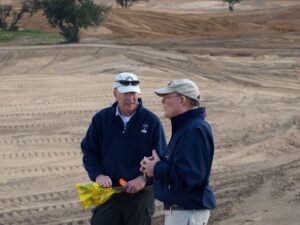
Tim Liddy and Pete Dye working on a course.
After graduating, Tim began his career with the Madison County Council of Governments. He later worked for Rundell, Ernstberger Associates, and a large engineering company in Indianapolis, where he met renowned golf course architect Pete Dye.
That introduction led to a professional relationship spanning roughly 30 years and connected Tim’s architectural education with his lifelong enjoyment of golf.
His work took him to courses across the United States and abroad. Career highlights include Dukes Golf Course in St Andrews, Scotland, now known as Craigtoun; Rock Hollow Golf Club in Peru, Indiana; and The Farms Golf Club in San Diego, California.
Each offered its own design challenges. At Rock Hollow, an abandoned gravel quarry became the setting for a golf course, a transformation Tim remembers as especially meaningful.
“Each project presented a distinct landscape, set of challenges, and design opportunity, making each memorable in its own way,” Tim said. “Rock Hollow was particularly rewarding because it demonstrated how a dramatically altered site could be transformed into an engaging and beautiful golf course.”
A Lasting Ball State Connection
David Ferguson, CAP dean and professor of landscape architecture, has known Tim since they were students together in the 1970s. He sees Tim’s approach to his work as central to his success.
“He is one of those wonderful success stories that frequently come from our college,” David said. “His humble and friendly, yet highly insightful approach to his projects makes him an ideal partner in developing and redeveloping some of the most cherished landscapes in the golf world.”
In 2013, Tim received CAP’s Distinguished Alumni Award, recognition from the college where he had returned to complete his education.

The Farms 3rd hole in San Diego, CA.
Now gradually transitioning into retirement, Tim is making more time for painting, traveling, and spending time with friends. Golf continues to connect him to the work and community that have been part of his life since childhood.
Years ago, Tim returned to Ball State to complete an unfinished degree. What followed was a career bringing new possibilities to landscapes, from an abandoned Indiana quarry to courses around the world.
For Tim, it was a mulligan worth taking.
To prepare the next generation of golf course architects, consider making a gift today to Ball State’s Landscape Architecture Department.