
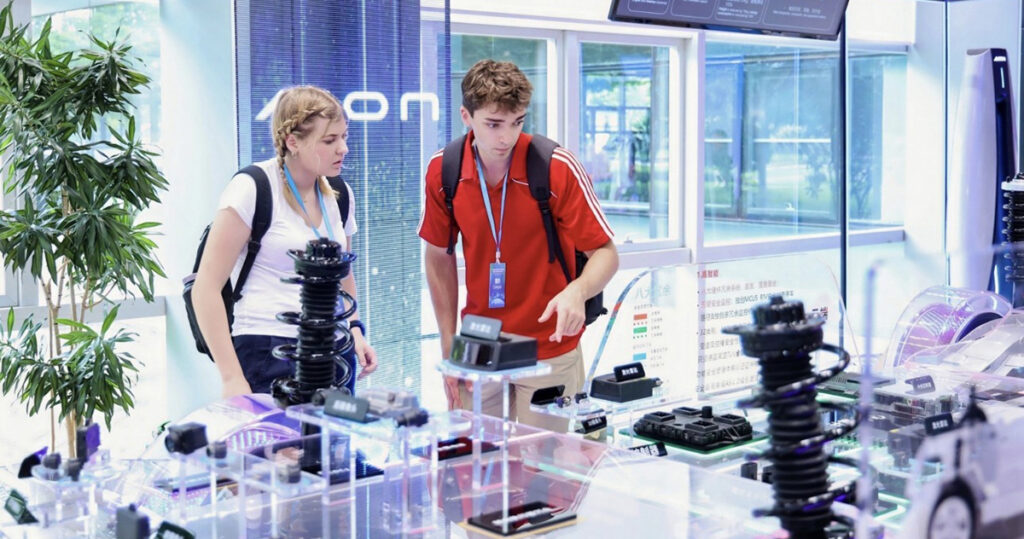
In addition to a solid education and career preparation, Ball State University offers its students opportunities to explore real-world problems and seek viable solutions. For Aaron Turner and Katherine Wilcox, economics students in Ball State’s Miller College of Business, one of those opportunities took them to the other side of the world.
Mr. Turner and Ms. Wilcox were among a handful of American college students who spent a week in China as participants in the 2026 China–U.S. Youth Future Climate Leaders Exchange Program, an event hosted by Guangdong University of Technology in Guangzhou, June 23–29. The program brought together college students from both countries to examine climate governance, green development, and environmental innovation through lectures, site visits, collaborative projects, and cultural exchange.
While climate innovation was a key part of the program’s framework, the relationships students built were among its most lasting outcomes.
“Meeting and collaborating with students from Guangdong University of Technology was an invaluable experience,” Ms. Wilcox said. “Cultural insight is incredibly important, and I feel grateful to have met and shared ideas with my peers in a country different than my own.”
Mr. Turner said he was struck by how quickly meaningful conversations developed with students from Guangdong University of Technology.
“It took all of about 15 minutes to find common ground, even though we exist 8,000 miles apart,” he said. “Everybody was excited to learn from each other. There was a lot of mutual respect.”
The exchange program was organized jointly with the Department of Ecology and Environment of Guangdong Province, the Department of Education of Guangdong Province, Guangdong University of Technology, and China Southern Airlines.
Collaborative problem-solving and cultural exchange
Throughout the week, participants toured water treatment facilities, waste management operations, new energy vehicle manufacturers, university research centers, and other green technology sites across China’s Greater Bay Area. They also participated in various activities and collaborated with their Chinese and American peers to identify potential solutions to climate-related problems. Those findings had to be presented to the entire group.
Mr. Turner and Ms. Wilcox found meaningful connections between their economics coursework and the program’s focus on sustainability, while broadening their world perspectives.
For Ms. Wilcox, one activity stood out.
“As an economics major, one of my favorite activities was the carbon emissions trading simulation game,” she said. “During this activity, groups pretended to be behind the scenes, making the decisions in the carbon market. I was able to explore environmental economics through a hands-on application.”
Mr. Turner, who is majoring in finance and economics, evaluated the policies and economic decisions behind the technologies, while appreciating the value of spending time with people from a different culture and country.
“When we toured these government-operated facilities, I kept thinking about the trade-offs,” he said. “How is this impacting people daily? Are there better or more efficient alternatives? Seeing those systems firsthand gave me a completely different perspective.”
“You always hear things about China,” he added. “But getting out there, talking with people, sitting in discussions, and seeing everything firsthand—that was huge.”
Preparing thoughtful leaders
Connecting students to programs such as this China exchange event demonstrates Ball State’s commitment to preparing students for thoughtful leadership in an increasingly interconnected and complicated world.
Mr. Turner credits Ball State for what it offers beyond traditional classroom learning.
“Going into college, you pick your major and think that’s what you’re going to do the entire time,” Mr. Turner said. “But more opportunities keep coming along, and they’ve really given me a more holistic education. That makes you a deeper person and allows you to have broader conversations with people.”
He believes those experiences will influence his future career in finance, analytics, or public policy by helping him understand not only numbers and markets, but also the people and communities behind them.
Ms. Wilcox said she gained a wider worldview and a deeper understanding of how intentional collaboration can help solve societal problems.
“The program has taught me that together we truly can make steps for a greener future,” she said, thanking Ball State and Miller College of Business for opportunities to learn in the classroom—and across the globe.
*Photo Courtesy of the 2026 China-US Future Climate Leaders Exchange Program


