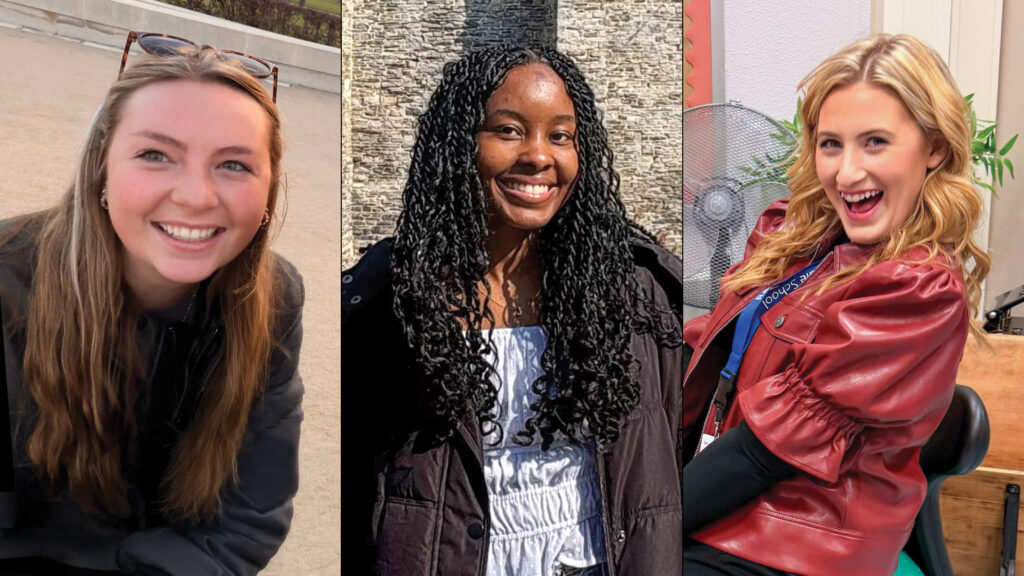
By Abigail Mensah Bonsu, Graduate Assistant, Teachers College International Programs, and Dr. Rachel Geesa, Associate Clinical Professor of Educational Leadership and Teachers College Director of International Programs
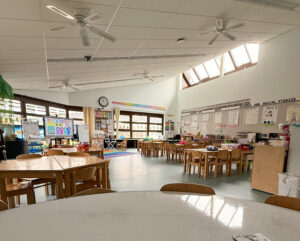
A DoWEA classroom in Ramstein, Germany – home base for this year’s Ball State student teachers.
It was the last class of the day, and the last time Ruby Denson would teach this lesson on connotative language. She had shown her seventh- and eighth-grade students the same black-and-white photo again and again: construction workers perched on a steel beam, eating lunch high above the city. The exercise was never really about the beam. It was about reading between the lines, until one student refused to let her have it.
“He kept mentioning that the beam the men were eating on was a steel beam,” Ruby remembers. “For the next five minutes, with the whole class chiming in, we got into a deep debate: how do you know, just from looking at a photo, that the beam is steel?” Neither of them backed down. It became a running joke for the rest of the semester, and one of Ruby’s favorite memories from a period of time that taught her she “could do hard things.”
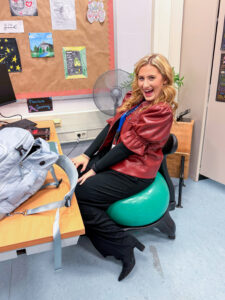
Ruby Denson in a DoWEA classroom in Ramstein, Germany.
Ruby Denson was one of Ball State student teachers who spent their final semester not in a familiar Indiana classroom, but on a U.S. military base in Germany, teaching the children of military service members and federal civilian employees at the Department of War Education Activity (DoWEA) (formerly Department of Defense Education Activity) schools in Ramstein and Kaiserslautern.
More Than Two Decades of Learning Abroad
The program traces back to the 2002-2003 academic year, when the National Education Association invited deans from three universities: Auburn University, Ball State University, and Florida State University, to explore partnerships with DoWEA schools on U.S. bases in Europe. After visits to bases in Belgium and Germany, Ball State launched its program in Baumholder in the fall of 2003, later moving to Kaiserslautern and Ramstein in 2013.
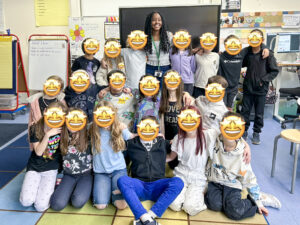
Jamie Johnson Harris with her class in Ramstein, where some bonds need no shared language. Student faces are covered to protect student privacy.
More than two decades later, Ball State is the only one of the original three universities still sending student teachers to Germany. More than 240 students have made the journey, splitting their days between lesson plans and navigating a new language and culture, and their weekends between grading papers and chasing trains across Europe.
The Kids Who’d Already Seen the World
Ask any of this year’s student teachers what surprised them most, and the answer is some version of: how much these kids already knew.
Jamie Johnson Harris, who taught second grade at Ramstein Elementary, expected the usual, kids who knew their neighborhood and not much outside of it. Instead, she found a classroom of seven- and eight-year-olds who could place countries on a map without blinking.
“Most second-grade students don’t know much about countries, states, or places far from home,” she said. “But because these students’ parents get reassigned to bases around the world, and the families travel often throughout Europe, they always recognized the destinations and landmarks I referenced in lessons.”
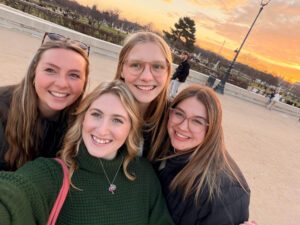
Sarah and fellow student teachers capture a sunset selfie in the Tuileries Garden during a weekend trip to Paris.
Sarah Duncan, teaching kindergarten down the hall, was floored by something else entirely: her five- and six-year-olds were already juggling three languages. “At just five and six years old, they already knew some German, ASL [American Sign Language], and English,” she said. It’s the kind of fluency, in language, in moving, in change, that comes standard for military kids, and that DoWEA’s nearly 160 schools worldwide exist specifically to support.
When a Backpack Becomes a Home
That built-in resilience doesn’t mean these students don’t need their teachers. It means they need a particular kind of teacher. Ruby saw that most clearly when a crisis overseas sent several military families to Ramstein without many of their personal belongings.
“I had the privilege of working alongside Anita Hammer,” Ruby said of her mentor teacher, “someone who stands up for the underdog, cares deeply, gives everyone the benefit of the doubt, and goes out of her way to help others.” For two straight weeks, Ruby watched Ms. Hammer organize beds, furniture, clothes, food, and decorations for the families being relocated, so that when they landed with nothing but a backpack “they walked into a home, not an empty house.”
“I have never seen a community of parents, students, and faculty rally together the way ours did,” Ruby said. “I always knew schools were woven into their communities, but knowing something and truly witnessing it are different things.”
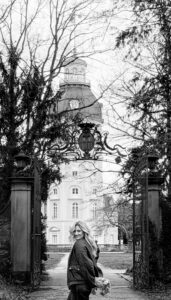
Free weekends meant time to explore beyond the base. Ruby visited the beautiful Karlsruhe Palace Garden in Karlsruhe, Germany.
It’s a fitting snapshot of what DoWEA schools are built for. The agency’s stated mission is to “educate, engage, and empower military-connected students to succeed in a dynamic world” students who move more often and face more disruption than almost any other population in American education. Ball State’s partnership with DoWEA, now in its third decade, exists so that student teachers learn to serve that population well. Long before they have a classroom of their own.
Learning Alongside Their Students
Ball State’s approach to the program goes beyond placing student teachers in German classrooms. One of its most distinctive features is the presence of a Ball State faculty member who lives in Germany for the entire semester, supervising student teachers in person rather than checking in from afar.
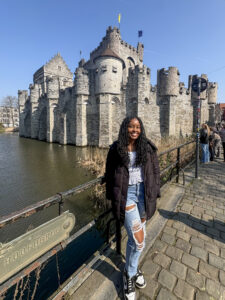
Jamie Johnson Harris visits Gravensteen Castle, a medieval landmark in Ghent, Belgium, during her student teaching experience in Germany.
A 2021 study of 19 former Ball State supervisors found that this hands-on presence shapes the entire experience. Student teachers from other universities, placed in the same DoWEA schools without a supervisor of their own, were often left to handle apartment hunting and other logistics largely on their own. They also received less frequent, less substantive feedback on their teaching. One former Ball State supervisor described the relationship that develops instead: in a typical stateside placement, a supervisor visits every few weeks, but in Germany, “you’re mom and dad.”
Learning to Let Go of the Sticky Note
For all the student teachers, the semester reshaped how they saw themselves as educators, not just how they saw their students.
Ruby started the semester teaching from a sticky note, a running list of everything she needed to cover that day. “As time went on, I got more comfortable with my material, my teaching, and myself, and I was able to put the sticky note down,” she said. “My teaching became organic and real; my lessons became a framework rather than a strict script.” She once stood on a chair mid-lesson to make a point. “I never would have done that if I’d stuck to my plan exactly.”
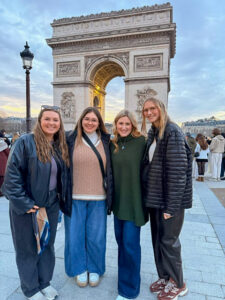
Sarah Duncan (far left) poses with three fellow student teachers in front of the Arc de Triomphe in Paris, France.
Jamie Johnson Harris found a similar shift, but through empathy rather than improvisation. “A student can’t learn if they’re upset about a deployed parent or stressed about an upcoming move,” she said. “It taught me to lead with empathy in every classroom I enter.”
Sarah Duncan landed somewhere in between. Newly confident teaching math, newly comfortable being “dramatic and expressive” in front of a room, and certain, for the first time, that she had the patience the job requires.
Half a Heart Left in Germany
Ask what they’ll remember outside the classroom, and the answers turn into a map of Europe. Ruby crossed a childhood bucket-list item off her list in Paris. Her bedroom growing up had been Paris-themed, and she came home with some of her favorite photos ever taken.
Jamie traveled to Switzerland and saw the Alps for the first time, then went paragliding above them.
Sarah didn’t need a passport stamp to sum up her semester: “I came back with half of my heart left in Germany, with my students, the culture, and a new desire to live in Europe someday.”

Ruby checked a childhood bucket-list item off her list with a trip to Paris, posing beneath the lights of the Eiffel Tower.
None of them describes it as easy. “Anyone who tells you that spending four months teaching in Germany is easy is lying to you,” Ruby said. “It’s hard. But it’s not impossible, and once you do it, you become unstoppable.”
Still on the Fence?
Each of them had the same advice for the next student teacher weighing whether to apply: GO!!!
“If you’re on the fence, jump over it,” Ruby said. “When else in your life will you get to be a 20-something living out of a suitcase for four months? You’ll have the rest of your life to work at the same school, teach the same books, and give the same tests.”
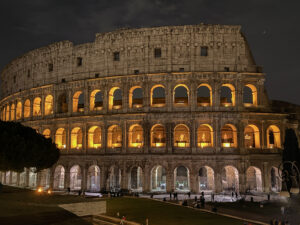
Rome’s Colosseum lit up for the evening, another stop on Ruby’s long list of weekend adventures.
For many of the student teachers who participate, the experience becomes a story that opens doors, both personally and professionally. Ruby has lost count of how many interviewers have lit up at the mention of DoWEA on her resume. Jamie recently landed an interview at a school that partners closely with local veterans, in part because her DoWEA background stood out to them. As Ruby put it, that history “gets you in the door.” What you do once you’re standing on that steel beam is up to you.
Interested in student teaching with DoWEA in Germany? Contact Dr. Rachel Geesa at rlgeesa@bsu.edu to learn more about the program and how to apply.
Comments: