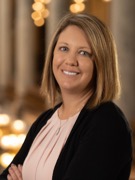
Meet Dana! Dana holds multiple education licenses from Ball State, including a High Ability license and a master’s degree in math education as an Elementary Mathematics Specialist! She currently works for the Indiana Department of Education. Chirp Chirp!
What led you to your graduate program at BSU?
I work for the Indiana Department of Education as the senior math specialist for the Office of Student Assessment. I spent a long time as the elementary STEM specialist and then an elementary Math specialist on the curriculum and instruction team. Working in math assessment is kind of my niche. I graduated from Ball State in 2004 and came back five years later to get a high-ability license as part of the license renewal process. I just fell in love with teaching high-ability students. I really saw myself in a lot of what we talked about in class, and I remember saying to my mom many times, now I know why I acted like that. After I received the high-ability licensure, I switched to teaching high-ability classes and taught them for the rest of my K-12 classroom career.
When I first started teaching, I realized that math didn’t have to be taught the way it was taught to me. In my very first job, I was hired as a math interventionist. My job was to work with first and second-graders who were struggling with math. The normal ways of teaching didn’t work with them. So I had to figure out something else. I spent time researching and trying to think of ways to help these kids. I started realizing there’s a different way to teach math that kids might do better and really prosper with. Once I had my own second-grade classroom, I started utilizing manipulatives and asking kids about their process while teaching math. Seeing some of their unique thinking made me more interested in how I could teach a concept in multiple ways. Then I transitioned to high-ability with kids who think creatively, and it became so much fun to see their thinking and have them show different ways of solving a problem.
I found Ball State’s graduate course for elementary math specialists that Ann Leitze and Cheryl Stump had developed. I started looking into it, and I thought it looked really cool. My husband and I decided I was going to do it and teach full-time. I completed all 36 graduate hours teaching full-time, including most summers, and in the middle of it, I left the classroom and came to the IDOE in the summer of 2021. I ended up finishing out my master’s while I was here at the department, and it’s been a roller coaster ride since then!
What was your proudest memory as a BSU grad student?
I had some amazing professors while in graduate school. I am still in contact with them and reach out to them for advice or their expertise. I have relationships with many of them because they are wonderful and amazing resources. These people are so knowledgeable. They are connected to state and nationally recognized organizations, and all the research that they do is incredible. There’s so much quality in that program that comes from who is teaching.
How have you been able to use your graduate degree(s) from BSU?
From continually working with mathematics standards and content Standards reduction in 2023, to the instruction map Math Instructional and Assessment Frameworks we wrote from scratch, to leading the mathematics work and development of the new iLearn Through-Year Assessment, I use my degree every day. I use my degree every day. I think it is so great because you hear a lot of times people get degrees and don’t use them, or they do adjacent things, but I am literally using the education I received in undergrad and grad every day. I still refer back to some of the resources that I used during my classes to find a relevant article or piece of research that can assist with the work we are doing at IDOE.
What advice or wisdom do you have to share with current BSU grad students?
First of all, I think they’ve already taken quite the leap. Even though at times it feels like you may never get to the end of it, because there are a lot of courses, you will. What you will gain from all that work will benefit you not only as a teacher or coach, but you will also have the knowledge and skill set to affect an entire school or corporation because you will emerge with such a deep understanding of mathematics. Just stick with it because what you will get out of it is so much more than just those 36 hours. We need strong mathematics educators in the field who not only understand math concepts but can also teach at a deeper level. Research shows that educators, especially in elementary school, can be wary of teaching math. Strong educators and coaches are in high demand, particularly in K-8, to lead schools and corporations in helping students build confidence in their math abilities and improve proficiency. Ball State is a great place to take that first step toward becoming a leader.


