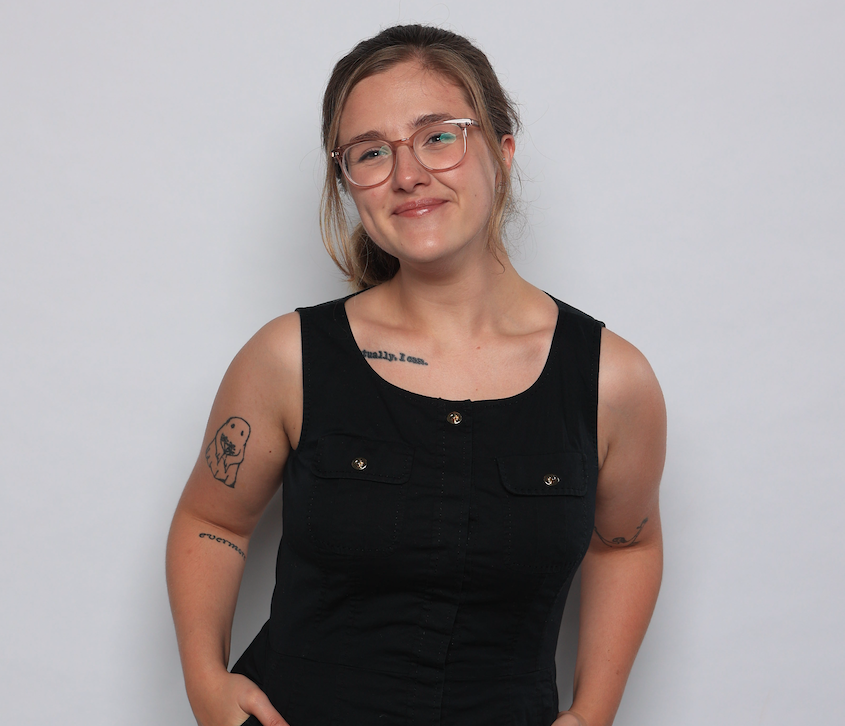
This year’s Excellence in Teaching Award recipient brings outstanding academic work to Ball State University. As a graduate instructor nominated by BSU faculty and selected through a rigorous peer review process, this award recognizes an educator who invites students to discover their voices, rethink their relationship with writing, and engage deeply with their own learning. Congratulations, Makayla!
Where is your hometown?
I’m from Leo, Indiana (just north of Fort Wayne).
What are a few of your favorite hobbies?
In my free time, I like to embroider, thrift, and occasionally scrapbook. As an English major, I also love to read and write, obviously! My preferred genre for reading is romance, and my preferred genre for writing is creative nonfiction.
Why did you choose Ball State?
Actually, I chose Ball State for grad school because it is where I received my undergraduate degree. I initially came to the university in 2020, intending to major in English Education, because I knew Ball State had a top-rated teacher’s college. In my third year, I switched to English Studies with a minor in Creative Writing, which ultimately led me to pursue a Master’s in Creative Writing.
What first interested you about your graduate program?
When I began looking at graduate programs, two things were at the top of my list: assistantship opportunities and top-notch faculty. Ball State offered both. I was particularly excited about the teaching assistantships, as they offered more training and hands-on practice than competing programs. Furthermore, my experience with the English Department faculty in undergrad was amazing, so I knew I would be in good hands under their mentorship. But what really sealed the deal was the fact that Ball State houses River Teeth, the number one creative nonfiction journal in the country. I knew that attending graduate school here meant I could intern for the journal, which was an opportunity I could not pass up.
How did you begin teaching as a graduate student on campus?
I began as a teaching assistant for Dr. Matthew Hartman’s English 103 course in the fall of 2024. During the semester, I was able to observe his instructional methods, then teach my own unit later on. Dr. Hartman was extremely encouraging and provided a lot of thoughtful feedback during his time as my mentor. This support helped me gain confidence in my ability to teach before taking on my own sections of 103 in the spring.
What is one lesson you have learned as a graduate student through your teaching experience?
It is okay to not know everything as a graduate instructor. In fact, you shouldn’t! The whole point of this opportunity is to learn and grow as an educator, so don’t be upset if (or rather, when) you mess up. The key is to be honest with yourself as well as your students that you are not an all-knowing being, but rather a graduate student who is trying their best. This transparency helps build rapport with students and allows them to feel like mistakes aren’t world-ending, but rather a natural part of the learning process.
What has been the most valuable part of your graduate teaching experience?
Most students come into English 103 expecting it to be a boring core curriculum class that won’t be useful to them. On top of that, many of them have had negative experiences in the writing classroom that have led them to believe they are simply incapable of good writing. The part of teaching that I cherish the most is watching that mindset change in real time. Seeing students develop their own unique voices and passions throughout the semester is endlessly valuable and has helped shape my teaching philosophy.
Is there anything else you would like to communicate about your experience as a teacher here on BSU’s campus?
I have never regretted being bold. Sometimes, it may feel easier to just fall into the cookie-cutter mold of instructing: lecture, assign homework, test, repeat. However, the best moments as an educator happen when you step off the beaten path. For me, this looks like designing most assignments from scratch and encouraging student-led discussion/activities. In order to be the best version of your instructor-self, you must be willing to make your class your own. So be bold, be innovative, and be prepared to make mistakes along the way.
What are your future plans and career goals?
I plan to teach on the non-tenure track for a few years before pursuing my MFA in Creative Nonfiction. Afterwards, I would like to continue teaching at the tenure-track level, ideally in the field of creative writing.


