In my previous blog, I wrote about my first semester at Ball State. The key word for that experience was adjustment.
I was learning how to adapt to a new classroom environment, how to express my ideas in English, and how to find my place in a completely unfamiliar culture. From being afraid to speak up, to slowly raising my hand, from feeling nervous during presentations to gradually building confidence—it was a process of constant adjustment.
But this semester, something started to change. Instead of only asking myself, “How do I adjust?” I began to ask different questions: What can I do here? How can I contribute? How can I start to participate more actively? This shift didn’t happen all at once. It showed up gradually—in the way I studied, worked, and interacted with others.
From Keeping Up to Taking Ownership
One of the first places I noticed this change was in my academic life.
When I first arrived at Ball State, I was mostly focused on keeping up with the pace of my classes. Even when I understood the material, I often hesitated to share my thoughts, worrying that I might not express myself clearly.
This semester, however, I began to find my own rhythm. I developed more consistent study habits and felt more comfortable engaging in class. From receiving the Academic Distinction award in my IEI courses and recognition in a speaking contest, to maintaining a 4.0 GPA across two semesters, these outcomes mattered—but more importantly, they reflected a deeper change. I became more confident in participating, more comfortable expressing my ideas, and more proactive in my learning process.
Instead of just trying to keep up, I started to feel like I was truly understanding and taking ownership of my learning. That confidence gave me the motivation to take on new challenges.
Stepping Beyond the Classroom: My First Research Experience
As my confidence grew, I also began to look beyond the classroom.
This semester, I joined the Teacher-Scholar Program and worked with my mentor, Dr. Li, on an interdisciplinary research project. This was my first time being involved in a long-term research process. Through this experience, I learned that research is rarely a straight line. It involves testing ideas, revising them, and trying again. Many ideas are unclear at the beginning, and it takes time, discussion, and feedback to refine them.
We explored different approaches, made adjustments, and gradually moved closer to our research goals. It also taught me how to collaborate, how to accept different perspectives, and how to keep moving forward even without clear answers. Slowly, I began to see myself not just as a student completing assignments, but as someone who could contribute ideas and be part of a shared project.
Sharing Ideas: Presentations and Academic Conversations
At the same time, I had more opportunities to bring my ideas into larger academic spaces.
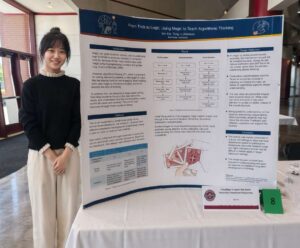
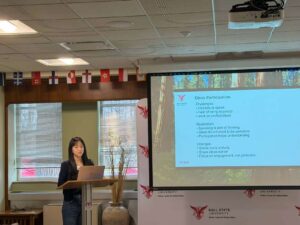
This semester, I presented as a main presenter at many events, including Practical Criticism Midwest Conference, the Better World Conference, and the Global Symposium. I also presented a poster at the Student Symposium during CHRIPS Week, where I had the chance to talk with faculty members and evaluators about my work. Across these different settings, I presented on a variety of topics. Some focused on my experience as an international student, others explored cultural adaptation and cross-cultural communication, and some were directly related to my research. This range of topics helped me learn how to adjust my communication depending on the audience and context.
Because of my interest in artificial intelligence, I also attended several AI-related events on campus, including the Ball State Artificial Intelligence Symposium and Promoting Academic Integrity in the Age of AI conference. These experiences exposed me to new ideas and gave me a better understanding of how AI connects with different fields.
Through all of this, I realized that presenting is not just about explaining content clearly—it is also about entering a conversation. It involves responding to questions, considering different perspectives, and refining your ideas through interaction. I also became more comfortable reaching out to professors outside of presentations. Through these conversations, I received valuable feedback and started to identify the topics I am most interested in. These experiences helped me clarify my direction and shape my academic focus for the next semester.
Most importantly, I began to understand that my ideas can be heard, and that they matter.
A New Sense of Identity
Looking back, the biggest change this semester was not what I did, but how I see myself.
When I first arrived, I saw myself mainly as an international student trying to adjust to a new environment.
Now, I am starting to see myself as someone who can actively participate—someone who can contribute in class, engage in research, and take part in academic conversations. I am no longer just waiting for opportunities. I am learning to seek them out, to talk with others, and to think more intentionally about my academic path. Through my interests and experiences, I have begun to develop a clearer sense of the direction I want to explore.
This shift has opened up new possibilities for my future and made me more willing to take initiative.
Support and Opportunities at Ball State
At the same time, I know that these changes did not happen on their own.
Ball State has provided an environment and opportunities that made this growth possible. Classroom discussions that encourage participation helped me build confidence. Programs like the Teacher-Scholar Program allowed me to engage in research. Conferences, symposiums, and presentation platforms gave me space to share my ideas. I have also been supported by many people along the way—mentors, professors, and peers—whose feedback and encouragement helped me grow.
To me, these are not just opportunities—they are a form of support that helped me move from adjustment to active participation.
Closing Thoughts
If my first semester was about adjusting to a new environment, this semester was about stepping into it—sharing my ideas, participating more actively, and beginning to find my place. I am no longer just learning how to adapt. I am learning how to engage, connect, and grow. And this is only the beginning.