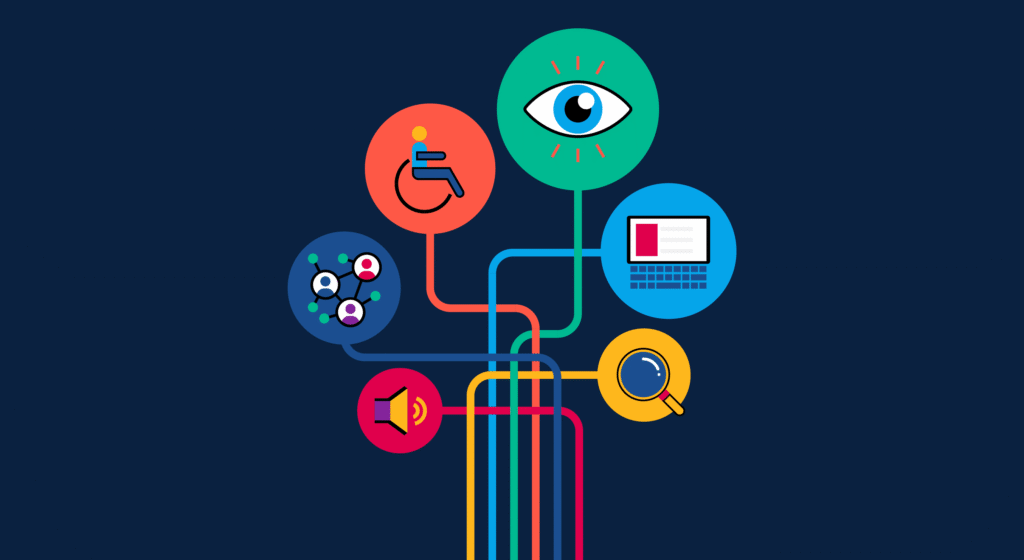
You’ve probably heard the term “accessibility” before, but you may not be entirely sure what it looks like in practice. Maybe you know that elevators and ramps are part of making a building accessible, but did you know that digital accessibility is an important concept too?
“Accessibility in any form is like making things usable and workable for as many people as possible,” Dr. Caleb Green, Digital Corps training and accessibility coordinator, said. “So in the digital context, it’s about making digital resources usable for people in as many ways and as many forms as possible.”
For example, one way that images can be made accessible to low-visibility users is through the use of alt text, which describes an image so that a screen reader can tell the user what the image is of without them having to see it.
“Especially here at a university, we want to make sure that everybody has access to information,” Green said. “Universities run on documents and information and things that are shared amongst different people. Has it really been shared if it’s being shared with a person and they don’t have the ability to perceive or understand it? So we just want to make sure that we’re making things as accessible by as many different people as possible.”
But accessibility doesn’t only benefit people with disabilities; all of society benefits when our online landscape is more accessible. People sharing messages benefit when they do so accessibly, as everyone is able to see and engage with their message. When people with disabilities are actively involved in online messaging and discourse, more perspectives, ideas, and points of view are shared.
Additionally, Green described the “curb cut effect,” where an alteration designed to make something more accessible for people with disabilities benefits the community at large. With the example of curb cuts, which are slopes that connect the road/crosswalk to the sidewalk, wheelchair users benefit, but so do bicyclists and anyone who has use of their feet.
“Captions are a great example [of the curb cut effect,]” Green said. “Yeah, maybe captions are for the deaf or hard of hearing, but also, have you ever been in a public place and the television has been on? And you can’t hear what’s going on on the television? Captions are helpful. Maybe you’re in the library and you don’t have your headphones, but you still want to watch a thing. Captions allow you to watch that.”
So next time you hear someone mention accessibility, know that it goes beyond physical infrastructure. Accessing the digital world is crucial in this day and age, and it’s important to build digital assets that can be accessed and enjoyed by all.
